
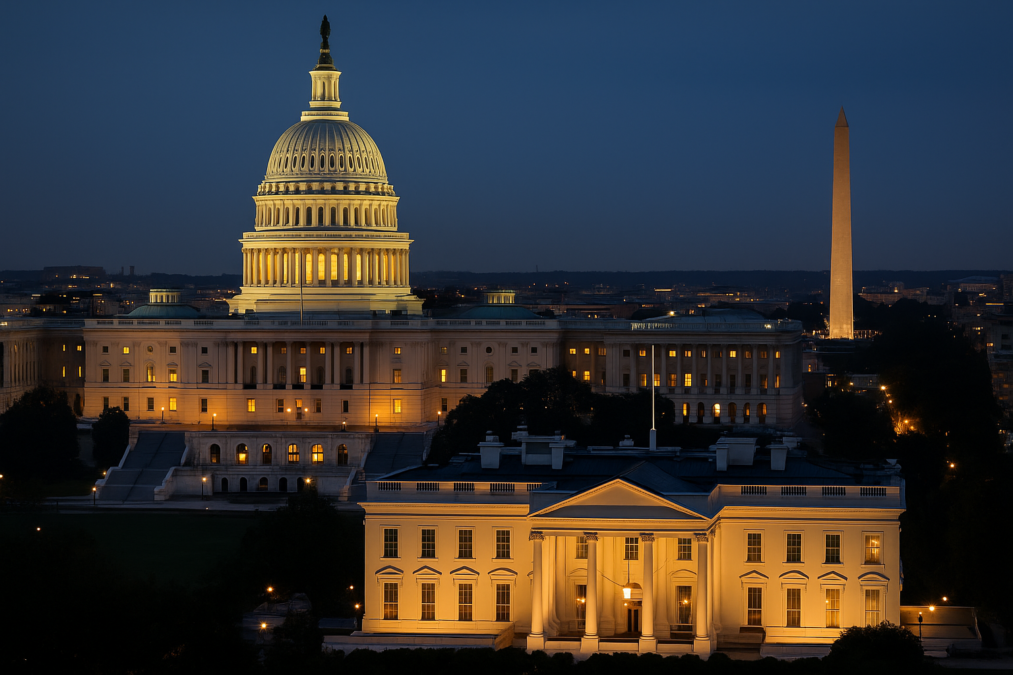
Senate Leaves Without Shutdown Deal as Pay Bills Fail
Editor’s note — archive report. This article documents events of 22–24 October 2025 and is published to the Fast Daily News archive as a record of that period. All figures, quotes and circumstances are given as they stood at the time of writing. The shutdown described below ran a further 19 days and ended on 12 November 2025, after 43 days — the longest in United States history. Readers seeking current information should consult our latest coverage.
The government shutdown entered another week with no resolution after the Senate adjourned for the weekend without reaching an agreement to restore federal funding, leaving millions of government employees facing continued uncertainty.
The longest funding impasse in a generation entered its fourth week this weekend with no resolution in sight, after senators left the capital having rejected two competing plans to put money back into the pockets of unpaid federal employees.
The failure was not for lack of agreement on the principle. Both parties spent Thursday insisting that workers who have been reporting for duty without compensation deserve to be paid. What they could not agree on was which workers, and on whose terms, and that narrow disagreement now stands between roughly two million federal employees and their bank accounts.
For the families involved, the arithmetic is immediate. For the wider economy, the effects are slower but harder to reverse. And with the Senate not due back until next week, the earliest realistic path out of the deadlock has already slipped by several days.
Why the Government Shutdown Continues
Funding lapsed at one minute past midnight on 1 October, after Congress failed to enact appropriations for the new fiscal year.
The proximate cause is a dispute over health care. Most Democrats have refused to supply the votes needed to reopen the government unless Republicans first negotiate an extension of enhanced Affordable Care Act premium subsidies, which are due to expire at the end of December. Republicans have taken the opposite sequencing position: reopen first, negotiate second.
Neither position is unreasonable on its own terms. Democrats argue that once the government reopens, their leverage evaporates and the subsidies quietly lapse. Republicans argue that legislating under the pressure of a shutdown sets a precedent that invites every future minority to do the same.
That structural disagreement, about the order of operations rather than the policy itself ,has proved remarkably durable.
Two Bills, Both Defeated
By Thursday, day 23, the argument had narrowed to federal pay.
Republicans brought forward a measure sponsored by Sen. Ron Johnson of Wisconsin, which would have paid “excepted” employees — those required to work through a funding lapse — along with military personnel, and would have applied to future shutdowns as well as this one. Democrats blocked it on a procedural vote of 54 to 45, short of the 60 required to advance.
Their objection was that the bill drew a line through the federal workforce. Employees who are involuntarily furloughed, and who have no ability to report for work even if they wished to, would have received nothing. Democrats also raised concerns that the measure gave Cabinet secretaries wide latitude to determine who fell into the protected category.
Democrats then sought a voice vote on their own alternative, which would have paid all federal employees and restricted the administration’s ability to conduct mass firings during the lapse. Republicans objected, and it went no further.
Sen. Gary Peters of Michigan noted before the votes that there appeared to be no disagreement in the chamber about whether federal workers should be paid — only about the vehicle. Senate Democratic Leader Chuck Schumer characterised the Republican bill as a device that would allow the shutdown to continue indefinitely while insulating the administration from its consequences.
With both efforts exhausted, the Senate adjourned.
What Happens Procedurally
Nothing can move until the chamber reconvenes. The House has been out of session since 19 September, and Speaker Mike Johnson has said he will not recall members until the Senate acts to reopen the government — a position that removes the lower chamber from the equation entirely for now.
Any eventual agreement will almost certainly take the form of a continuing resolution, the short-term funding mechanism that has ended every shutdown since 1990.
Impact on Federal Workers
The distinction between “excepted” and furloughed staff determines almost everything about how the shutdown is experienced.
Excepted employees — air traffic controllers, Transportation Security Administration officers, federal law enforcement, active-duty military — continue working. They are legally guaranteed back pay once funding resumes, but receive nothing in the interim. Furloughed employees, of whom the Bipartisan Policy Center estimates at least 670,000, are barred from working at all.
Many in both categories are now missing their first full paycheck. Unlike the partial payments some received earlier in the month, this one is complete.
The Congressional Budget Office estimated in September that compensation for furloughed workers alone amounts to roughly $400 million per day in deferred wages. That figure captures the fiscal scale but not the household one: mortgage payments, childcare, medical costs and car loans do not pause because an appropriations bill has stalled.
Food distribution centres have begun operating in areas with concentrated federal employment. Agencies, meanwhile, are absorbing damage that outlasts the shutdown itself — deferred inspections, suspended rulemaking, halted research and a backlog that will take months to clear.
Transportation Secretary Sean Duffy said on Thursday that his message to air traffic controllers was to continue reporting for duty. Staffing pressure in that workforce is among the more closely watched indicators, because controller absences translate quickly into visible flight delays, and visible flight delays translate into political pressure.
Political Analysis
Both parties are betting that the other will absorb the blame.
Republicans control the White House and both chambers, which historically concentrates public responsibility on the governing party. Democrats, however, are the ones supplying the blocking votes, and Republicans have pressed that point relentlessly.
The health care argument is the more strategically significant. If the subsidies lapse and premiums rise in January, Democrats gain a potent campaign issue. If Republicans concede an extension, they hand the minority a demonstration that shutdown leverage works.
Several Republicans have expressed frustration at what they see as insufficient direct pressure from the White House on Senate Democrats. President Trump has remained largely disengaged from the negotiations and is due to travel to Asia shortly. Three Democrats have shown some willingness to break ranks on procedural votes, which is a signal worth watching but well short of the numbers required.
When the Senate returns, the most likely mechanism for a breakthrough is a face-saving construction: a commitment to a future vote on the subsidies, without a guarantee of the outcome, paired with a short-term funding bill.
The White House and Russia
Separately, the administration moved this week to its most confrontational posture toward Moscow since January.
On 22 October, the Treasury Department’s Office of Foreign Assets Control imposed blocking sanctions on Rosneft and Lukoil — Russia’s two largest oil producers — together with dozens of their subsidiaries. Between them the companies account for close to half of Russian crude exports.
These are the first sanctions the current administration has imposed directly on Russia.
Treasury Secretary Scott Bessent described the decision as a response to Moscow’s refusal to move toward a settlement in Ukraine, stating that “now is the time to stop the killing and call for an immediate ceasefire.” He said the Treasury Department was prepared to take further action and urged allied governments to align their own measures.
The sanctions followed the collapse of a planned summit between President Donald Trump and Russian President Vladimir Putin in Budapest. Trump said he had canceled the meeting because he did not believe it would produce the necessary outcome, while suggesting it could be revived at a later date. Planning was halted after a call between Secretary of State Marco Rubio and Russian Foreign Minister Sergey Lavrov indicated that Moscow’s position had not materially changed.
Speaking alongside NATO Secretary General Mark Rutte in the Oval Office, Trump said he hoped the measures would not remain in place for long.
The United Kingdom sanctioned both companies the previous week, and the European Union approved a nineteenth package targeting Russian gas exports. Moscow described the American measures as counterproductive. President Volodymyr Zelenskyy welcomed them.
The practical effect remains uncertain. Analysts have cautioned that Russia has developed considerable experience in mitigating sanctions pressure, and that the measures represent a threshold shift in intent more clearly than a guaranteed change in Russian behaviour.
Portland: Competing Accounts
The administration’s effort to deploy National Guard troops to Portland, Oregon, has produced a legal contest that appears headed for the Supreme Court.
Demonstrations have focused for months on an Immigration and Customs Enforcement (ICE) facility in southern Portland, driven by opposition to federal immigration enforcement policies.
On 4 October, U.S. District Judge Karin Immergut — a Trump appointee — blocked the federalization of 200 Oregon National Guard members, ruling that conditions in the city were not severe enough to justify the move and describing the administration’s characterization of the situation as “untethered to the facts.” On 20 October, a divided panel of the Ninth U.S. Circuit Court of Appeals stayed that order in a 2–1 decision, concluding that the president had likely acted within his statutory authority. The majority also found that the lower court had given insufficient weight to earlier incidents, including the extended closure of the ICE facility during the summer.
Asked about the ruling during a White House event on 21 October, President Trump said he had watched events in Portland over the weekend and claimed that “the city was burning down, just burning down.”
Local officials and independent reporting painted a different picture. On Saturday, 18 October, an estimated 40,000 people marched in Portland as part of the nationwide “No Kings” demonstrations, with police reporting three arrests at the ICE facility. Portland officials said the protests were overwhelmingly peaceful. Oregon Attorney General Dan Rayfield described the appellate court’s ruling as a dangerous development.
Fast Daily News has not independently verified conditions on the ground. The gap between the President’s description and the accounts of local authorities and photographers present is substantial, and readers should weigh both.
Wider Context and What Comes Next
The two stories are not formally connected, but they share a political climate: an administration testing the boundaries of executive authority, a legislature unable to perform its most basic function, and a public increasingly weary of both.
When the Senate reconvenes, three things are worth watching: whether any additional Democrats break on procedural votes, whether Republican leadership offers a firmer commitment on a subsidies vote, and whether disruption to air travel reaches a level that forces the issue. In every previous shutdown of comparable length, it was operational pain rather than argument that produced the settlement.