
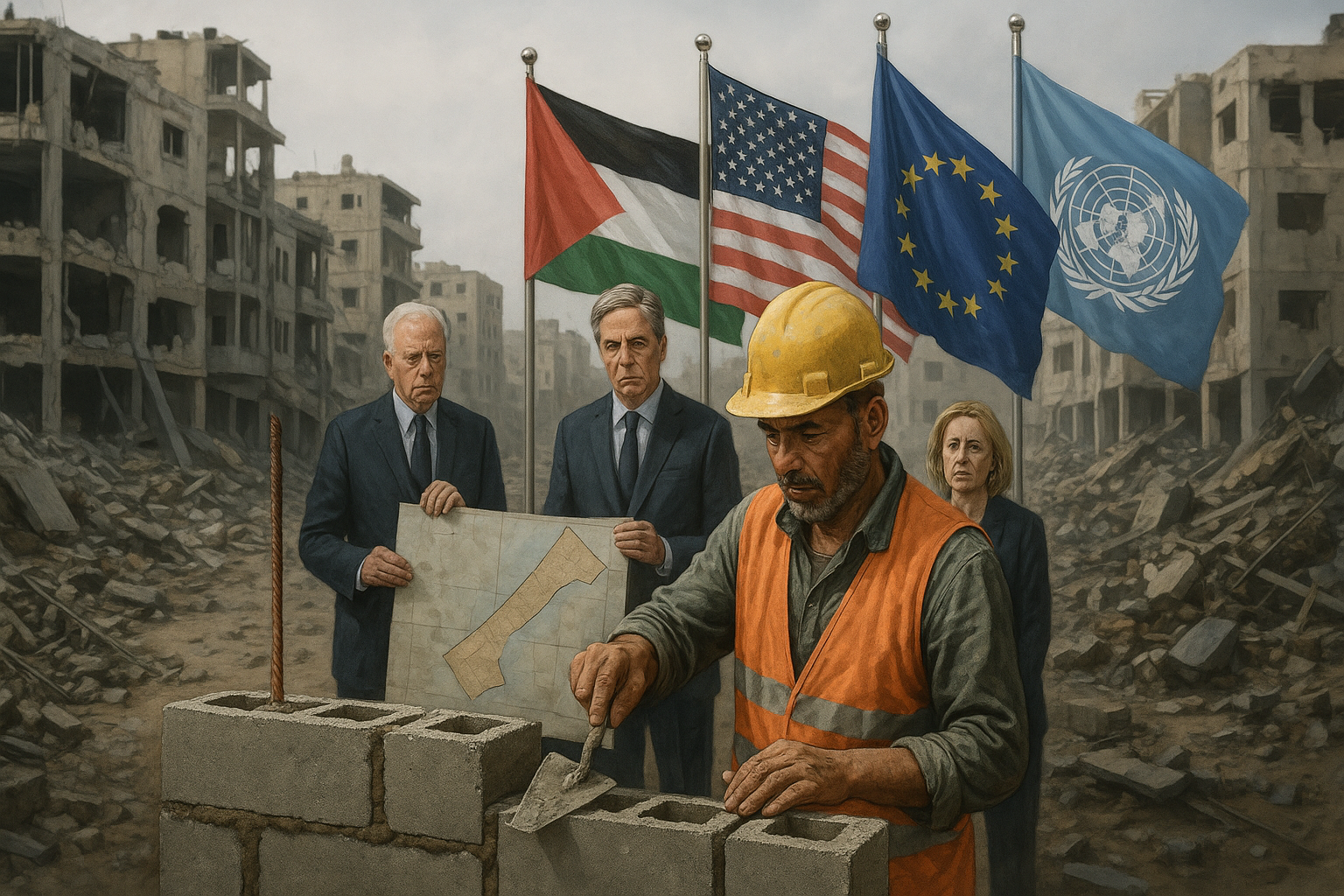
Gaza’s Rebuild Divides the World: Competing Plans and Uncertain Futures
Gaza is beginning to emerge from the destruction of war, but the effort to rebuild the territory is already becoming one of the most divisive political struggles in the modern Middle East.
The physical devastation is immense. Entire neighbourhoods have vanished. Roads are buried under concrete and steel. Hundreds of thousands of families remain displaced. Yet even before reconstruction has truly begun, there is growing disagreement over who should control Gaza’s future and what the territory should become.
Some leaders want Gaza rebuilt by Palestinians themselves, preserving its communities and identity. Others are proposing entirely new visions, from international trusteeships to luxury developments along Gaza’s Mediterranean coast.
The battle over Gaza’s future may ultimately prove almost as contentious as the war itself.
A Landscape of Ruin
Across Gaza City, Khan Younis and northern districts, bulldozers have started clearing debris from the streets.
In neighbourhoods such as Sheikh Radwan, entire blocks have disappeared. Concrete apartment buildings have collapsed into piles of rubble. Burned cars, twisted metal and shattered walls now line the roads.
Residents are slowly returning to what remains of their communities.
“This was my home,” says 63-year-old Abu Iyad Hamdouna, standing beside the ruins of his house in Gaza City.
He points towards a mound of broken concrete where his family once lived.
“At this rate, it could take 10 years to rebuild,” he says. “I do not think I will live to see it.”
Nearby, families search through debris for anything that can still be used. Some collect bricks. Others recover furniture, blankets and pieces of wood to build temporary shelters.
In Jabalia and Beit Hanoun, many families are now living in tents pitched beside the remains of their former homes.
“We returned because there is nowhere else to go,” says 43-year-old Nihad al-Madhoun.
“Removing the rubble alone may take five years. We still do not have enough water or electricity.”
According to the United Nations, nearly 300,000 homes and apartments across Gaza have been damaged or destroyed.
The territory is estimated to contain more than 60 million tonnes of rubble. Much of it may be contaminated with unexploded bombs and other dangerous materials.
The overall cost of rebuilding Gaza is now believed to exceed $70 billion.
The Scale of the Reconstruction Challenge
International aid agencies say Gaza faces one of the largest reconstruction operations in recent history.
The destruction affects almost every part of daily life.
Hospitals have been damaged or destroyed. Schools have been flattened. Water systems, sewage pipes and electricity networks no longer function in large areas.
The territory’s roads and transport links have also been heavily affected.
Experts say rebuilding Gaza will not simply involve replacing destroyed homes. Entire neighbourhoods may need to be redesigned from the ground up.
Some areas may have to be completely cleared before construction can begin.
Others could take decades to recover.
“This is not just a normal rebuilding project,” says Shelly Culbertson.
“Some districts can be repaired piece by piece. Others may need to be demolished entirely and rebuilt from scratch.”
She warns that reconstruction is likely to take decades rather than years.
A Palestinian Vision: The Phoenix Plan
As international powers debate Gaza’s future, a group of Palestinian architects, planners and engineers has developed its own proposal.
Known as the Phoenix Plan, the project was created by hundreds of Palestinian experts over more than a year.
The plan aims to rebuild Gaza with modern housing, stronger infrastructure and better public services, while preserving the territory’s social and cultural identity.
Rather than replacing Gaza’s existing communities, the Phoenix Plan proposes rebuilding them where they already stand.
It also focuses on keeping neighbourhoods together and protecting the territory’s historic character.
Yahya al-Sarraj, Gaza City’s Hamas-appointed mayor, says reconstruction has already started in small ways.
“People are reopening shops and restaurants,” he says. “They deserve to live.”
He supports the Phoenix Plan because it was created by Palestinians themselves.
Supporters argue that Gaza should not be redesigned by foreign governments or investors with little understanding of local communities.
“A foreign-imposed plan for reconstruction cannot exist,” says Yara Salem.
“We wanted to fill the vacuum with a Palestinian vision.”
Salem says the project was designed to ensure that Gaza’s future remains in the hands of its own people.
The plan includes new apartment blocks, rebuilt schools and hospitals, renewable energy systems and stronger transport links.
However, supporters admit that the project will only succeed if international donors are willing to fund it.
Trump’s “Gaza Riviera” Proposal
While Palestinian planners are calling for a locally led reconstruction effort, former US President Donald Trump has suggested a very different vision.
Trump has proposed transforming Gaza into what he described as a “Gaza Riviera”.
His idea would turn the Mediterranean coastline into a luxury development filled with hotels, tourist resorts and new commercial districts.
Trump has also suggested that the United States could take a long-term ownership role in Gaza during the reconstruction process.
The proposal has caused outrage among many Palestinians and Arab governments.
Critics argue that it treats Gaza less as a homeland for more than two million people and more as a real estate project.
Trump’s son-in-law, Jared Kushner, has previously described Gaza’s coastline as “valuable waterfront property”.
The comments drew sharp criticism from Palestinians, who accused him of ignoring the human suffering caused by the war.
Supporters of Trump’s plan argue that Gaza needs major investment and that foreign capital could help rebuild the territory more quickly.
But critics say the proposal risks erasing Gaza’s communities and replacing them with developments designed mainly for outsiders.
The “Great” Plan and an American Trusteeship
Another controversial proposal has also emerged.
The project, known as “Great” – short for Gaza Reconstitution, Economic Acceleration and Transformation Trust – was reportedly drafted by American and Israeli consultants.
The leaked proposal calls for Gaza to be placed under a US-led trusteeship for ten years.
During that period, foreign administrators would oversee reconstruction and create what the plan describes as a modern, high-tech territory.
The proposal includes smart cities, AI-managed infrastructure and new business zones.
It also reportedly includes incentives for what it describes as “voluntary relocation” for up to a quarter of Gaza’s population.
That aspect of the plan has proved especially controversial.
Palestinians and human rights groups argue that encouraging people to leave Gaza, even voluntarily, would amount to a form of displacement.
“This is disaster capitalism,” says Raja Khalidi.
He warns that Gaza risks becoming an experiment for foreign governments and investors.
“These plans are detached from reality,” he says. “Reconstruction must be led by Palestinians.”
The Arab League’s Alternative
Arab governments are also trying to shape the debate.
The Arab League, led largely by Egypt, has backed a five-year reconstruction programme for Gaza.
The proposal places greater emphasis on local participation and is closer in spirit to the Phoenix Plan.
Under the Arab League proposal, Gaza would be rebuilt with support from Arab governments and international donors, but Palestinians would remain at the centre of the process.
Egypt has argued that Gaza should not be separated from the wider Palestinian issue.
Instead, Cairo wants reconstruction to support the eventual creation of a Palestinian state linking Gaza and the West Bank.
The Palestinian Authority has also put forward its own plan.
The PA says Gaza must be reconnected politically and economically with the West Bank.
Estephan Salameh says reconstruction should protect Gaza’s communities rather than replace them.
“Seventy percent of Gaza’s population are refugees,” he says.
“We must preserve Gaza’s soul and identity.”
Salameh argues that places such as Jabalia should be rebuilt where they are, rather than moved or redesigned.
“We want to rebuild Jabalia where it was,” he says. “People belong to these communities.”
Political Barriers to Rebuilding
Even if there is agreement on a reconstruction plan, major political obstacles remain.
Israel has said reconstruction can only take place in areas under its military control.
Israeli officials also want guarantees that new infrastructure will not be used by Hamas or other militant groups.
At the same time, many donor countries are reluctant to invest billions of dollars without assurances that another war will not destroy the rebuilt areas.
Countries such as Saudi Arabia and United Arab Emirates are expected to play an important role in financing reconstruction.
However, both countries have indicated that they want political guarantees before committing large amounts of money.
Diplomats say there are also disagreements over who would govern Gaza after the rebuilding process begins.
Israel does not want Hamas to remain in control.
The Palestinian Authority wants to return to Gaza, but Hamas has rejected that idea.
International officials have suggested temporary foreign supervision, but there is little agreement over how that would work.
An international donor conference hosted by Egypt is expected in the coming months, although no date has yet been announced.
The Human Reality Behind the Debate
For politicians and foreign governments, Gaza’s reconstruction has become a debate about power, security and influence.
For ordinary people inside Gaza, it is something much simpler.
It is about having a roof, clean water and a place to return to.
“We do not need a Riviera,” says Abu Iyad Hamdouna.
“We need homes.”
He now lives in a tent next to the ruins of his former house.
Like thousands of other families, he is waiting for rebuilding to begin.
Yet he fears that arguments between politicians may delay it for years.
“We just want water and electricity,” he says.
“We want our children to have a normal life again.”
For now, Gaza’s future remains uncertain.
The territory may one day be rebuilt according to Palestinian plans, international proposals or some compromise between the two.
But as the arguments continue, the ruins remain.
And for the people living among them, every delay means another day without a home.