
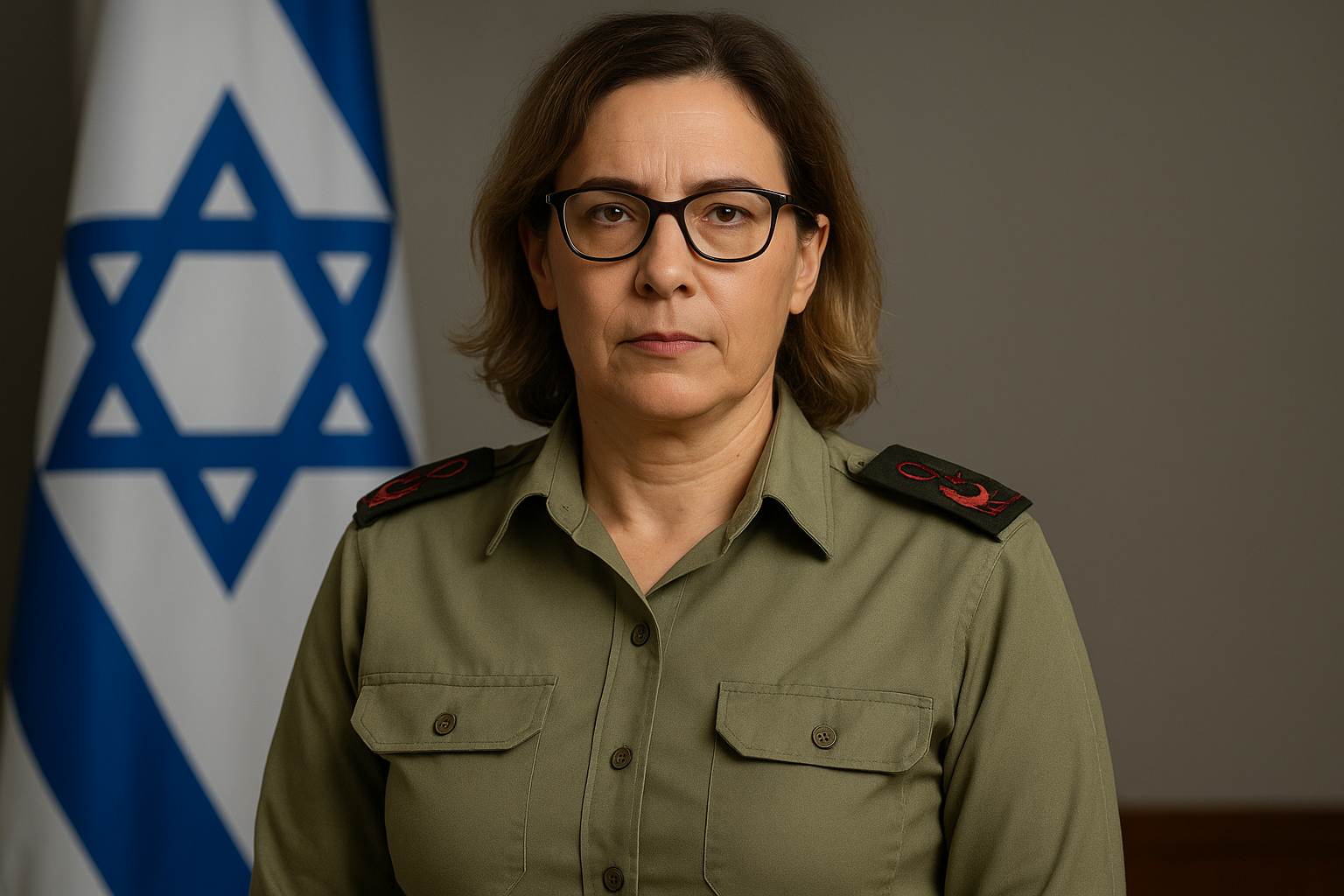
Ex-Israeli Military Lawyer Arrested Over Leaked Abuse Video
Israel’s former top military lawyer has been arrested in a case that has rapidly become one of the country’s most divisive political scandals in years.
Major General Yifat Tomer-Yerushalmi, who until days ago served as the Israel Defense Forces’ Military Advocate General, was taken into custody after investigators linked her to the leaking of a video that allegedly shows Israeli soldiers abusing a Palestinian detainee.
The footage, recorded at the Sde Teiman military base in southern Israel, has reignited fierce arguments inside Israel over the conduct of its military during the war in Gaza, the treatment of Palestinian prisoners, and whether the country’s legal institutions are willing or able to hold soldiers accountable.
Supporters of Tomer-Yerushalmi say she acted out of a duty to expose wrongdoing and protect the credibility of the military justice system. Her critics accuse her of betraying Israeli soldiers during wartime and handing ammunition to Israel’s enemies.
The arrest comes after months of tension, accusations, and public outrage surrounding the now-infamous video.
Search Along the Coast
The dramatic developments began early on Sunday, 2 November 2025, when Tomer-Yerushalmi was reported missing.
Israeli police launched a large-scale search operation along the Mediterranean coastline north of Tel Aviv after relatives and associates lost contact with her. Officers, helicopters, and rescue teams were reportedly involved in the search, which focused on the area between Tel Aviv and Herzliya.
For several hours, concern grew that something serious may have happened to the former military lawyer.
Later in the day, police announced that she had been found safe near Herzliya. Authorities said she was in good physical condition.
However, instead of returning home, Tomer-Yerushalmi was immediately taken in for questioning.
Within hours, police confirmed that she had been arrested as part of an investigation into “leaking and other serious criminal offences.”
Israeli media later reported that she was not the only senior figure detained.
Colonel Matan Solomosh, the former chief military prosecutor, was also arrested in connection with the same investigation.
Officials have so far released few details about the exact allegations. However, investigators are believed to be examining how sensitive military material was passed to the media, who authorised the leak, and whether classified information was unlawfully disclosed.
The arrests immediately triggered a political storm.
The Video That Sparked the Crisis
At the centre of the investigation is a video first broadcast in August 2024 by an Israeli television network.
The footage allegedly shows a group of Israeli reservists at Sde Teiman assaulting a Palestinian detainee.
According to reports, the soldiers are seen forming a barrier around the prisoner in an apparent attempt to block the view of cameras and others nearby. The footage then appears to show the detainee being beaten and stabbed with a sharp object.
The prisoner later required hospital treatment for serious injuries.
The video quickly spread through Israeli and international media.
For critics of the Israeli military, it appeared to confirm longstanding accusations that Palestinian detainees held after the Gaza war were being abused inside detention facilities.
For many Israelis, however, the leak itself became as controversial as the contents of the footage.
Some argued that exposing the alleged abuse was necessary if the military wanted to maintain public trust. Others believed that publishing such images during wartime damaged Israel’s reputation abroad and unfairly portrayed soldiers as criminals.
The Sde Teiman base, where the incident allegedly took place, has already been the focus of repeated scrutiny.
Since the start of the war following the Hamas attacks of 7 October 2023, the base has been used to hold Palestinian detainees from Gaza.
Human rights organisations, former detainees, and international investigators have accused the facility of widespread mistreatment.
Israeli officials have consistently denied claims of systematic abuse.
Soldiers Charged, But Deny Wrongdoing
Following the broadcast of the footage, Israeli military prosecutors launched an investigation.
Five reservists were later charged with aggravated assault and causing severe bodily harm.
The soldiers have denied all allegations.
Their lawyers insist that the case against them is politically motivated and based on misleading interpretations of the footage.
On Sunday, 2 November 2025, only hours before Tomer-Yerushalmi’s arrest became public, four of the accused reservists appeared outside Israel’s Supreme Court.
Standing before journalists with their faces covered, the men insisted they had done nothing wrong.
They described themselves as victims of what they said was an unfair and politically driven legal campaign.
Their attorney, Adi Keidar, who represents them through the right-wing legal organisation Honenu, strongly attacked the investigation.
He claimed that prosecutors had targeted the soldiers because of political pressure and international criticism directed at Israel.
“The case is biased and completely fabricated,” he said.
Keidar argued that the soldiers were being punished not because of evidence, but because authorities wanted to show the world that Israel was taking action.
Supporters of the reservists echoed those claims.
Several right-wing activists and lawmakers have argued that Israeli troops operating after the Hamas attacks faced extraordinary conditions and should not be judged by what they describe as unrealistic legal standards.
Critics of that view say such arguments risk placing soldiers above the law.
Resignation Days Before Arrest
Tomer-Yerushalmi’s arrest came on Sunday, 2 November 2025, only two days after she resigned from her position as Military Advocate General.
She had served as the highest-ranking legal officer in the Israeli military and was responsible for overseeing investigations into alleged misconduct by soldiers.
Her resignation followed a decision by Israeli Defence Minister Israel Katz, who announced that she would not remain in her role while the leak investigation continued.
Faced with growing political pressure, Tomer-Yerushalmi stepped down on Friday.
In her resignation letter, she acknowledged that she had authorised the release of certain material to journalists.
However, she argued that the purpose had not been to harm the military.
Instead, she said she acted because she believed false claims and propaganda were spreading about the military legal system.
She wrote that she accepted “full responsibility” for the decision.
According to her statement, the material was released in an effort to defend the integrity of the army’s internal investigations.
“It is our duty to investigate whenever there is reasonable suspicion of violence against a detainee,” she wrote.
Those words have become central to the debate now dividing Israel.
To her supporters, the statement was an attempt to protect the rule of law.
To her opponents, it amounted to an admission that she deliberately leaked sensitive information.
Fierce Reaction From Israel’s Leadership
The reaction from senior Israeli officials was swift and severe.
Defence Minister Israel Katz publicly condemned Tomer-Yerushalmi.
He accused her of undermining Israeli soldiers and damaging the country during a time of war.
“Anyone who spreads blood libels against IDF soldiers is unfit to wear the uniform,” Katz said.
The phrase “blood libel” has particular weight in Israeli political discourse. It is often used by officials to describe accusations against Jews or Israelis that they believe are false and malicious.
Katz’s use of the term signalled just how seriously the government viewed the leak.
Prime Minister Benjamin Netanyahu later joined the criticism.
He described the release of the video as “one of the most damaging public relations attacks Israel has faced since its founding.”
Netanyahu did not directly accuse Tomer-Yerushalmi of wrongdoing, but his remarks made clear that the government sees the leak as a major national crisis.
The Prime Minister’s comments also reflected a wider concern inside the Israeli leadership.
Since the war in Gaza began, Israel has faced increasing international criticism over civilian deaths, military operations, and the treatment of Palestinian detainees.
Officials fear that the video could strengthen calls for war crimes investigations and increase pressure from foreign governments and international organisations.
A Deepening Divide Inside Israel
The case has exposed a growing divide within Israeli society.
Many on the political right see Tomer-Yerushalmi as someone who turned against the soldiers she was supposed to defend.
For them, the leak was an act of betrayal.
Some believe that she and other senior legal officials have become too influenced by international opinion and too willing to investigate soldiers while ignoring the pressures of combat.
Human rights groups, legal experts, and opposition figures see the matter very differently.
They argue that failing to investigate allegations of abuse would cause far greater damage to Israel in the long term.
According to these critics, exposing misconduct is essential if Israel wants to prove that its institutions are capable of policing themselves.
Several former military officials have warned that suppressing evidence of abuse could further erode public confidence.
“If there are crimes, they must be investigated,” one retired Israeli legal officer said in a television interview. “Otherwise the public will believe there is one law for ordinary citizens and another for soldiers.”
The tensions surrounding the case were already visible months earlier.
In July 2024, military investigators arrived at Sde Teiman to question soldiers linked to the incident.
Before they could complete their work, far-right protesters gathered outside the base.
Some demonstrators forced their way into the facility.
Among them were several lawmakers from parties within Netanyahu’s governing coalition.
The protesters argued that the soldiers were being unfairly targeted.
The images of politicians and activists storming a military base shocked many Israelis and highlighted how politically explosive the issue had become.
The Detainee at the Centre of the Case
The Palestinian detainee seen in the video was later released.
In October 2024, he was returned to Gaza as part of a prisoner-hostage exchange agreement between Israel and Hamas.
Little has been publicly revealed about his identity.
However, according to reports, he suffered serious injuries and required extensive medical treatment after the alleged assault.
The case has also drawn renewed attention to wider allegations regarding Palestinian prisoners.
International organisations, including United Nations investigators, have repeatedly accused Israel of mistreating detainees held after the 7 October attacks.
A UN commission of inquiry last year claimed that Palestinians from Gaza had been subjected to torture, sexual violence, physical abuse, and severe psychological mistreatment.
The commission said some of the alleged acts could amount to war crimes.
Israel has strongly rejected those accusations.
Israeli officials insist that the military operates according to strict legal standards and that all credible complaints are examined.
The government argues that international organisations often ignore the context of the war and fail to acknowledge the brutality of the Hamas attacks that triggered the conflict.
Even so, the Sde Teiman case has become difficult for Israel to dismiss.
Unlike previous allegations based mainly on testimony, this case involves video footage, internal investigations, and the arrest of some of the country’s most senior legal officials.
What Happens Next
Police have not yet announced whether Tomer-Yerushalmi or Colonel Solomosh will face formal charges.
Both remain under investigation.
Forensic experts and intelligence officers are continuing to examine how the video reached the media and whether additional people were involved.
Investigators are also trying to establish whether the leak violated military secrecy laws or other criminal statutes.
The case could take months to resolve.
If charges are eventually filed, it is likely to trigger an even larger political confrontation.
For now, the affair has already become more than a criminal investigation.
It has turned into a test of how Israel balances national security, military loyalty, and accountability.
The central question remains unresolved.
Should exposing alleged abuse be seen as a betrayal of the army, or as proof that the rule of law still matters even during war?
The answer may shape not only the future of those under investigation, but also the direction of Israeli politics and the credibility of its military institutions for years to come.