
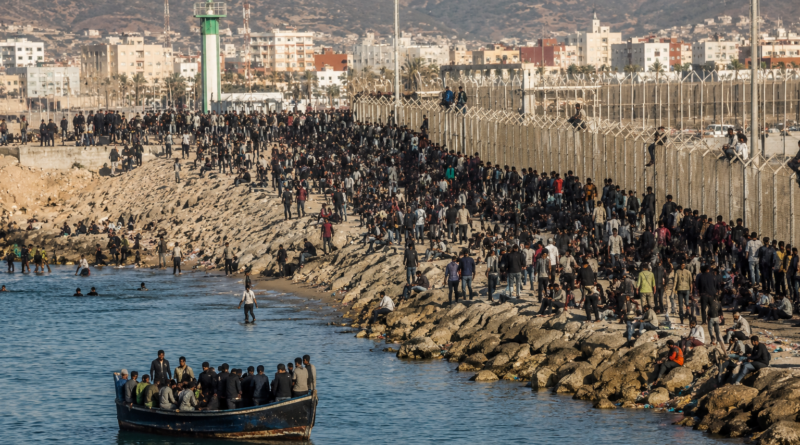
Spain Responds to the Ceuta Migration Crisis
Spain has sent soldiers to its North African city of Ceuta after one of the largest single-day movements of people across a European border in living memory. Officials are still arguing over the numbers — and over who, or what, opened the door.
Ceuta Migration Crisis Overwhelms the City
The Ceuta migration crisis has intensified after thousands of people crossed from Morocco into the Spanish territory within 24 hours, prompting Spain to deploy additional troops.
Ceuta covers barely 19 square kilometres of rock and coastline on the northern tip of Morocco. Roughly 83,600 people live there. In the space of about 24 hours, beginning in the early hours of Thursday 30 July, that figure effectively doubled.
Juan Jesús Vivas, who heads Ceuta’s regional government, told reporters on Friday that around 60,000 people had entered the city — a number equivalent to more than 70 per cent of its resident population. He called the situation absolutely unsustainable and said no municipality of that size could absorb such pressure.
Spain’s Interior Ministry has been more conservative, putting the figure closer to 50,000 since Thursday morning. A separate arm of government, the Department of National Security, briefly published an estimate of more than 49,000 irregular entries in 24 hours before quietly removing the statement from its website without explanation — an editing decision that has done little to settle the argument over scale.
The death toll has moved in the same uncertain way. Interior Ministry figures on Friday morning recorded 18 deaths. By Friday afternoon the ministry’s count had risen to 34. Spanish news agency EFE, citing police sources, reported at least 43. Bodies were recovered from the water; other deaths appear to have occurred in crushes on the breakwater at Tarajal beach, where crowds funnelled towards the point where the border fence meets the sea.
By early Friday afternoon, the Interior Ministry said more than 25,000 people had already turned around and headed back towards Morocco of their own accord. Later figures put returns above 37,500. At its peak, the ministry described people leaving Ceuta at a rate of roughly 150 a minute, though it offered no explanation of how that figure was measured.
At Melilla, Spain’s second North African city some 380 kilometres east along the coast, the picture was far smaller but still unusual: between 300 and 400 crossings reported overnight.
How they got in
For years, reaching Ceuta by sea has meant swimming several kilometres down the Moroccan coast, usually at night, usually in small numbers. This week looked nothing like that.
Video and eyewitness accounts describe people reaching the border fence itself with little difficulty. Some walked out along the rocks of the jetty and simply rounded the end of it. Most entered the water for a short stretch and swam around the breakwater to the beaches on the Spanish side. Many carried inner tubes as flotation aids. Photographers recorded discarded rings and wet clothing piled on the shoreline. Phones were sealed into waterproof pouches — the practical detail of people who had planned the crossing rather than improvised it.
The crowd was overwhelmingly young and overwhelmingly male, though women, children and infants were present throughout. Spanish officials estimate that somewhere between 7,000 and 8,000 of those who entered were minors — a category that matters enormously, because unaccompanied children cannot lawfully be returned in the same way as adults and become the responsibility of the Spanish state.
What remains unexplained is the absence of Moroccan gendarmes at the critical hours. In normal conditions, Moroccan security forces intercept and disperse groups well before they reach the fence. On Thursday, they did not. By Friday, they had returned in force at the frontier town of Fnideq, deploying water cannon and pushing crowds back from the gates. Vehicles were set alight during clashes on the Moroccan side.
Once inside, scenes were closer to celebration than confrontation. People walked into the centre of Ceuta soaked and cheering, some kissing the ground, some thanking Spanish police officers who made little attempt to stop them and in places directed new arrivals towards the city’s reception centre.
Not everyone stayed euphoric. One man, heading back towards Morocco, told Reuters that people were dying and urged anyone still thinking of attempting it not to come. Residents described a city that had shut itself indoors. A hospital security guard told Spanish daily ABC that people were frightened, and that this felt sharper and more aggressive than anything Ceuta had experienced before.
What the Ceuta Migration Crisis Means for Europe
The proximate cause is a piece of administrative law.
On 29 June, the Fifth Section of the Administrative Litigation Chamber of Spain’s Supreme Court handed down judgment 814/2026. It was made public on 8 July. The case concerned an Algerian man who, on 14 November 2024, was intercepted in the water while swimming towards Ceuta alongside two others and handed straight back to Moroccan authorities — no written decision, no lawyer, no opportunity to lodge a claim for international protection.
At issue was the mechanism Spanish law calls rechazo en frontera, “rejection at the border,” and which critics have long called devoluciones en caliente — hot returns. The tenth additional provision of Spain’s immigration law permits officers to turn a person back on the spot when that person attempts to overcome the physical containment elements of Ceuta or Melilla: the fences, the razor wire, the barriers.
The Supreme Court drew a line. Someone who climbs a fence has overcome a containment element. Someone swimming through open water has not. The summary procedure therefore cannot be applied to people intercepted at sea; they must go through the ordinary immigration process, which means identification, legal representation and a genuine chance to claim asylum. The judgment sits on top of the non-refoulement principle embedded in the 1951 Refugee Convention and European human rights law.
The legal reasoning is narrow. Its practical effect was not. For more than a decade, interception at sea had meant near-certain return within hours, and that near-certainty was itself the deterrent. Remove it, and the calculation changes: reaching Spanish water now carries a real prospect of remaining on Spanish soil.
Smuggling networks understood this faster than Madrid did, and — according to Spain’s Interior Ministry — marketed it aggressively. A Civil Guard spokesperson described the pattern to Reuters as a slow trickle since the ruling, then an explosion. Between 1,500 and 2,000 people had entered Ceuta in the preceding ten days. Then came Thursday.
Prime Minister Pedro Sánchez, visiting Ceuta on Friday with Interior Minister Fernando Grande-Marlaska, put it in blunter terms, accusing trafficking mafias of a self-serving interpretation of the ruling and saying misinformation had spread like wildfire. He described what happened as an attack and a violation of Spain’s territorial integrity, and said everyone who entered illegally would be returned to Morocco as quickly as possible. Rabat, he said, was cooperating with those plans.
The other explanation: geopolitics
There is a second reading circulating in Madrid, Rabat and Algiers, and it has nothing to do with case law.
Ceuta and Melilla have been Spanish since the fifteenth and sixteenth centuries and have held limited self-government since 1995. Morocco claims both. They constitute the European Union’s only land borders with the African continent, which makes the tap that controls them a lever of unusual power.
That lever has been pulled before. In May 2021, roughly 8,000 to 10,000 people crossed into Ceuta over two days after Moroccan controls relaxed — an episode that followed Spain’s decision to allow Brahim Ghali, leader of the Polisario Front, to receive medical treatment on Spanish soil. Morocco denied any orchestration. The rupture was repaired in March 2022 when Madrid formally endorsed Morocco’s autonomy plan for Western Sahara.
This time the backdrop is Algeria. On 20 July, Sánchez travelled to Algiers to meet President Abdelmadjid Tebboune, accompanied by executives from Naturgy, Repsol and Enagás. The purpose was gas: expanded imports through the Medgaz pipeline, from a supplier that provided roughly a third of Spain’s natural gas in the first half of 2026. Algeria backs independence for Western Sahara. Sánchez sought commercial concessions without offering Rabat anything in return.
Thursday’s events came ten days later, and coincided with the Commemoration of the Throne, the most significant date in Morocco’s political calendar. Regional analysts have read the timing as a signal rather than a coincidence.
Spain’s Foreign Ministry rejects that framing outright, insisting the relationship with Morocco is excellent and unaffected by warmer ties with Algiers. Morocco’s government has issued no official statement; a source quoted by Europa Press blamed criminal organisations exploiting vulnerable people. Achraf Maimouni of the Moroccan Association for Human Rights suggested the Tarajal crossing had been opened under unusual circumstances. Algerian media have accused Rabat of weaponising migration; the Moroccan press has framed the episode as a question of sovereignty.
Europe reacts, loudly and not always accurately
The images travelled fast, and the political response was immediate.
Italian Prime Minister Giorgia Meloni called the scenes shocking and said uncontrolled illegal immigration posed a concrete threat to European border security. She announced that Rome was convening the relevant bodies and was prepared to intervene with extraordinary measures, including suspending the Schengen arrangement with Spain. Since the two countries share no land border, the practical effect would fall on flights — additional checks on passengers arriving from Spain.
Madrid’s response was frosty. The Spanish foreign minister called the remarks improper coming from a partner and friendly country from which Spain expected European solidarity rather than partisan demagoguery, and summoned Italy’s ambassador on Friday.
Others piled in. European Commission President Ursula von der Leyen called the images unacceptable and said dangerous crossings must stop immediately, smuggling networks be dismantled and returns be swift. German Chancellor Friedrich Merz demanded Morocco take back illegal migrants immediately. Finland’s Interior Minister Mari Rantanen backed Meloni’s proposal and said Spain had failed to protect the external border. Dutch Interior Minister Tom Berendsen called the events concerning. France went further than rhetoric: Interior Minister Laurent Nuñez ordered an immediate reinforcement of controls on the Spanish border and activated rapid intervention border units for in-depth inspections. UK Prime Minister Andy Burnham and the French president both offered Spain assistance.
One point is worth stating plainly, because much of the commentary has obscured it: EU law contains no mechanism for one member state to suspend another from Schengen. The Schengen Borders Code allows a country to reintroduce controls at its own internal borders when facing a serious threat to public policy or internal security, and those measures must be temporary and proportionate. What Italy is threatening is Italian checks on arrivals from Spain — not Spain’s expulsion from the passport-free area.
The numbers behind the numbers
Set against the recent record, the scale is extraordinary. UN data reviewed by BBC Verify recorded 2,826 arrivals in Ceuta up to 15 July this year, plus 181 in Melilla. That was already high by recent standards: 994 crossings into the two cities in all of 2025, 476 in 2024, 467 in 2023.
Elsewhere, the trend has been moving the other way. Irregular arrivals to Spain as a whole fell from 17,990 in the first half of 2025 to 12,138 in the same period this year. Ceuta is not a symptom of a rising national tide; it is a single valve that opened.
What happens next
Spain has deployed the armed forces to reinforce the Civil Guard in Ceuta and around Melilla, and both governments have moved to strengthen the border fence. By Friday evening, mass crossings appeared largely halted, and the flow had reversed: tens of thousands walking back the way they came.
Three problems remain. The adults who stay must now be processed under ordinary immigration procedure rather than returned on the spot — precisely what the Supreme Court required. The thousands of minors cannot be summarily returned at all and fall to Spanish child protection services, an outcome that consumed Spanish politics for months after 2021. And the deterrent that governed this border for a decade no longer legally exists, which means the underlying incentive has not changed simply because the fence has been reinforced.
Domestically, the political cost is landing on Sánchez. His government has been an outlier in Europe, pursuing a plan to give around 500,000 undocumented people a path to legal status, with more than a million applications received. Santiago Abascal of Vox has accused him of engineering an invasion to shore up his own position. The Popular Party has seized the moment. The Civil Guard’s police union called the situation absolute chaos. As El País noted, the vocabulary itself split along political lines: taxi drivers called it an invasion, NGOs a humanitarian crisis, and local officials a national emergency.
All three descriptions were being used, in the same city, on the same day.