Ukraine on High Alert: What Did Zelenskyy Warn About as Russia Threatens New Missile Strikes?
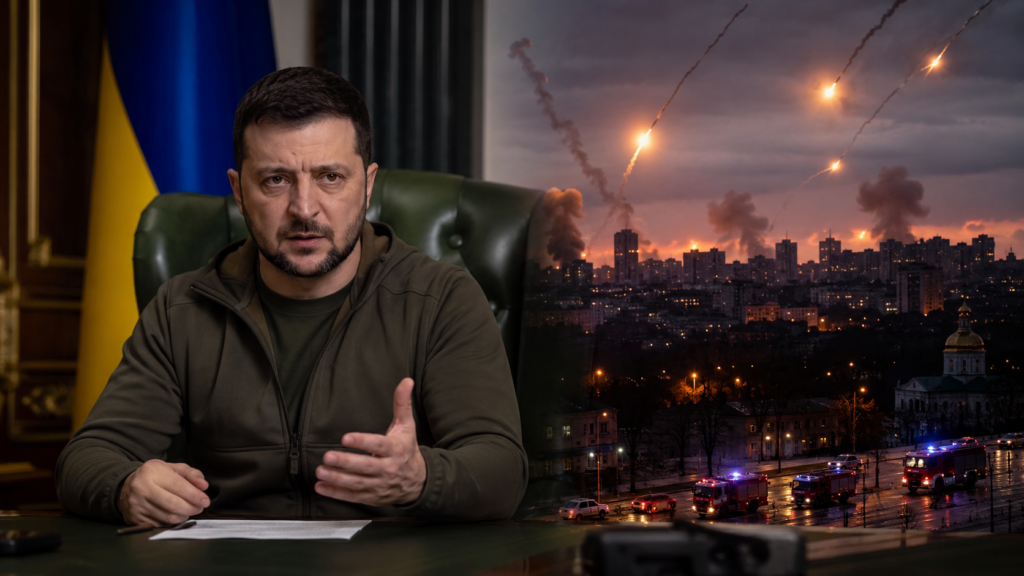
Ukraine on High Alert after President Volodyrmyr Zelenskyy warned that intelligence suggests Russia could be preparing another wave of missile and drone attacks. The warning has raised concerns across Europe as Ukrainian authorities strengthen air defences and emergency preparations.
Ukraine is once again bracing for what its own government describes as an imminent, large-scale Russian missile attack. On July 24, 2026, President Volodymyr Zelenskyy said Ukrainian intelligence, corroborated by information from allied partners, indicated that Russia had “readied missiles” for a new massive strike that could occur within 48 hours. The warning came only hours after a Russian ballistic missile strike on the Kyiv region killed at least ten people and injured around one hundred more, at a site where members of Ukraine’s defense industry had gathered for an exhibition.
This is not the first time in recent weeks that Zelenskyy has issued this kind of alert. A similar warning on July 5 preceded one of the most damaging Russian assaults on Kyiv since the start of the full-scale invasion, and an earlier warning on July 1–2 came hours before a strike that killed twenty-two people in the capital. That track record is part of why the latest alert is being taken so seriously by Ukrainian civilians, government officials, and Western military analysts alike: Zelenskyy’s recent warnings have, more often than not, been followed by real attacks.
The story matters far beyond Ukraine’s borders. It touches NATO’s internal debate over air-defense stockpiles, the European Union’s growing role in financing Ukraine’s military needs, global energy and shipping markets, and the broader question of whether the war is edging toward a new, more dangerous phase or toward the diplomatic track that some regional actors are now urging. This analysis lays out what is confirmed, what remains uncertain, and what to watch in the days ahead.
What Exactly Did Zelenskyy Say?
In his evening address on July 24, Zelenskyy stated that intelligence sources and Ukraine’s partners indicated Russia had prepared missiles for a new massive strike, with preliminary information suggesting the attack could occur within 48 hours. He urged citizens to pay close attention to air-raid alerts, a recurring theme in his recent statements, since sirens sounding in rapid succession are sometimes ignored by weary residents.
The warning followed a Russian strike earlier that day using ballistic missiles fired from the north toward the Kyiv region. Ukrainian air defenses intercepted one of the incoming missiles, while two others struck the Bucha district, hitting an event where Ukrainian defense manufacturers had gathered. Ukraine’s Prosecutor General opened a criminal investigation into how the event was organized and whether adequate security precautions were taken under martial law, and regional authorities declared a day of mourning.
Zelenskyy’s statement was not simply rhetorical. Ukrainian officials have repeatedly said that these warnings are based on specific indicators — missile readiness reports, troop and launcher movements, and allied intelligence sharing — rather than general assumptions about Russian intent. At the same time, independent verification of the precise intelligence behind any single warning is not publicly available, and the exact timing of a “massive strike” has sometimes varied by a day or more from initial estimates. That distinction between a confirmed pattern of warnings and unverifiable underlying intelligence is important for readers trying to gauge how seriously to treat any individual alert.
Why Is Ukraine on High Alert?
Several factors are feeding Kyiv’s assessment that a new large-scale strike is likely. First is the pattern itself: Zelenskyy’s last several public warnings of “massive” attacks were followed, within a day or two, by strikes that matched the scale he described. Ukrainian officials argue this consistency reflects real-time intelligence rather than routine caution.
Second, military analysts have pointed to Russia’s evolving strike tempo. In early July, Russia launched one of its largest combined attacks of the war — nearly 500 attack drones alongside 77 missiles, including 25 ballistic or hypersonic weapons, over an eleven-hour period. Attacks of that scale require significant pre-positioning of munitions and launch platforms, which Western and Ukrainian intelligence services can sometimes detect in advance.
Third, the timing of Russian strikes has often coincided with symbolically significant moments for Ukraine’s allies — for instance, attacks shortly after the United States’ Independence Day and immediately before the NATO summit in Ankara in July. Zelenskyy has suggested this timing reflects a deliberate attempt to undercut Western unity or overshadow diplomatic meetings, though this interpretation is an assessment rather than a confirmed fact.
Finally, Ukrainian officials say Russia is separately preparing a new wave of mobilization for the autumn, citing figures suggesting Russian battlefield losses currently exceed recruitment. Analysts caution that this claim, like most wartime loss estimates from either side, has not been independently verified by neutral sources.
Russia’s Current Strategy
Russia’s air campaign has shifted markedly since the war’s early years. Rather than relying on missiles alone, Russian forces now typically combine hundreds of relatively low-cost Shahed-type attack drones with smaller numbers of higher-value cruise and ballistic missiles in a single wave. The intent, according to Western military analysts, is to saturate Ukraine’s layered air-defense network, forcing defenders to expend scarce, expensive interceptors on drones while ballistic missiles — the hardest threat to stop — slip through.
The results illustrate the strategy’s effectiveness. In one early-July attack, Ukraine intercepted more than 90 percent of both cruise missiles and Shahed-type drones, but its forces failed to bring down a single one of 29 ballistic missiles fired at Kyiv in one wave, and a separate attack saw all 23 ballistic missiles get through as well. Ukraine’s air force has openly acknowledged that its interception rate against ballistic weapons is, in the words of one spokesperson, low “to put it mildly.”
Targets have increasingly included energy infrastructure, residential apartment blocks, and — in the July 24 case — a gathering of defense-industry representatives, alongside more conventional military objectives. Russia’s Defense Ministry has at times characterized these strikes as retaliation for Ukraine’s own long-range attacks on Russian territory, which have intensified in recent months and now regularly target oil refineries, fuel depots, and logistics hubs deep inside Russia. Analysts describe the overall pattern as a deliberate mix of military and psychological pressure: degrading Ukraine’s war-fighting capacity while also testing civilian resilience and allied resolve ahead of key diplomatic moments.
Ukraine’s Defensive Preparations
Ukraine’s air-defense network is layered, combining short-range systems like NASAMS and IRIS-T with the U.S.-made Patriot system, which remains the only platform in Ukraine’s arsenal capable of reliably intercepting ballistic missiles. Radar and early-warning networks feed target data to these systems, while a nationwide siren network and a system of shelters — from purpose-built bunkers to metro stations — form the civil-defense backbone that protects civilians during an alert.
The central problem, according to Ukrainian and allied officials, is not the effectiveness of the Patriot system itself but the shortage of interceptor missiles. Zelenskyy said in mid-July that Ukraine needs close to 100 Patriot interceptors per month to keep pace with Russian ballistic missile launches, which would mean roughly 1,200 missiles a year if the current strike tempo continues. Lockheed Martin, the sole manufacturer of the PAC-3 interceptor, currently produces only about 55 to 60 missiles per month globally — a gap that has left Ukraine, and the U.S. defense industrial base more broadly, stretched thin. Compounding the shortfall, some estimates suggest each incoming Russian ballistic missile may require two to three interceptors to reliably down.
In response, Ukraine’s Defense Ministry has appealed to nearly 40 partner countries to urgently transfer Patriot missiles from existing stockpiles in exchange for future contracted deliveries. The European Union has financed a roughly $1 billion purchase of about 100 additional Patriot missiles, and NATO and EU partners have pressed Greece to release up to 200 PAC-2 interceptors from its own stocks, structured so Athens keeps its radars, launchers, and crews. Separately, ten European countries have announced a new “anti-ballistic coalition” intended to develop a lower-cost Patriot alternative built around Ukraine’s domestically produced FP-7 (Freyja) missile alongside European radar technology, though defense analysts have questioned whether the coalition’s stated twelve-month development timeline is realistic given the technical complexity involved.
The Human Impact
The human cost of the current strike wave has been severe. The July 6 Kyiv attack killed at least 15 people in the capital and eight more in the wider Kyiv region, injuring 56. The July 2 assault on Kyiv killed 22 people. On July 24, the strike near Bucha killed 10 and injured around 100, while a separate attack the same day on Slovyansk killed five more. Overnight strikes on July 25–26 hit a residential building in Kyiv directly, destroying dozens of apartments across multiple floors, according to Zelenskyy, who shared footage showing extensive structural damage.
Beyond the immediate casualties, residents of Kyiv and other frequently targeted cities describe a grinding routine of nightly air-raid sirens, disrupted sleep, and repeated evacuations to shelters or metro stations. Displaced families, damaged apartment blocks, and disrupted schooling and medical care have become recurring features of daily life in Ukraine’s major cities during the current phase of the war. Ukrainian officials have not published comprehensive, independently verified national statistics on displacement tied specifically to this latest strike wave, and any such figures should be treated with appropriate caution until confirmed by organizations such as the UN’s humanitarian coordination bodies.
International Response
The renewed strikes have shaped discussions at the highest levels of NATO and the EU. At the NATO summit in Ankara on July 7–8, Zelenskyy urged allies to leave with concrete commitments on air defense, describing Russia’s ballistic missile advantage as the Kremlin’s “last major advantage” and calling for Europe to develop its own affordable, mass-produced anti-ballistic missile systems.
The United States has continued to supply Patriot components and has reportedly agreed to license PAC-3 production to European partners, including Germany, though production has been constrained by shortages of high-tech seeker components used in the missiles’ guidance systems. U.S. stockpiles have themselves come under strain following the war in Ukraine alongside separate military engagements involving Israel and Iran, according to reporting on Pentagon inventory levels.
The United Kingdom, France, and other European governments have continued bilateral military aid, while the EU has taken a more direct financing role through joint interceptor purchases. Neighboring and regional states have offered more varied responses: Kazakhstan’s President Kassym-Jomart Tokayev, for example, has publicly called for a freeze in the war and a return to negotiations based on the earlier Istanbul talks framework, reflecting continued interest from some non-aligned states in a diplomatic off-ramp. Separately, U.S. President Donald Trump has said he has spoken with both Zelenskyy and Russian President Vladimir Putin and has claimed both leaders want to reach a deal, though no concrete agreement or ceasefire framework has been confirmed as a result of those conversations.
Military Analysis
Military analysts broadly agree on a few points while differing on others. There is wide consensus that Russia’s combined drone-and-missile tactics are specifically designed to exploit Ukraine’s interceptor shortage, and that this shortage — rather than any fundamental weakness in the Patriot system’s technology — explains the recent run of failed intercepts against ballistic missiles. Analysts also generally agree that Russia’s stepped-up long-range strike campaign inside Russian territory, targeting refineries and logistics hubs, reflects Kyiv’s attempt to impose economic and military costs on Moscow that partially offset its disadvantage in air defense.
Where assessments diverge is on Russian intent and next steps. Some analysts view the repeated large-scale strikes as an effort to pressure Ukraine and its allies ahead of any future negotiation, maximizing leverage before diplomatic talks resume. Others see the pattern as evidence that Moscow currently has no interest in a near-term ceasefire and is instead preparing for a longer war of attrition, a view supported by reports of a planned autumn mobilization drive. Both interpretations remain analytical judgments rather than confirmed Russian policy, and neither has been independently verified through official Russian government statements.
Economic Consequences
The war’s economic ripple effects remain closely watched by international markets. Ukraine’s continued strikes on Russian oil refineries and fuel depots have periodically disrupted Russian domestic fuel supply and export logistics, contributing to volatility in regional energy markets. European gas and electricity prices, already sensitive to any disruption near Ukraine’s energy infrastructure or Black Sea shipping routes, tend to react to major escalations in the conflict.
Ukrainian grain exports, a critical component of global food security, continue to depend heavily on Black Sea shipping corridors that remain vulnerable to attacks on vessels and port infrastructure — including a recent Ukrainian strike on a vessel in the Caspian Sea reportedly used for military cargo transport linked to Iran, which drew a formal protest from Tehran. Maritime insurance premiums for vessels operating near Ukrainian and Russian Black Sea ports have remained elevated throughout the war, adding costs that are ultimately passed on to shippers and, in some cases, consumers. European economies with close trade and energy ties to the region continue to monitor the conflict as a persistent source of macroeconomic risk, particularly heading into the winter heating season.
Could the Conflict Escalate Further?
Several realistic scenarios could shape the coming weeks. On the escalatory side, a continued shortage of Patriot interceptors could allow more Russian ballistic missiles to reach their targets, increasing civilian casualties and pressure on Ukraine’s government to respond with expanded strikes into Russian territory — a cycle that could further widen the war’s geographic footprint. A confirmed large-scale Russian mobilization this autumn would also signal an intent to sustain, rather than wind down, the conflict.
On the de-escalatory side, renewed diplomatic engagement — including the kind of outreach reportedly underway between Trump, Zelenskyy, and Putin, along with calls from states such as Kazakhstan for a return to talks — could open a path toward at least a partial ceasefire or negotiated freeze, even if a comprehensive peace settlement remains distant. The rollout of new European air-defense capacity, if it happens on the timelines discussed, could also reduce Russia’s current tactical advantage and, in theory, lower the incentive for further large-scale missile campaigns. As of this writing, no ceasefire framework, formal negotiation date, or mutual troop-withdrawal plan has been publicly confirmed by either side.
Frequently Asked Questions
Why is Ukraine on high alert right now? Because President Zelenskyy warned on July 24, 2026 that Ukrainian intelligence and allied sources indicated Russia had prepared missiles for a new massive strike expected within 48 hours, following a deadly attack on the Kyiv region earlier that day.
What did Zelenskyy actually warn about? He said intelligence pointed to Russia having “readied missiles” for a large-scale attack and urged Ukrainians to pay close attention to air-raid alerts. He has issued similar warnings multiple times in July 2026, several of which preceded real attacks.
Is Russia definitely preparing another missile attack? This cannot be independently confirmed by outside sources; it is based on Ukrainian government and allied intelligence assessments, which have proven accurate in recent weeks but are not verifiable in real time by the public.
How effective is Ukraine’s air defense right now? Ukraine’s air defenses intercept the large majority of drones and cruise missiles — often over 90 percent — but have struggled badly against ballistic missiles due to a critical shortage of Patriot interceptors, in some recent attacks intercepting none of the incoming ballistic missiles.
Why does Ukraine need more Patriot missiles specifically? Patriot is currently the only system in Ukraine’s inventory able to reliably intercept ballistic missiles. Zelenskyy has said Ukraine needs close to 100 interceptors per month, while global production is limited to roughly 55–60 per month.
Could NATO become directly involved in the fighting? There is no indication of that at this stage. NATO’s role has focused on supplying air-defense equipment, interceptor missiles, and diplomatic support rather than direct military engagement.
Why are civilians advised to seek shelter during these alerts? Because ballistic missile strikes can occur with very little warning time, and recent attacks have hit residential buildings, meaning delayed sheltering has contributed to civilian casualties.
How are drone attacks different from missile strikes? Drones are slower, cheaper, and easier to intercept individually, but Russia now launches them in the hundreds to overwhelm defenses, while ballistic missiles are far faster and harder to shoot down but are used in smaller numbers due to cost and availability.
What is Europe doing to help solve the interceptor shortage? The EU has financed new Patriot purchases, pressured Greece to release stockpiled interceptors, and ten European countries have launched a coalition to develop a cheaper Patriot alternative, though experts are skeptical the proposed 12-month timeline is achievable.
What happens next? That depends on whether the warned strike materializes at the scale described, whether interceptor shipments arrive quickly enough to change the intercept rate against ballistic missiles, and whether renewed diplomatic contacts lead to any concrete steps toward negotiations.
Ukraine’s latest high-alert warning fits a troubling pattern from July 2026: repeated Zelenskyy warnings of “massive” Russian strikes, several of which have been followed within days by attacks matching that description. The underlying dynamics are relatively clear and well documented — Russia is combining mass drone barrages with a smaller number of hard-to-stop ballistic missiles, while Ukraine’s air defense, though highly effective against drones and cruise missiles, remains critically short of the Patriot interceptors needed to stop ballistic threats. What remains uncertain is the precise timing and scale of any specific coming strike, Russia’s ultimate strategic intent, and whether recent diplomatic contacts between Washington, Kyiv, and Moscow will lead anywhere concrete. Readers should watch three things in the coming days: whether the warned strike occurs and at what scale, how quickly promised interceptor deliveries from the EU, Greece, and the new European coalition materialize, and whether the diplomatic signals reported around Trump’s conversations with both leaders develop into any formal negotiating process.