How 2026 Israel–U.S. Elections Could Spark Iran War
A decision made inside a polling station in Israel this Tuesday could help determine the outcome.
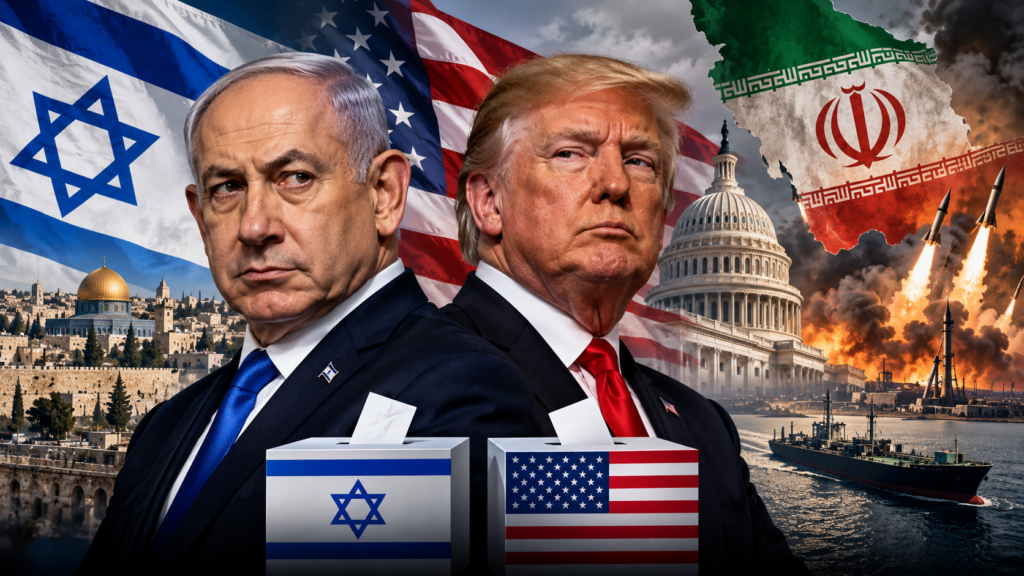
This could indicate whether the Middle East moves toward another confrontation with Iran in Israel and US elections 2026.
The elections are taking place thousands of miles apart, but they are bound together by a conflict that has disrupted energy supplies, strained alliances and raised the cost of everyday life. The consequences will be felt well beyond either country.
Israelis will choose a new 120-seat parliament on 27 October.
Americans will vote on 3 November for the House of Representatives and many Senate seats.
Neither election offers a simple answer to the region’s problems.
Moreover, Israel and US elections 2026 may shape who makes the next decisions.
They could also influence opposition strength and the room for diplomacy to recover.
For Israeli families, security and the possibility of another war are urgent concerns. In America, expensive fuel and household bills dominate conversations. Increasingly, the two questions are connected.
Israel votes on leadership, security and trust
For Benjamin Netanyahu, the election is about more than remaining prime minister. It is a test of whether a public deeply affected by the Hamas-led attacks of 7 October 2023, the war in Gaza and subsequent regional fighting still trusts him to lead.
Supporters point to his decades of experience confronting Israel’s enemies. Opponents question the security failures preceding the attacks and whether his approach has left the country safer or more isolated.
The campaign has reopened arguments about judicial independence, military exemptions for ultra-Orthodox men and the costs of repeated mobilization.
Netanyahu faces a significant challenge from Gadi Eisenkot, a former military chief who has sought to present himself as a more accountable alternative. His criticism of the prime minister does not mean he favors a softer position towards Iran. There is considerable agreement across Israel’s mainstream political parties that Tehran’s military capabilities and regional influence must be contained.
Where the candidates may differ is in their judgment about timing, methods and the political value of further military action.
Final polls put the opposition bloc ahead of Netanyahu’s allies, but neither is assured the 61 seats needed for a parliamentary majority.
Winning the most seats does not guarantee power. Disagreements over alliances with parties representing Arab citizens of Israel could complicate Eisenkot’s path. Netanyahu could remain caretaker prime minister if negotiations fail.
Palestinians in the occupied West Bank and Gaza do not vote in Israeli parliamentary elections, but decisions made by the next government will directly affect their lives. That reality gives the result an importance extending far beyond Israel’s own electorate.
It is possible that the ballots will settle the question of which side has greater support without resolving who actually holds power. Israel has experienced prolonged coalition disputes before. This time, political paralysis would arrive against the background of an unresolved regional war.
The unfinished conflict with Iran
Additionally, the immediate international question is what happens next between Israel, Iran, and Israel and US elections 2026.
The US and Israel began major strikes against Iranian targets on 28 February 2026, saying they intended to damage Tehran’s nuclear and missile programs and military infrastructure. Senior Iranian leaders were killed, including the country’s supreme leader. But the Iranian state did not collapse, and the conflict widened as Tehran retaliated.
Iranian attacks on regional targets and restrictions on shipping through the Strait of Hormuz transformed a military confrontation into an economic shock. The narrow waterway linking the Gulf with international markets is central to the movement of oil and gas. When ships cannot use it safely and reliably, prices and supply chains can be affected far beyond the Middle East.
A diplomatic understanding brokered in June reduced large-scale fighting but left disputes over nuclear activity, sanctions and shipping unresolved. Reduced hostilities do not amount to lasting peace.
Netanyahu has made the Iranian threat a central theme of his re-election campaign. He has raised the prospect of renewed attacks and warned about Iran’s nuclear ambitions. Some of his more alarming recent claims have not been accompanied by publicly presented evidence, making it important to distinguish his warnings from independently established findings.
Trump has openly backed Netanyahu and suggested their countries may resume operations against Iran. Supporters of renewed action believe earlier strikes achieved too little. Critics fear an even wider war without lasting political change.
Recent reports have suggested Netanyahu sought support for fresh action before the Israeli election, while Trump was reluctant to authorize strikes so close to America’s vote. Netanyahu’s office has rejected reporting about such plans. The conflicting accounts underline how uncertain the situation remains.
Iranian officials have warned of retaliation against military installations and regional infrastructure. Energy and water facilities are especially vulnerable in Gulf states, where disruption could quickly endanger civilians.
Every military option therefore carries a wider question: even if another operation achieves its immediate objectives, what happens the following day?
Why the American election changes the calculation
The US midterms are often described as a verdict on the president’s domestic performance. This year, foreign policy and the cost of living are difficult to separate.
Trump’s Republicans are trying to retain control of Congress while voters assess the administration’s management of the economy and the war. Democrats hope public dissatisfaction will help them gain seats and greater power to scrutinize White House decisions.
High energy prices have become a political liability. Disruption around the Strait of Hormuz has affected fuel markets, while higher transport and production costs can filter through to food prices and other household expenses. Not every price increase can be attributed to Iran, but the conflict has made an already difficult affordability debate more urgent.
The effects extend beyond the countries at war. Businesses face uncertain shipping costs, governments confront pressure to protect consumers and households feel the impact at petrol stations and in utility bills.
Trump has tried to ease that pressure, including by temporarily relaxing certain restrictions on Russian-origin oil earlier this year. That approach also carries diplomatic costs as Washington seeks leverage over Russia’s war in Ukraine.
Earlier this month, Trump publicly said the United States would not attack Iran before the 3 November elections. More recent statements have left open the possibility of renewed military action or an agreement with Tehran.
Those shifts explain why the timing of the elections has become part of the strategic calculation. A president who wants to avoid another rise in fuel prices before polling day may judge the political risks differently afterwards. But that does not establish that another offensive has been decided, nor that it would succeed.
Renewed fighting could bring casualties, further economic disruption and retaliation against American forces.
A changing argument about Israel in Washington
The elections may also reveal how much the relationship between Israel and the United States is changing.
Support for Israel has long crossed American party lines. That consensus is now under pressure because of the wars in Gaza and Iran and conditions in the occupied West Bank.
In Michigan, Democratic Senate candidate Abdul El-Sayed has called for a tougher approach to military assistance for Israel. His contest against Republican Mike Rogers has drawn attention to the way debates about an overseas conflict can shape a closely fought American race.
The issue reaches beyond one state. In New York, Democratic congressional candidate Brad Lander was detained with other volunteers while accompanying Palestinian olive farmers in the occupied West Bank. He was later released. Lander said the farmers needed protection; Israeli officials cited security concerns and a lack of coordination.
Such disputes would once have been unusual features of a closing American election campaign. Now, for some candidates and voters, questions about Palestinian rights, military aid and Israel’s conduct are part of the wider argument about America’s role abroad.
Republican candidates generally remain more closely aligned with Netanyahu’s approach, while Democrats differ over how far Washington should challenge the Israeli government. The political division is real, but it would be misleading to suggest either party has one completely uniform position.
If Democrats gain control of one or both chambers of Congress, they could demand hearings, investigate decisions, challenge arms sales and seek restrictions on spending. A new majority could complicate the president’s plans and alter the tone of American policy.
It could not, however, simply take over foreign affairs. Trump would remain president, retain substantial executive authority and have the power to veto legislation. A change in Congress would create new political constraints, not an immediate replacement for the administration’s foreign policy.
The voters who belong to both countries
There is also a more direct connection between the two elections: people eligible to vote in both.
Republicans Overseas Israel, an organization encouraging Americans living in Israel to participate in US elections, estimates that more than 500,000 American citizens live in Israel. That is the organization’s estimate, not a verified count of people who will cast ballots.
These voters live with the consequences of Israeli security policy while retaining a voice in the United States, Israel’s principal military and diplomatic backer.
In a tight American race, votes sent from overseas can matter. But the precise impact depends on registration, turnout, where those voters are eligible to cast ballots and how close a contest becomes.
For some households, the two elections are personal decisions about the same uncertain future.
What happens when the polling stations close?
Several outcomes are possible, and none should be mistaken for a prediction.
A Netanyahu victory could reinforce his argument that Israelis support his security strategy and want continued close coordination with Trump. It would not guarantee another attack on Iran, but it might strengthen the political case for one.
An Eisenkot-led government could change the tone of relations with Washington and place more emphasis on restoring public trust at home. Yet a different leader would still face the same Iranian capabilities, the same regional dangers and the same pressure to demonstrate that Israel can protect itself.
A deadlocked Israeli parliament may leave the caretaker government managing urgent security decisions while parties struggle to form a coalition. Calls for a unity arrangement are possible, although Eisenkot has rejected joining a government under Netanyahu. Deadlock could therefore become a major story in its own right.
In the United States, Republican victories would be interpreted as a measure of continued support for Trump’s agenda. Democratic gains would strengthen the opposition’s ability to demand answers about the war’s purpose, its cost and the prospect of an exit.
For Iran and its neighbors, the central concern will be whether these political changes encourage negotiation or further confrontation. Tehran has survived the campaign against it, but economic pressure and military damage have been severe. A renewed attack could provoke retaliation that spreads rapidly through the Gulf.
The greatest uncertainty is whether the governments involved see a credible route to ending the crisis. Military force may alter the balance of power, but it cannot by itself settle every dispute over nuclear activity, regional security, sanctions and political authority.
The coming votes will not decide the future of the Middle East on their own. Nor will the result in Washington immediately determine the direction of the world economy. Too many other governments, markets and events have a part to play.
But elections determine who gets to make difficult choices, whose warnings carry weight and which policies face resistance.
Over the next eight days, millions of people will enter polling stations thinking about their own security, jobs and families. By the time their votes are counted, the rest of the world may have a clearer idea of whether the next chapter is likely to be shaped by diplomacy, another military gamble or a prolonged period of uncertainty.