
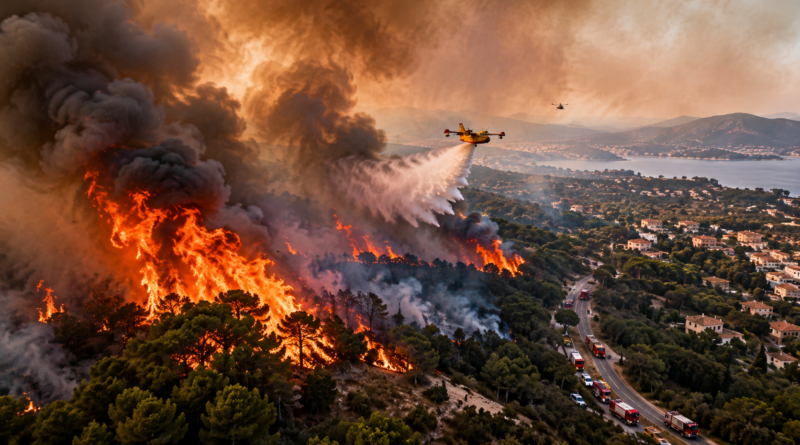
Europe Wildfires 2026: Why Are Europe Wildfires 2026 So Dangerous?
Europe Wildfires 2026 have become one of the continent’s biggest environmental emergencies in recent years. More than 320,000 people have fled their homes across France and Spain as extreme heat, drought and strong winds fuel devastating fires across southern Europe.
More than 320,000 people have fled their homes in France and Spain alone since early July, at least 16 civilians and three firefighters have died, and France has recorded its largest burned area since record-keeping began — with the peak of the Mediterranean fire season still weeks away. A record-shattering June heatwave, which the World Weather Attribution scientific network says would have been “virtually impossible” without human-caused climate change, dried out vegetation across the continent and set the stage for a summer of near-simultaneous fires in Spain, France, Portugal, Greece, Italy and Turkey. The 2026 season is not yet as destructive as 2025, Europe’s worst on record, but it is running well above the twenty-year average, and authorities from Bordeaux to Madrid are warning that conditions could still worsen as a fourth heatwave approaches this week. This is what is known, verified against official data from Copernicus, the European Union and national emergency services, about how bad it has become and why.
Europe Wildfires 2026: The Latest Situation
As of July 27, wildfires burning across southwestern Europe have forced more than 320,000 evacuations in France and Spain combined, according to figures compiled from French and Spanish authorities and reported by CNN, Euronews and Al Jazeera. In France’s Gironde department, a fire that broke out on July 22 near the Atlantic coast has burned roughly 42,000 hectares and prompted the evacuation of about 220,000 people — described by French officials as the country’s largest peacetime evacuation since the Second World War. A further 30,000 people have been evacuated in the neighboring Landes department. French Interior Minister Laurent Nuñez said the country has burned more than 115,000 hectares so far in 2026, a national record, with the season not yet at its historical peak.
In Spain, wildfires have scorched roughly 152,678 hectares of land as of July 26 — about six times the area burned by the same date in 2025 — according to data compiled from EFFIS, the EU’s satellite-based fire monitoring system. The country’s deadliest blaze struck the Almería region in Andalusia earlier this month, killing at least 13 people, most of them foreign nationals, making it Spain’s deadliest wildfire in roughly two decades. A separate cluster of fires has merged across a stretch of the Madrid region near Ávila and Toledo, prompting Spanish authorities to declare a national emergency on July 24. Spain’s overall wildfire death toll for the month has reached 14.
Portugal has lost around 30,000 hectares this season, with a major blaze near Vouzela in the country’s center sending a smoke plume more than 600 kilometers long. Greece has battled fires near Thessaloniki, west of Athens and in the central Fthiotida region, where a man and his 12-year-old son died. Italy’s fire activity intensified sharply in late July amid temperatures above 40°C, and a firefighter, Alessandro Marchi, died on July 23 responding to a blaze in Sicily. Outside the EU, Turkey has recorded nearly 50,000 hectares burned. Fires have also broken out unusually far north, including a wildfire on Conwy Mountain in North Wales that triggered a major-incident declaration and the evacuation of 36 homes.
Weather has offered only brief respite. Gusty winds that drove the France and Spain fires eased over the weekend, giving crews a narrow window to build containment lines, but Spain’s national weather agency, AEMET, has forecast a fourth heatwave beginning around July 29, and French authorities warn the Gironde fire remains “stabilized” but not contained.
Why Europe is burning
Fire scientists trace this summer’s outbreak to a compounding sequence of extreme weather rather than any single cause. June 2026 was the hottest June on record for Western Europe, averaging 3.05°C above the 1991–2020 norm, according to the EU’s Copernicus Climate Change Service; temperatures hit 45.1°C in Andújar, southern Spain, and France recorded its hottest day since national records began in 1947. World Weather Attribution found the heatwave’s intensity was “unequivocally” linked to fossil-fuel-driven climate change, noting that an equivalent event in the climate of 1976 would have been roughly 3.5°C cooler.
That heat followed an unusually wet winter across parts of the Mediterranean, which spurred heavy vegetation growth earlier in the year. As summer heat arrived, that same vegetation dried into abundant fuel. Juli G. Pausas, a fire ecologist at Spain’s Centre for Research on Desertification, said the current fires are “exactly what we expected” given this pattern. Strong, erratic winds have driven some fires into rare and dangerous “pyrocumulonimbus” formations — fire-generated storm clouds capable of producing their own lightning and wind gusts — including at the Gironde blaze, which a French fire captain described to AFP as effectively unmanageable once it reached that stage.
Human activity remains the dominant ignition source. The European Environment Agency estimates 95% of European wildfires are caused directly or indirectly by people, and Greek fire officials have said roughly 85% of blazes in Greece stem from negligence — agricultural machinery sparks, discarded cigarettes and outdoor barbecues chief among them. Longer-term structural factors compound the risk: decades of rural depopulation across southern Europe have left abandoned farmland and unmanaged forest to accumulate as continuous fuel, while expanding development at the edge of forested land — the wildland-urban interface — puts more homes and infrastructure directly in fire paths. Stefan Doerr, a wildland fire scientist at Swansea University, has pointed to both climate change and inadequate landscape management as compounding drivers of this summer’s intensity.
Europe Wildfires 2026: Countries Most Affected
Spain has suffered the season’s deadliest single event and now its most geographically complex crisis, with fires around Ávila, Toledo and Madrid effectively merged along a roughly 15-kilometer front in San Martín de Valdeiglesias. The government has deployed 2,737 personnel, 426 ground vehicles and 21 aircraft, reinforced by crews and equipment from Greece, Italy and Portugal. Prime Minister Pedro Sánchez said Spain has already burned more than 300,000 acres this year, compared with an annual average closer to 250,000 acres over the past decade.
France is confronting its most severe fire season on record by area burned, centered on the Gironde department west of Bordeaux. The blaze forced the pre-emptive evacuation of defense-industry sites tied to France’s submarine-launched ballistic missile program, according to CNN, and President Emmanuel Macron convened a crisis meeting on July 27 to coordinate the response, which now includes military cargo aircraft alongside civilian Canadair and Dash 8 water bombers. Foreign reinforcements, including firefighters from French-speaking Switzerland, have arrived in Bordeaux.
Portugal activated the EU Civil Protection Mechanism in early July alongside France, deploying more than 1,200 firefighters, nearly 400 vehicles and 15 aircraft against the Vouzela fire in its early days. The country’s roughly 30,000 hectares burned this season sit within its historically fire-prone central and northern regions.
Greece, despite fighting its own fires near Thessaloniki, Athens and in Fthiotida, has sent CL-415 water-bomber aircraft to assist Spain under the EU mechanism — one of several instances of cross-border solidarity this season. Authorities in Thessaloniki have warned residents to stay indoors after a recycling plant fire released toxic smoke over the city.
Italy saw its fire season escalate later than its neighbors, with hundreds of blazes and around 6,000 emergency responders deployed by late July as temperatures topped 40°C, particularly in Sicily, where a firefighter died in the line of duty.
Turkey, outside the EU but a major contributor to the continent’s overall fire load, has recorded nearly 50,000 hectares burned and continues to battle active fires alongside Cyprus, which is set to host a new EU-funded regional firefighting base.
Economic consequences
The economic toll of southern Europe’s recurring wildfire seasons is substantial even before this year’s fires are fully tallied. A peer-reviewed analysis published in the journal Regional Science and Urban Economics, matching Eurostat data with satellite-mapped burned areas across Portugal, Spain, Italy and Greece, estimated that an average wildfire season costs Southern Europe between €13 billion and €21 billion in lost production annually, with measurable declines in regional GDP growth concentrated in tourism, retail and transport, partly offset by growth in insurance and reconstruction-related sectors.
This year’s fires are testing that pattern directly. Ratings agency Morningstar DBRS said in a note that trees, plantations and undeveloped land are frequently uninsured or excluded from standard property policies, meaning the true economic loss from this season will likely exceed insured losses by a wide margin. The agency cautioned that the financial calculus would shift sharply if fires reach dense urban areas — a risk Bordeaux and the outskirts of Madrid have both faced this month — since claims would then extend to smoke and ash damage, business interruption, evacuation costs and temporary housing. European insurers, DBRS noted, entered the season with strong capital positions, and global reinsurance capital stood at a record $790 billion in the first quarter of 2026, providing a buffer against a severe claims year.
Tourism operators are reporting disruption rather than collapse so far. Near Bordeaux, wine industry figures have said the region’s vineyards have not been directly damaged by the Gironde fire, even as evacuation orders and smoke have unsettled the area during peak summer season. Airports, rail lines and highways in the affected regions of France and Spain have faced intermittent closures during active fire fronts, and national park access has been restricted in several regions. Electricity infrastructure has also come under strain, both from fire risk to transmission lines and from the broader summer heat’s effect on power demand and generation.
Environmental impact
Europe’s wildfires have released significant carbon emissions this year. The World Health Organization’s European regional office said that from the start of 2026 through July 22, 1,254 fires had been detected across the continent, releasing more than 8.31 million tonnes of CO2 — a running total that has continued to climb as the Gironde, Madrid and Sicilian fires have burned since. The EU’s Copernicus Atmosphere Monitoring Service has tracked the resulting smoke plumes drifting hundreds of kilometers beyond the fire zones, degrading air quality in cities well removed from the flames themselves, a pattern also documented during 2025’s record season.
Beyond emissions, the fires are erasing forest cover that in many cases took decades to establish, with consequences for soil stability, water retention and wildlife habitat in the burned areas — effects that typically unfold over years rather than the days or weeks that fires themselves last. The European Environment Agency has noted that repeated fire exposure in the same landscapes, without adequate recovery time between events, increasingly prevents forests from regenerating naturally, pushing some burned Mediterranean landscapes toward shrubland rather than returning to forest. Land abandonment across the region has compounded this dynamic: unmanaged former farmland and vineyards, once natural firebreaks when actively cultivated, now often provide continuous fuel that allows fires to spread further than they otherwise would.
Health impacts
The WHO‘s European regional director, Hans Kluge, said this week that wildfires have increased 57% across Europe over the past four years and that smoke exposure can worsen heart and respiratory conditions and affect mental health, particularly among older people, children, pregnant women and those with chronic illness. Wildfire smoke contains fine particulate matter (PM2.5) along with nitrogen oxides and other pollutants; when fires reach built-up areas, they can also release toxic substances from burning plastics, electronics and building materials, as seen in the Thessaloniki recycling-plant fire.
The WHO has urged residents and travelers in affected regions to follow official evacuation and shelter guidance, avoid unnecessary travel into smoke-affected areas, and wear a well-fitting protective mask such as an FFP2 or KN95 respirator if they must go outdoors in smoky conditions. Kluge called on governments to provide timely wildfire, weather and air-quality alerts, clear public health advice, and accessible primary and emergency care, along with cooling and clean-air spaces and support helplines for the most vulnerable. It is worth noting that the far larger death toll this summer has come not from the fires directly but from the underlying heatwaves: the European mortality-monitoring network EuroMOMO recorded more than 10,000 excess deaths across 27 countries in the single worst heatwave week of late June, a separate and larger public health crisis running in parallel with the fires themselves.
How authorities are responding
The European Commission has mobilized what it describes as its largest-ever wildfire response for the 2026 season. Under the EU Civil Protection Mechanism, 777 firefighters from 14 countries have been pre-positioned in high-risk areas of Cyprus, Greece, Italy, France, Spain and Portugal — the highest level of participation since the pre-positioning program began in 2022 — alongside 22 firefighting aircraft and five helicopters held in reserve under the EU’s rescEU program. “Firefighters from across our continent share one mission: to protect people, homes and forests,” Commission President Ursula von der Leyen said when the deployment was announced in June. The EU also plans to open a new regional firefighting base in Cyprus to strengthen coverage of the southern Mediterranean.
France and Portugal activated the Civil Protection Mechanism in early July as their first major fires broke out, drawing on the European Civil Protection Pool’s shared aircraft, ground crews and emergency medical teams. Spain’s national government has since deployed thousands of its own personnel and accepted reinforcements from Greece, Italy and Portugal. Copernicus satellite monitoring, through EFFIS and the Emergency Management Service, continues to provide the burned-area mapping and fire-danger forecasting that national agencies and the EU rely on to allocate resources.
Longer term, the European Commission presented a new integrated wildfire risk management strategy in March 2026, shifting emphasis toward prevention alongside response: guidance on adapting protected Natura 2000 sites to a changing climate, encouragement for EU countries to fold wildfire prevention into spatial planning, updated national risk-assessment guidelines, and continued development of AI-assisted fire modeling within EFFIS. A permanent rescEU aircraft fleet — twelve new firefighting planes based in Portugal, Spain, France, Italy, Croatia and Greece, plus helicopters already being delivered to Slovakia, Czechia and Romania — is being built out, though the first new planes are not expected until 2028.
Could this become Europe’s new normal?
Fire and climate scientists are largely converging on the view that this summer’s pattern — a wet winter fueling vegetation growth, followed by intensifying heatwaves that dry it into tinder, arriving on a landscape reshaped by rural depopulation and expanding development — is likely to recur rather than prove exceptional. Speaking to France 24, a wildfire researcher argued that Europe needs to move from a reactive model built around emergency response toward a preventive one centered on strategic landscape design and long-term ecological planning, describing the current trajectory as possibly representing “the new normal” for the continent’s summers.
The European Commission’s March 2026 strategy reflects a similar shift in official thinking, explicitly acknowledging that wildfire seasons are becoming longer, starting earlier and causing more damage, and framing forest restoration and diversified, better-managed landscapes as central to reducing future risk rather than simply expanding firefighting capacity. The 2025 season, which burned more than a million hectares within the EU alone and was described by the Commission as the worst in the bloc’s records, is the immediate reference point driving this year’s expanded pre-positioning of firefighters and aircraft. Whether 2026 ultimately approaches that scale will depend heavily on conditions in August, historically the peak of the Mediterranean fire season, and on whether the heatwave forecast for this week is followed by further dry, windy spells.
Europe’s 2026 wildfire season has already produced a national burned-area record in France, one of Spain’s deadliest fires in decades, and the largest peacetime evacuation in French history, even as it remains, by total area burned across the continent, less extreme than 2025. Containment lines around Bordeaux and Madrid have held over the past two days as winds eased, but a fourth heatwave forecast to arrive around July 29 threatens to reverse that progress just as the traditionally most dangerous weeks of the season begin. Authorities in France, Spain, Portugal, Greece and Italy are drawing on a record EU firefighting deployment, but the coming weeks — not the past three — will likely determine how this season is ultimately remembered. Readers in or traveling to affected regions should continue to monitor official advisories, EFFIS fire-risk maps and national meteorological forecasts rather than assume the current lull will hold.
This article is based on verified reporting and data from the European Commission, Copernicus Climate Change and Emergency Management Services, the World Health Organization Regional Office for Europe, the European Environment Agency, World Weather Attribution, and wire and broadcast reporting from Reuters, AP, AFP, CNN, Euronews, NPR, Al Jazeera and France 24, current as of July 27, 2026. Figures on active, fast-moving fires may change; readers should consult EFFIS (effis.jrc.ec.europa.eu) for real-time burned-area data.