
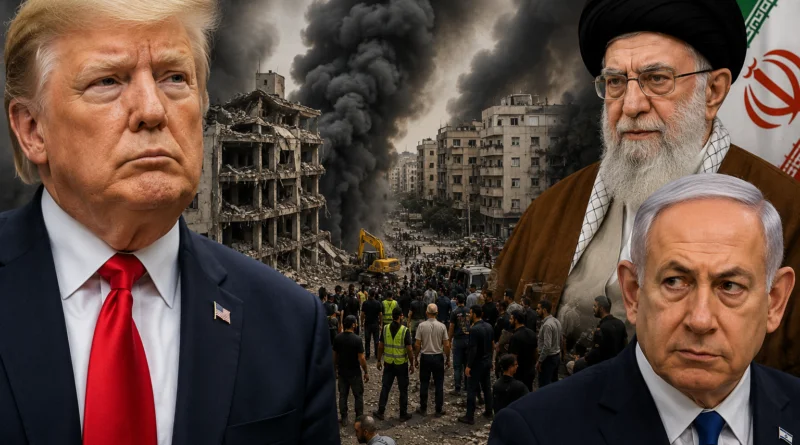
Trump Urges Calm After Beirut Strike Threatens Prospective US-Iran Peace Deal
Israeli Attack on Beirut Raises Concerns Over Fragile Diplomatic Progress
Efforts to secure a landmark agreement between the United States and Iran have been thrown into uncertainty after an Israeli air strike on the southern suburbs of Beirut sparked warnings from Tehran and raised fears that a diplomatic breakthrough could be delayed.
The strike targeted an area in the Lebanese capital associated with the Iran-backed armed group Hezbollah and came just hours before officials suggested a long-awaited agreement between Washington and Tehran could be finalized.
According to Lebanese authorities, three people were killed and at least fifteen others were injured when the attack struck the Dahieh district, a stronghold of Hezbollah in southern Beirut. Emergency services and security forces rushed to the scene as residents searched through damaged buildings and debris.
The incident immediately drew international attention because it occurred amid growing expectations that the United States and Iran were nearing an agreement aimed at reducing tensions across the Middle East.
US President Donald Trump publicly criticized the timing of the strike and urged all sides to avoid actions that could jeopardize diplomatic efforts.
Writing on social media, Trump warned that the region was closer than ever to a deal that could bring stability to several ongoing conflicts.
“Let’s not blow it,” the president wrote, describing the latest violence as an unnecessary risk to a process that many believed was approaching a successful conclusion.
Beirut Strike Leaves Dead and Injured
The Israeli attack hit Beirut’s southern suburbs on Sunday, causing significant destruction and prompting rescue operations throughout the day.
Lebanon’s civil defence agency reported that three bodies were recovered from the rubble while fifteen people were treated for injuries. Officials also said several residential buildings and businesses suffered extensive damage.
Photographs from the scene showed emergency responders, Lebanese soldiers, and local residents gathering among collapsed structures as recovery efforts continued.
The attack represented one of the most significant incidents in Beirut in recent weeks and reignited fears that Lebanon could once again become the centre of a broader regional confrontation.
For many residents, the strike served as a reminder of how quickly tensions between Israel and Hezbollah can escalate despite ongoing diplomatic efforts elsewhere in the region.
Israel Says Hezbollah Provoked the Attack
Israeli officials defended the operation, arguing that it was a direct response to threats originating from Lebanese territory earlier in the day.
The Israel Defense Forces (IDF) reported multiple impacts involving what it described as aerial targets launched toward Israeli territory. According to the military, several incidents occurred near the border with Lebanon, while another impacted an area where Israeli troops were operating in southern Lebanon.
Israeli authorities said no casualties were reported from those incidents.
Later, the military announced that it had targeted what it described as a Hezbollah command centre located in the Dahieh district of Beirut.
According to the IDF, the facility was being used to coordinate attacks against Israel.
Israel’s Foreign Ministry also rejected criticism of the operation, insisting that Hezbollah had initiated the latest escalation and continued to pose a threat to Israeli civilians.
In a statement, the ministry accused Hezbollah of carrying out attacks even after previous ceasefire arrangements and argued that Israel had the right to defend itself against ongoing security threats.
Tehran Warns Diplomatic Progress Could Be Undermined
Iranian officials reacted angrily to the Beirut strike, arguing that the attack threatened to undermine months of diplomatic efforts.
Iran’s chief negotiator suggested there was little value in continuing discussions if military actions continued against Hezbollah while negotiations were underway.
The comments reflected growing concern in Tehran that regional developments could jeopardize progress achieved during recent talks with Washington.
Iran has repeatedly insisted that any lasting agreement must address not only bilateral issues between Tehran and Washington but also broader regional conflicts, including the situation in Lebanon.
Officials in Tehran have long argued that peace in the Middle East cannot be achieved while fighting continues involving Hezbollah and Israeli forces.
The latest strike therefore raised questions about whether diplomatic momentum could survive renewed military escalation.
Iran Issues Warning of Potential Response
Tensions increased further after senior Iranian security officials warned that retaliation could follow the attack.
Mohammad Bagher Zolghadr, a senior member of Iran’s Supreme National Security Council, condemned the strike and warned that actions crossing Tehran’s red lines would not go unanswered.
He described Lebanon as strategically important to Iran and suggested that continued attacks could trigger a response from forces aligned with Tehran.
Although Iranian officials stopped short of announcing specific measures, the warning added to concerns that the situation could escalate further.
Regional analysts noted that previous exchanges between Iran, Israel, and Hezbollah have demonstrated how quickly local incidents can evolve into wider confrontations.
The comments also reinforced Tehran’s position that developments in Lebanon remain closely linked to negotiations with the United States.
Trump Pushes for Diplomatic Breakthrough
Despite the latest violence, President Donald Trump continued to express confidence that an agreement with Iran remained within reach.
Speaking to Fox News, Trump said he believed a deal could still be finalized within hours.
According to Fox News correspondent Trey Yingst, Trump revealed that he had spoken directly with Israeli Prime Minister Benjamin Netanyahu following the Beirut strike.
During the conversation, Trump reportedly urged Netanyahu not to authorize additional military action that could jeopardize negotiations.
The president’s comments suggested frustration within the White House over developments that threatened to complicate what officials had described as a promising diplomatic moment.
Observers noted that Trump had invested significant political capital in securing an agreement and had repeatedly signaled optimism about the chances of success.
His public criticism of the strike highlighted growing concern that military events on the ground could undermine diplomatic progress.
Signs of Tension Between Trump and Netanyahu
Political analysts pointed to Trump’s remarks as evidence of increasing strain between Washington and Jerusalem.
The US president has frequently emphasized his close relationship with Netanyahu and has often portrayed himself as having significant influence over Israeli decision-making.
However, Sunday’s developments appeared to challenge that perception.
Reports suggested Trump was particularly frustrated because the strike occurred at a time when negotiations with Iran seemed close to reaching a conclusion.
The timing also attracted attention because speculation had grown that a deal could be announced on Trump’s 80th birthday, allowing the president to present the agreement as a major diplomatic achievement.
Whether that objective remains achievable is now uncertain.
The latest incident has highlighted the complex relationship between military realities in the region and diplomatic efforts taking place behind closed doors.
Iran and the US Continue to Signal Progress
Despite the setback, officials from both countries have continued to indicate that negotiations remain active.
Iranian President Masoud Pezeshkian defended ongoing talks and insisted that Iran’s political leadership remained united in supporting negotiations.
He said protecting national interests remained the primary objective and stressed that major decisions continued to be coordinated through the country’s security institutions.
On the American side, Defence Secretary Pete Hegseth also expressed confidence that an agreement would eventually be reached.
Speaking to CBS, Hegseth said negotiations remained on track and described the process as a question of timing rather than possibility.
He also urged Iran to restrain Hezbollah and prevent further attacks against Israel, arguing that regional stability would be essential for any agreement to succeed.
Lebanon Remains the Biggest Obstacle
While reports suggest significant progress has been made in negotiations, Lebanon continues to represent one of the most difficult issues facing diplomats.
Iran has consistently argued that any agreement must include guarantees related to the conflict involving Hezbollah.
Israel, however, maintains that its military operations against Hezbollah are separate from negotiations concerning Iran.
This difference remains one of the most significant challenges confronting negotiators.
Analysts say the latest strike demonstrates how fragile the process remains.
Even if an agreement is signed, regional disputes involving Hezbollah, Lebanon, and Israel could continue to threaten its long-term stability.
Some Israeli commentators have also expressed concerns about reported elements of the proposed deal, arguing that it may not adequately address Israel’s security objectives.
What Could the Agreement Include?
Although the full details of the proposed framework have not been released, several reports have offered clues about what may be included.
According to officials familiar with the discussions, the agreement could involve measures designed to prevent Iran from developing nuclear weapons while also reducing tensions in key strategic areas.
One reported element involves the reopening of the Strait of Hormuz to unrestricted international shipping.
The waterway is one of the world’s most important energy routes, and disruptions there have historically affected global oil markets.
Other reports suggest Iran may agree to additional measures regarding highly enriched uranium, though details remain unclear.
Neither Washington nor Tehran has officially confirmed the final terms.
Uncertain Days Ahead
As rescue workers continued searching through rubble in Beirut and diplomats worked behind the scenes to keep negotiations alive, uncertainty continued to dominate the political landscape.
The Israeli strike has demonstrated how quickly regional tensions can complicate diplomatic efforts, even when agreements appear close.
For now, neither side has abandoned negotiations, and officials continue to signal that a deal remains possible.
However, Sunday’s events have served as a reminder that peace efforts in the Middle East remain vulnerable to sudden developments on the ground.
Whether the United States and Iran can overcome the latest obstacle may become clear in the coming days.
For a region that has endured years of instability, the outcome could have consequences far beyond Washington, Tehran, Beirut, or Jerusalem.