
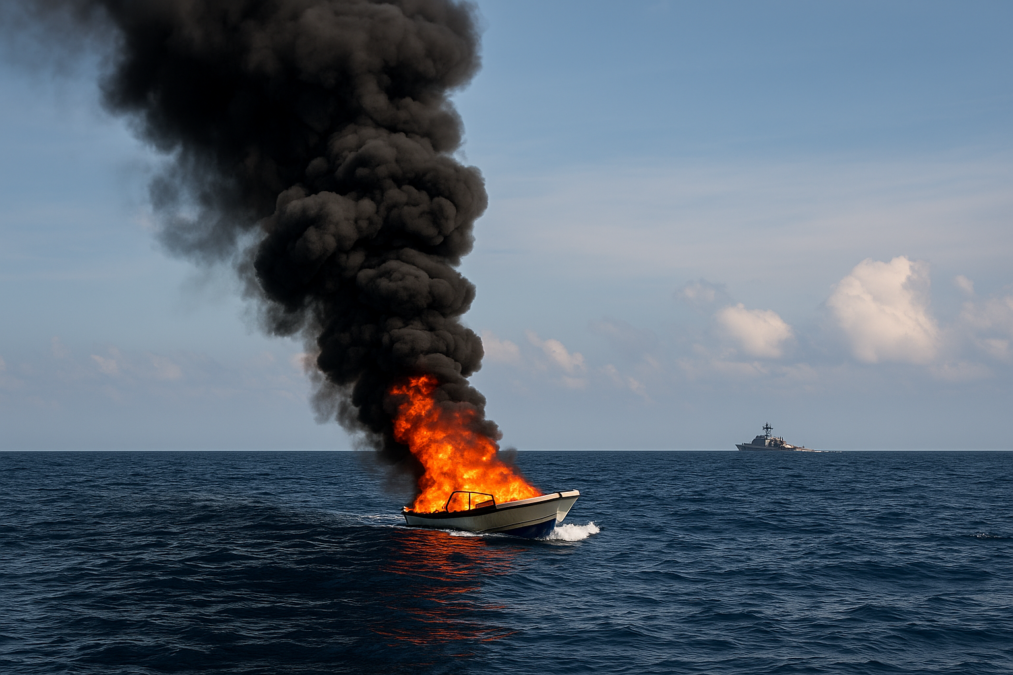
US Strikes Kill 14 on Suspected Drug Boats in Pacific, Mexico Condemns Action
Why This Matters
- The United States has dramatically expanded its campaign against drug trafficking in the Pacific and Caribbean.
- The latest operation, which killed at least 14 people aboard suspected smuggling boats, has intensified tensions between Washington and Latin American governments.
- Mexico, Colombia and Venezuela have all criticised the strikes, arguing they may violate international law.
- The operation has also triggered growing concern in the US Congress over whether President Donald Trump has the legal authority to authorise such attacks without congressional approval.
- The incident raises wider questions about whether the Trump administration is moving toward a more militarised anti-drug strategy across Latin America.
US Launches Deadly Operation in Eastern Pacific
The United States military has carried out one of its deadliest anti-drug operations in years, killing at least 14 people in a series of air and naval strikes targeting suspected trafficking boats in the eastern Pacific Ocean.
According to Defence Secretary Pete Hegseth, the strikes took place on Monday against four vessels that US intelligence had identified as part of a major narcotics-smuggling route operating across the Pacific.
The boats were reportedly intercepted roughly 400 miles southwest of Acapulco, in an area long used by trafficking networks moving cocaine and other drugs from South America toward Mexico and eventually into the United States.
Hegseth said the operation was conducted under direct orders from President Donald Trump and formed part of a broader campaign aimed at disrupting transnational cartels.
He described the vessels as “known narco-trafficking boats” and said they had been operating along established smuggling corridors used by organised crime groups.
According to the Pentagon, the first strike killed eight people aboard one of the vessels. A second operation killed four more, while a third strike killed another three people.
US officials later revised the total number of fatalities to 14 after confirming that one person initially believed dead had survived.
That individual was reportedly rescued by the Mexican Navy, which continues to search the area.
“The Department has spent more than two decades defending other nations’ borders,” Hegseth wrote on social media. “Now, we are defending our own.”
He accompanied the statement with footage that appeared to show several small boats exploding and burning after being hit by US munitions.
The videos quickly circulated online, drawing praise from some supporters of the administration and outrage from critics who questioned whether those aboard the vessels had been given any opportunity to surrender.
Mexico Confirms Rescue Operation
Mexico’s Navy, known as SEMAR, confirmed that it had sent a patrol vessel and surveillance aircraft to the scene after the strikes.
In a brief statement, SEMAR said the operation was carried out in order to “safeguard human life at sea” and assist any survivors.
Mexican authorities did not identify the survivor or provide details about the condition of those recovered from the area.
Officials also did not publicly confirm whether the vessels were in international waters or inside Mexico’s exclusive economic zone.
That question may become crucial as the diplomatic dispute deepens.
If the boats were operating inside waters claimed by Mexico, critics argue the strikes could represent a significant violation of Mexican sovereignty.
Even if the vessels were in international waters, legal experts say the use of lethal force without attempts at arrest or interception may still violate international law.
Mexico has worked closely with the United States for decades on anti-drug operations.
However, relations between the two countries have become increasingly strained under Trump’s second presidency.
The administration has adopted a far more aggressive approach toward Latin American cartels, repeatedly suggesting that military force may be necessary.
Trump has described the cartels as “terrorist organisations” and has argued that the United States must be prepared to act beyond its borders if neighbouring countries cannot stop drug trafficking.
Monday’s strikes appear to be the clearest sign yet that the White House is willing to move from surveillance and interception to direct military action.
Mexico Condemns the Strikes
Mexican President Claudia Sheinbaum reacted sharply to the operation.
Speaking at a press conference in Mexico City, she said her government “does not agree with these attacks” and warned that all international agreements must be respected.
“We want all international treaties to be respected,” Sheinbaum said. “Mexico does not support actions of this kind.”
She confirmed that Mexico’s foreign ministry and senior navy officials had requested an urgent meeting with the US ambassador.
The purpose of the meeting, she said, was to clarify what happened, determine whether Mexican territory or waters had been involved, and demand greater transparency from Washington.
Sheinbaum has repeatedly argued that cooperation against organised crime must remain based on intelligence-sharing, policing and judicial cooperation rather than unilateral military action.
Her government fears that if the United States begins carrying out direct strikes near Mexican territory, it could set a precedent for future operations.
Some Mexican officials are concerned that Washington may eventually seek to target cartel infrastructure on land.
Trump has already suggested that possibility.
Earlier this month, he said he was “totally prepared” to expand operations to include land-based cartel targets if necessary.
Such a move would represent a major escalation and would almost certainly provoke fierce opposition from Mexico.
A Growing Regional Campaign
The latest strikes are not an isolated incident.
They form part of a wider campaign launched by the Trump administration in recent months across both the Pacific and Caribbean.
The Pentagon says the campaign is designed to cut off drug-trafficking routes before narcotics reach North America.
US officials argue that traditional methods, including arrests and seizures, have failed to reduce the flow of drugs into the United States.
As a result, the administration has turned increasingly toward military force.
Since the beginning of the campaign, at least 57 people are believed to have been killed in US strikes targeting suspected traffickers.
The operations have involved drones, surveillance aircraft, naval patrols and warships.
Several incidents have occurred in waters near Colombia, Venezuela and Central America.
US officials insist the people targeted were involved in organised criminal networks.
However, there has been little publicly available evidence about the identities of those killed.
The Pentagon has not released names, photographs or intelligence assessments linking the victims to specific cartels.
That lack of transparency has fuelled criticism from human rights organisations and foreign governments.
Critics argue that the United States appears to be carrying out targeted killings without trial.
Congress Questions Trump’s Authority
The strikes have also provoked growing concern inside the United States.
Members of Congress from both parties have questioned whether Trump has the authority to order military attacks in international waters without explicit approval from lawmakers.
Under the US Constitution, Congress has the power to declare war.
Presidents can authorise limited military action in certain circumstances, particularly when defending US forces or responding to immediate threats.
However, legal experts say it is far less clear whether that authority extends to attacking suspected drug traffickers outside US territory.
Several lawmakers have demanded a classified briefing from the White House and the Pentagon.
They want to know what legal justification was used and whether the administration believes the campaign falls under existing anti-terrorism or national security powers.
Some members of Congress fear that the White House may be attempting to create a precedent for broader military operations in Latin America.
“This is not a normal anti-drug operation,” one senator said. “This is the use of lethal military force against individuals who have not been charged, arrested or tried.”
Others have warned that the administration risks bypassing Congress entirely.
The debate has revived memories of earlier disputes over US military actions overseas, including drone strikes and counter-terrorism campaigns.
Critics say the anti-drug campaign now resembles a form of undeclared war.
International Law Experts Raise Alarm
International legal scholars have expressed even stronger concerns.
Mary Ellen O’Connell, a professor at Notre Dame University and a specialist in international law, said the operation could amount to an unlawful use of force.
“Summarily executing people suspected of drug trafficking is a greater crime than the act of trafficking itself,” she said.
“Criminal suspects are entitled to due process.”
O’Connell and other experts argue that individuals accused of crimes should, whenever possible, be arrested and brought before a court.
The use of lethal force is generally only considered lawful if there is an immediate threat to life.
In this case, critics argue that the boats do not appear to have posed an immediate military threat to the United States.
The people aboard may have been suspected traffickers, but there is no indication they were firing on US forces or engaging in combat.
As a result, some scholars believe the strikes may violate both international humanitarian law and international human rights law.
Human rights organisations have also criticised the operation.
Several groups said the administration appears to be using military power in place of law enforcement.
“This looks less like a counter-narcotics operation and more like an execution carried out from the air,” one analyst said.
The White House rejects those claims.
Officials argue that the cartels have become so powerful and violent that they should be treated as transnational security threats.
The administration says the boats were operating as part of organised criminal networks responsible for flooding the United States with drugs.
Colombia and Venezuela Join Criticism
Mexico is not the only country condemning the strikes.
Colombia and Venezuela have also criticised the operation and accused the United States of violating international norms.
Colombian Deputy Foreign Minister Mauricio Jaramillo said those aboard the boats had been attacked “without judicial order or due process”.
He warned that the use of military force in international waters could create a dangerous precedent.
Colombia has long been one of Washington’s closest allies in Latin America on counter-narcotics issues.
However, relations have become increasingly tense under President Gustavo Petro.
Petro has criticised the Trump administration’s approach and argued that militarisation will not solve the drug trade.
The White House has responded by accusing Petro of failing to control Colombian cartels.
Earlier this month, the United States imposed sanctions on Petro and several Colombian officials.
Washington said Colombia had not done enough to stop drug production and trafficking.
The move caused a sharp deterioration in relations between the two countries.
Venezuela has reacted even more strongly.
The country’s attorney general accused Washington of using the anti-drug campaign as a cover for wider geopolitical ambitions.
He claimed the United States was trying to destabilise the region and gain greater influence over natural resources, including Venezuela’s oil and gold reserves.
The Trump administration rejects those accusations.
Washington continues to refuse recognition of Venezuelan President Nicolás Maduro, whose disputed 2024 re-election was widely criticised by Western governments.
The hostility between Washington and Caracas means that any expansion of the campaign near Venezuelan waters could become particularly dangerous.
USS Gerald R. Ford Sent to the Region
The latest strikes come as the United States increases its military presence across the region.
Last week, the US Navy deployed the USS Gerald R. Ford, the largest warship in the American fleet, to waters near the Caribbean and eastern Pacific.
The aircraft carrier is capable of launching fighter jets, helicopters and surveillance aircraft.
Its arrival was widely seen as a signal that the administration intends to continue and possibly expand the campaign.
The Pentagon has also increased the number of naval patrols, surveillance drones and military aircraft operating near major trafficking routes.
Additional troops have reportedly been sent to bases in Puerto Rico, southern Florida and other strategic locations.
Supporters of the policy say the stronger military presence is necessary because cartels now possess advanced weapons, semi-submersible vessels and international networks.
Critics argue that sending major warships against traffickers risks transforming a law-enforcement issue into a military confrontation.
Some fear that heavily armed US vessels operating close to Latin American territory could eventually lead to a direct diplomatic or military incident.
Could Trump Expand the Campaign Further?
President Trump has repeatedly defended the strikes.
He says he has the authority to act in international waters and insists the operations are necessary to protect the United States.
According to Trump, cartels represent one of the greatest threats facing the country.
“They are poisoning our people and killing our communities,” he said earlier this month.
He has also hinted that the campaign may not stop at sea.
Trump said he would be prepared to authorise strikes against cartel facilities on land if Congress approved such action.
That possibility alarms many observers.
A campaign against land targets could involve operations in Mexico, Colombia or other countries.
Such a move would raise major questions about sovereignty and could trigger a severe regional crisis.
Even some Republicans have expressed caution.
They support stronger action against drug trafficking but worry that military operations inside another country could draw the United States into a prolonged conflict.
A Dangerous Turning Point
The latest strikes represent a turning point in the way the United States approaches the fight against drugs.
For decades, Washington has relied mainly on intelligence-sharing, police cooperation and sanctions.
Now, the Trump administration appears increasingly willing to use direct military force.
Supporters argue that the traditional approach has failed and that stronger action is required.
Critics say the administration is crossing a dangerous line.
They warn that the deaths of suspected traffickers without trial could undermine international law, increase anti-American sentiment and damage relations across Latin America.
There are also fears that civilians could be caught in future operations if intelligence proves wrong.
For now, the Pentagon insists the strikes were justified and successful.
But the diplomatic fallout is growing.
Mexico has demanded answers. Colombia and Venezuela have condemned the operation. Congress is asking questions. Legal experts are warning of possible violations.
The coming days may determine whether Monday’s strikes remain an isolated operation or become the beginning of a far wider and more controversial campaign.