
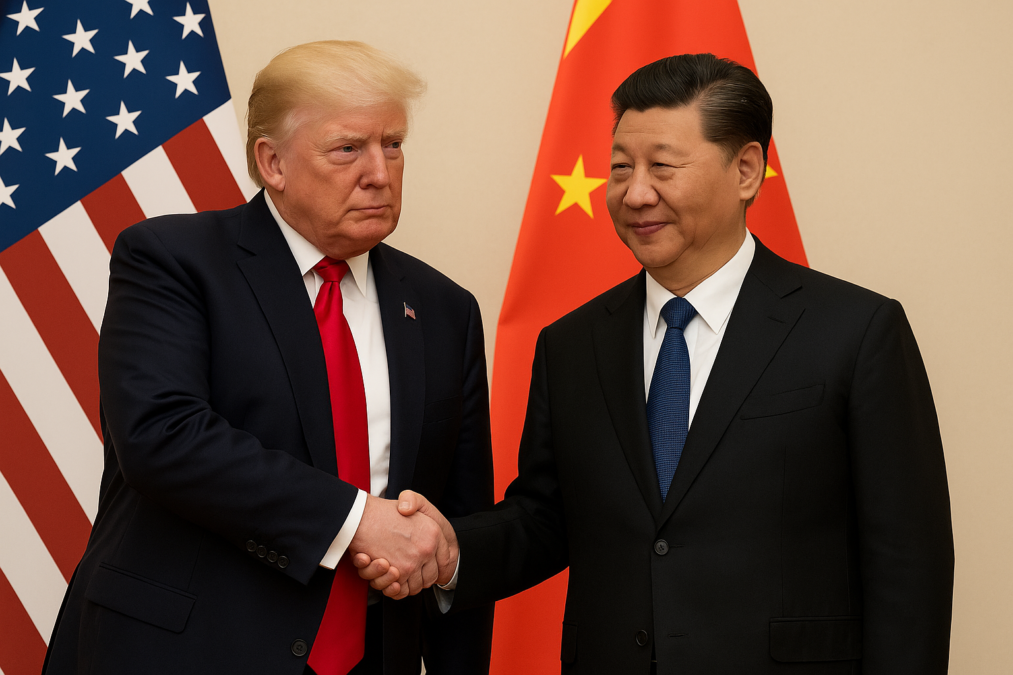
Trump Seeks China’s Help to Push Russia Toward Ukraine Peace Talks
Why This Matters
- Donald Trump is attempting to involve China directly in efforts to end the war in Ukraine.
- Beijing has significant influence over Moscow because of its economic and political ties with Russia.
- Ukraine faces a difficult military and diplomatic moment as Western support becomes more uncertain.
- Any Chinese involvement could reshape the balance of power between Washington, Moscow and Kyiv.
- Analysts remain deeply sceptical that China would pressure Russia unless it also serves Beijing’s strategic interests.
Trump Turns to China in Search of a Breakthrough
US President Donald Trump has expressed his desire for China to help persuade Russia. He wants Russia to enter serious peace talks over the war in Ukraine. This begins a new diplomatic front. He is trying to end a conflict that has lasted for more than three years.
Trump spoke to reporters aboard Air Force One while travelling to Asia. He said he intends to raise the issue directly with Chinese President Xi Jinping. This will occur during a meeting in South Korea.
“I’d like China to help us out with Russia,” Trump said. “I have a very good relationship with President Xi. Very good. I think he also wants to see this war end.”
The comments mark a clear sign. The Trump administration believes traditional Western pressure on Moscow has not delivered results. Instead, Washington is now looking toward Beijing, Russia’s closest major ally. They hope that China could use its influence to move President Vladimir Putin toward negotiations.
Trump has repeatedly promised to end the war in Ukraine. He has described the conflict as one of the greatest threats to global stability. However, nearly a year into his renewed presidency, he has struggled to secure meaningful progress.
His attempts to build a direct line with Putin have produced little more than public statements and temporary optimism. Trump has spoken several times of his “good conversations” with the Russian leader. However, he admitted this week that such talks have not translated into real movement.
“Every time I speak to Vladimir, we have good conversations, and then nothing happens,” Trump said.
The frustration appears to have led the White House to consider whether Xi could succeed where Trump has not.
Why China Matters More Than Any Other Country
China is perhaps the only country outside Russia itself with enough economic and political leverage to influence Kremlin decision-making.
Since Russia launched its full-scale invasion of Ukraine in 2022, Beijing has become Moscow’s most important international partner. As Western countries imposed sanctions and cut economic ties with Russia, China stepped in.
Chinese companies dramatically increased purchases of Russian oil and gas. Trade between the two countries reached record levels. China became a key supplier of industrial components. China also provided electronics and other goods. These were items that Russia struggled to obtain from Europe and the United States.
Western governments have accused Beijing of helping Russia sustain its war effort. They do this by exporting dual-use items. These products can be used for civilian purposes but also have military applications.
These include microchips, machine tools, drones, navigation systems and specialised manufacturing equipment.
China has repeatedly denied helping Russia militarily. Beijing insists it is neutral in the conflict and says it supports peace talks. Chinese officials argue that they have not supplied weapons to either side and accuse Western governments of exaggerating China’s role.
Nevertheless, analysts say there is little doubt that Russia has become increasingly dependent on China.
“Without Chinese trade and financial support, Russia would face a much more difficult economic situation,” said one former European diplomat. “The Kremlin may not follow Chinese instructions, but Beijing certainly has more influence over Moscow than any Western government does.”
That influence is exactly what Trump hopes to use.
A Difficult Week for Ukraine
Trump’s appeal to Xi comes at a particularly difficult moment for Ukraine.
Kyiv has endured one of its most challenging weeks in months, both on the battlefield and diplomatically.
The United States declined a Ukrainian request for Tomahawk cruise missiles, one of Kyiv’s most sought-after weapons systems. Officials in Washington reportedly concluded that providing such long-range missiles would risk further escalation with Russia.
At the same time, European Union leaders delayed a decision on whether to release additional frozen Russian assets to help fund Ukraine’s defence.
The delay disappointed Ukrainian officials, who had hoped Europe would move more quickly as the war enters another winter.
Meanwhile, Russia intensified its air campaign.
Over the past several days, Russian missiles and drones have struck multiple Ukrainian cities, including Kyiv, Kharkiv, Dnipro and Odesa. Ukrainian authorities said several people were killed in attacks on residential areas and energy infrastructure.
Emergency crews worked through the night in parts of Kyiv after one strike damaged apartment buildings and caused major fires.
Ukrainian President Volodymyr Zelensky described the latest attacks as further evidence that Russia has no genuine interest in peace.
“No country should face such evil alone,” Zelensky wrote on Telegram. “Ukraine needs stronger support, stronger air defences and stronger pressure on Russia.”
The renewed violence has increased pressure on Trump to demonstrate that his diplomacy can achieve results.
Trump’s Peace Strategy Faces Growing Questions
Trump entered office promising that he could end the war quickly.
During the election campaign, he repeatedly suggested he could secure a ceasefire within weeks. He claimed this was because of his personal relationships with both Putin and Zelensky.
However, the reality has proved far more difficult.
In August, Trump met Putin at a high-profile summit that many hoped could become a turning point. The meeting ended without any major breakthrough.
No ceasefire was agreed. No new negotiating process was announced. Instead, the two sides left with sharply different positions.
Russia continued to insist that Ukraine must accept territorial losses and agree not to join NATO. Ukraine rejected those demands and said it would not negotiate under military pressure.
Since then, Trump has tried to balance pressure and diplomacy.
On Wednesday, his administration announced sanctions on Russia’s two largest oil companies. It was the first major new economic measure imposed by Washington against Moscow since the beginning of the war.
The White House said the sanctions were intended to increase pressure on the Kremlin and demonstrate that the United States was prepared to act if Russia refused to negotiate.
Russia dismissed the move.
Kremlin spokesman Dmitry Peskov said Moscow had already adapted to years of Western sanctions and was effectively “immune” to further economic pressure.
Russian officials argued that the new measures would have little impact because Russia had already redirected much of its energy trade toward China, India and other non-Western countries.
That response may be one reason why Trump is increasingly focused on China.
If Beijing remains willing to support Russia economically, Western sanctions alone may not be enough to force the Kremlin to change course.
Xi Jinping Holds the Balance
Trump’s meeting with Xi is expected to focus largely on trade, tariffs and the broader US-China relationship.
But the Ukraine war is now expected to become one of the central topics.
Earlier this week, Trump suggested that Xi has far greater influence over Putin than many people realise.
“He has a lot of power over Russia,” Trump said. “They’re very close. Maybe closer than people understand.”
There is some evidence to support that view.
Over the past three years, Xi and Putin have met frequently and publicly described their countries as strategic partners.
In 2022, shortly before Russia launched its invasion of Ukraine, China and Russia declared a “friendship without limits”.
Since then, the two leaders have continued to strengthen political, economic and military cooperation.
Last month, Putin, Xi and North Korean leader Kim Jong Un appeared together in Beijing in a striking show of unity.
The meeting included military ceremonies, public speeches and discussions on security cooperation.
For many Western governments, the gathering appeared to underline the emergence of a new bloc led by China and Russia.
That is one reason why many analysts doubt Beijing will be eager to help the United States.
China may want to avoid a prolonged and unstable war in Europe, particularly because the conflict has disrupted global trade and increased tensions with the West.
But Beijing also benefits from a Russia that depends heavily on China.
The longer Russia remains isolated from Europe, the more reliant it becomes on Chinese markets, Chinese investment and Chinese political support.
“China has influence over Russia, but that does not mean China will use it in the way Washington hopes,” said one Asia analyst. “Beijing’s first priority is advancing its own interests.”
What China Could Realistically Do
Even if Xi does decide to become more involved, there are limits to what China can achieve.
Beijing is unlikely to publicly pressure Putin or threaten to cut economic ties. Such a move would damage China’s strategic partnership with Russia and could be seen as a major humiliation for the Kremlin.
Instead, analysts say China would be more likely to work quietly behind the scenes.
Xi could encourage Putin to agree to a temporary ceasefire, prisoner exchange or new diplomatic talks.
China could also present itself as a mediator and attempt to organise discussions between Russia and Ukraine.
Beijing has tried something similar before.
In 2023, China published a twelve-point proposal for ending the war. The plan called for a ceasefire, negotiations and respect for national sovereignty. However, Western governments criticised the proposal for failing to demand a Russian withdrawal from occupied territory.
Ukraine also viewed the Chinese plan cautiously, arguing that it risked freezing the conflict on terms favourable to Moscow.
This time, China may see an opportunity to improve its global image.
By helping to broker talks, Xi could present China as a responsible world power capable of solving major international crises.
That would also strengthen Beijing’s position at a time when relations with Washington remain tense over trade, Taiwan and technology.
However, any Chinese role would likely come with conditions.
Beijing could seek concessions from the United States on tariffs, export restrictions or other areas of disagreement.
Trump may therefore find that asking China for help on Ukraine comes with a political price.
Ukraine Fears Being Sidelined
In Kyiv, there is growing concern that discussions between Washington, Beijing and Moscow could leave Ukraine in a weaker position.
Ukrainian officials have repeatedly insisted that no decisions about Ukraine should be made without Ukraine itself.
There are fears that Trump’s desire for a quick agreement could result in pressure on Kyiv to accept a ceasefire that leaves Russia in control of occupied territory.
Zelensky has made clear that Ukraine will not accept any peace deal imposed from outside.
He has said repeatedly that a lasting settlement must include the return of occupied land, security guarantees and accountability for Russian actions.
Some Ukrainian officials also worry that China cannot be trusted to act as a neutral mediator because of its close relationship with Russia.
“China is not an independent actor in this conflict,” one Ukrainian lawmaker said. “China has supported Russia economically and politically from the beginning.”
Even so, Ukraine may have little choice but to pay attention to the discussions.
If China does become more active, it could significantly shape the next phase of the conflict.
Continued Fighting on Both Sides
While leaders prepare for diplomacy, the fighting continues.
As Trump spoke aboard Air Force One, Ukrainian emergency services were responding to fresh Russian strikes in Kyiv.
Officials said several people were killed and dozens more injured.
Buildings, roads and power systems were damaged.
At the same time, Russia accused Ukraine of carrying out an attack in the Belgorod region.
Authorities ordered residents near a local dam and reservoir to evacuate after Ukrainian strikes reportedly damaged the area.
Russian officials warned there was a risk of flooding if the reservoir collapsed.
The incident illustrated how the war is increasingly affecting communities on both sides of the border.
Despite growing talk of negotiations, neither side appears ready to stop fighting.
Russia continues to believe that time is on its side.
Ukraine hopes that additional Western support and continued resistance will eventually force Moscow to reconsider.
For now, Trump is betting that China may provide the missing piece.
Xi’s willingness to use his influence may determine the war’s outcome. Putin’s willingness to listen is also crucial. These factors may move the war closer to peace or into another dangerous phase.