
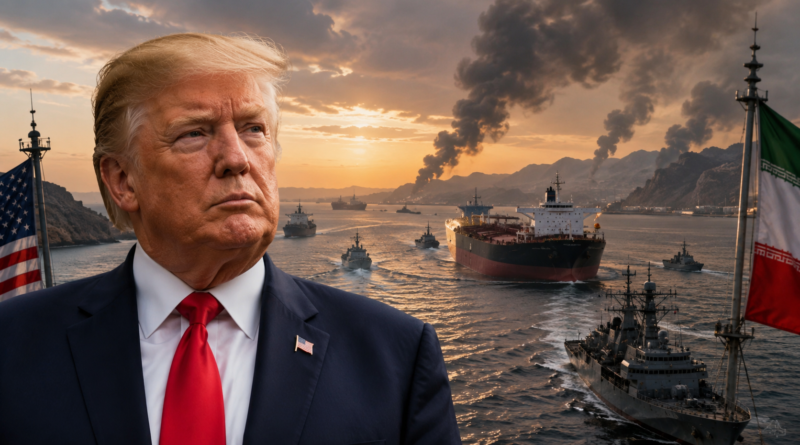
Trump Rejects Iran’s War Proposal as Tensions Over Hormuz and Nuclear Programme Intensify
Trump Rejects Iran Deal as diplomatic tensions between Washington and Tehran continue to grow over the Strait of Hormuz crisis and ongoing ceasefire negotiations.
The fragile diplomatic efforts aimed at ending months of conflict between Iran, Israel, and the United States appear increasingly uncertain after President Donald Trump publicly dismissed Tehran’s latest proposal for a ceasefire and broader negotiations.
Speaking through a post on Truth Social, Trump described Iran’s response to American proposals as “totally unacceptable”, signalling that major disagreements remain despite weeks of indirect diplomacy and an uneasy reduction in military activity across the region.
The remarks come at a critical moment in the conflict, with the Strait of Hormuz still partially blocked, international oil markets under pressure, and multiple countries preparing new naval operations in the Gulf.
Iran, meanwhile, insists it will not negotiate under pressure and has warned neighbouring states against assisting any expanded Western military presence near its territorial waters.
The latest exchange has renewed fears that the conflict, temporarily slowed by a fragile ceasefire, could once again escalate into wider regional warfare.
Why Trump Rejects Iran Deal With Tehran
According to officials familiar with the negotiations, Iran recently delivered a revised proposal through Pakistani mediators as part of ongoing indirect talks with Washington.
Pakistan has quietly emerged as one of the few governments maintaining communication channels with both Tehran and Washington since direct diplomatic relations remain frozen.
Iran’s proposal reportedly included several core demands:
- an immediate end to military operations by all sides
- guarantees against future attacks on Iranian territory
- compensation for infrastructure damage caused during the war
- the removal of US naval restrictions around Iranian ports
- recognition of Iranian sovereignty over the Strait of Hormuz
Tehran also reportedly sought a phased reduction of sanctions in exchange for future negotiations over its nuclear activities.
However, the White House appears unwilling to accept several of those conditions.
Trump’s public rejection of the proposal marks the clearest sign yet that the diplomatic process may be entering another period of stalemate.
“I have just read the response from Iran’s so-called representatives,” Trump wrote online. “I don’t like it, totally unacceptable.”
The White House has not released the full contents of the American proposal, but reports from US media suggest Washington’s terms include a suspension of uranium enrichment, the restoration of commercial shipping access through Hormuz, and expanded international monitoring of Iran’s nuclear infrastructure.
Officials have also reportedly discussed conditional sanctions relief if Tehran agrees to long-term nuclear restrictions.
Neither side has officially confirmed the full details of the negotiations.
A Ceasefire Holding – But Barely
Despite the diplomatic tensions, the ceasefire established last month has largely held across much of the region.
The reduction in direct missile exchanges between Iranian forces and the US-Israeli coalition has allowed some humanitarian aid to reach affected areas and temporarily eased fears of an immediate wider war.
Yet military incidents continue to occur almost daily.
Naval confrontations, drone interceptions, cyber attacks, and sporadic strikes on strategic positions have all continued at lower intensity levels.
Regional observers warn that the ceasefire resembles a pause rather than a true peace agreement.
Several analysts believe both sides are attempting to regroup militarily while simultaneously testing diplomatic options.
The conflict began after coordinated US and Israeli strikes targeted Iranian military and nuclear infrastructure earlier this year. Washington and Tel Aviv argued the attacks were necessary to prevent Iran from rapidly expanding its nuclear programme and threatening regional security.
Iran responded with missile launches, drone attacks, and the disruption of shipping traffic through the Strait of Hormuz, one of the world’s most important maritime trade routes.
Since then, the confrontation has drawn in multiple regional powers and triggered fears of global economic disruption.
Netanyahu Demands Full Nuclear Dismantlement
Israeli Prime Minister Benjamin Netanyahu has continued to adopt a far more uncompromising tone than some Western allies.
In a televised interview broadcast in the United States, Netanyahu argued that the conflict cannot truly end unless Iran’s nuclear capabilities are dismantled entirely.
“There are still enrichment facilities that have to be removed,” he said.
Israeli officials remain deeply sceptical of any agreement that would allow Iran to continue uranium enrichment at any level.
Israel has long viewed Iran’s nuclear programme as an existential threat, despite Tehran repeatedly insisting that its activities are intended for civilian energy production and scientific research.
Western intelligence agencies have warned in recent years that Iran has significantly expanded its stockpile of highly enriched uranium, though Tehran denies seeking nuclear weapons.
The issue of enrichment remains one of the largest obstacles in negotiations.
Iran insists it has the sovereign right to pursue peaceful nuclear technology under international law.
The United States and its allies argue that current enrichment levels exceed civilian requirements and create the risk of rapid weaponisation.
Strait of Hormuz Remains at the Centre of Crisis
One of the most dangerous flashpoints remains the Strait of Hormuz.
The narrow waterway connects the Persian Gulf to the Arabian Sea and handles roughly one-fifth of the world’s oil and liquefied natural gas exports.
Since the conflict intensified, commercial shipping traffic through the route has slowed dramatically.
Insurance costs for vessels operating in the area have surged, while several shipping companies have temporarily suspended operations altogether.
Oil prices have climbed sharply in recent weeks as traders fear a prolonged disruption.
Iran has repeatedly warned that foreign naval activity in the region could provoke further escalation.
Military spokesperson Mohammad Akraminia stated that vessels failing to coordinate with Tehran could face “serious consequences”.
Iranian officials also accused the United States of attempting to impose an illegal maritime blockade around Iranian ports.
Washington argues its naval operations are intended to pressure Tehran economically and protect international shipping routes.
The US Navy has significantly increased its presence across the Gulf in recent months, operating alongside allied forces stationed in Bahrain, Qatar, Kuwait, Saudi Arabia, and the United Arab Emirates.
European Powers Consider Security Mission
Britain and France are now leading discussions over a possible multinational maritime security operation once major fighting subsides.
British Defence Secretary John Healey and French officials are expected to chair meetings involving more than 40 countries to discuss future protection for commercial shipping in the Gulf.
The proposed mission would focus on escorting vessels and monitoring threats near Hormuz.
However, the initiative has already triggered warnings from Tehran.
Iranian authorities stated that any British or French deployment near the strait would receive a “decisive and immediate response” if viewed as hostile.
French President Emmanuel Macron later attempted to reduce tensions by insisting that Paris was not planning an aggressive naval operation but rather a co-ordinated security framework intended to stabilise maritime traffic.
British Prime Minister Sir Keir Starmer has also stressed that any mission would likely depend on a broader regional ceasefire remaining in place.
Civilian Shipping Incidents Raise Alarm
Concerns over maritime security intensified further after several incidents involving commercial vessels near the Gulf.
The UK Maritime Trade Operations Centre reported that a cargo ship north-east of Doha suffered damage after being struck by what officials described as an “unknown projectile”.
A small fire broke out onboard, though no casualties were reported.
Iranian media later claimed the vessel had connections to the United States, though these reports remain unverified.
Separately, Kuwait announced that drones had entered its airspace and had been intercepted by military forces.
The United Arab Emirates later reported intercepting two additional drones approaching from the direction of Iran.
Such incidents have increased fears that miscalculations or accidental engagements could rapidly trigger a wider confrontation involving Gulf states.
Trump Insists Conflict Can End Quickly
Despite the growing uncertainty, Trump has continued to insist that the war could end rapidly if Iran accepts American conditions.
Earlier this week, he repeated that the conflict would be “over quickly” if Tehran agreed to negotiate under terms acceptable to Washington and its allies.
However, critics argue that the administration’s demands may be unrealistic given Iran’s current political climate.
Iranian President Masoud Pezeshkian has adopted increasingly defiant rhetoric in recent days.
“We will never bow our heads before the enemy,” he said during a public speech.
“If dialogue happens, it does not mean surrender.”
The comments reflect growing pressure inside Iran from hardliners who oppose concessions to the United States following months of air strikes, economic restrictions, and military losses.
Political divisions inside Tehran may now complicate negotiations further.
Economic Impact Spreading Worldwide
The conflict’s impact is no longer limited to the Middle East.
Energy markets remain volatile, with oil prices fluctuating sharply after every major development.
Several European governments have warned that prolonged instability around Hormuz could worsen inflation and disrupt global supply chains already weakened by previous crises.
Shipping companies have also reported major delays and increased operating costs due to rerouted cargo traffic.
Insurance firms are demanding higher premiums for vessels operating near Gulf waters.
Analysts warn that even a partial long-term disruption to Hormuz traffic could affect fuel prices, manufacturing costs, and food distribution across multiple continents.
Asian economies heavily dependent on Gulf energy imports are particularly vulnerable.
China, India, Japan, and South Korea have all reportedly urged restraint privately while increasing contingency planning for potential supply disruptions.
Questions Over Long-Term Strategy
The conflict has also reignited debate over long-term American involvement in the Middle East.
In a surprising development, Netanyahu stated that Israel should eventually reduce its dependence on US military funding.
Israel currently receives billions of dollars annually in American defence assistance.
Netanyahu suggested that support should gradually decline over the next decade.
The remarks generated significant political discussion in both Washington and Tel Aviv, where questions continue over future military strategy and alliance structures.
Some analysts believe the statement reflects concerns that prolonged dependence on American assistance may become politically difficult in future US administrations.
Others view it as symbolic messaging intended to reinforce Israel’s image of military independence during wartime.
What Happens Next?
For now, the situation remains highly unstable.
Diplomatic contacts continue behind closed doors, but public rhetoric from all sides has hardened considerably.
The ceasefire remains fragile.
Military forces across the Gulf remain on high alert.
Commercial shipping through Hormuz has not returned to normal levels.
And the core disputes, Iran’s nuclear programme, sanctions, regional security, and maritime control, remain unresolved.
Much may now depend on whether mediators can prevent further military incidents while pushing both sides back toward negotiations.
The coming days could prove decisive.
If diplomacy collapses completely, regional officials fear the conflict could rapidly expand again, drawing in additional states and placing even greater pressure on the global economy.
For millions watching around the world, the question is no longer simply whether tensions can be reduced, but whether the fragile pause in fighting can survive long enough for meaningful negotiations to begin at all.
Why This Moment Matters
The latest breakdown in negotiations suggests that neither Washington nor Tehran is yet prepared to compromise on the core issues driving the conflict.
While the ceasefire has reduced the scale of direct military attacks, the continued standoff over nuclear enrichment and control of the Strait of Hormuz means the risk of escalation remains extremely high.
In my view, the most dangerous aspect of the crisis is not necessarily a single military strike, but the possibility of miscalculation. With warships, drones, and regional forces operating in close proximity across the Gulf, even a limited incident could rapidly spiral into a much wider confrontation.
If diplomatic efforts fail in the coming days, the economic consequences could extend far beyond the Middle East, affecting fuel prices, global trade, and international stability.
— Julia M, Fast Daily News