
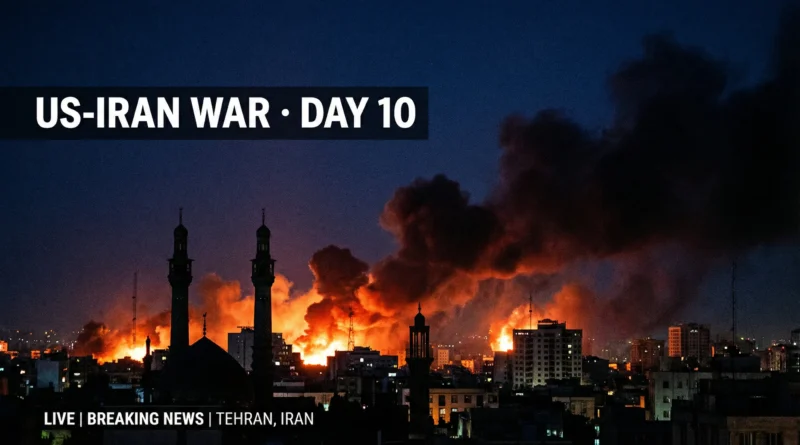
Unprecedented Escalation: Pentagon Vows “Most Intense” Day of Strikes on Iran as Tehran Residents Describe Nights of Terror
The United States has pledged its heaviest bombardment yet on Iranian territory. The ten-day-old conflict is deepening across the Middle East. Iran’s top security official has issued a personal threat to President Trump. Meanwhile, global energy markets reel from the disruption of Strait of Hormuz shipping.

Fires rage across Tehran. Vast plumes of smoke rise above the Iranian capital. This follows overnight airstrikes targeting oil infrastructure and military installations.
Key Developments
- U.S. Defense Secretary Pete Hegseth announces the “most intense” day of strikes yet, with the largest deployment of fighters and bombers to date.
- Iran’s ballistic missile launches have dropped 90% and one-way drone attacks by 83% since the campaign began, according to the Pentagon.
- Iran’s top security official Ali Larijani warns President Trump to “be careful, so that you won’t get eliminated.”
- British warship HMS Dragon departs Portsmouth, heading to the Eastern Mediterranean amid growing regional instability.
- Brent crude oil falls to ~$88/barrel after Trump signals possible talks, down from Monday’s peak of ~$119.
- Russia’s daily fossil fuel export earnings surge 14% above February averages, according to energy analysts.
- UAE air defences have intercepted a cumulative total of 241 ballistic missiles and 1,385 drones since the war began.
The United States military is prepared to launch its most formidable wave of strikes on Iranian territory. This is the most aggressive action since the conflict began ten days ago. Defense Secretary Pete Hegseth made this declaration at a Pentagon press conference on Tuesday. Hegseth stood alongside General Dan Caine, the Chair of the Joint Chiefs of Staff. He confirmed that the day’s operations would involve the largest number of fighter aircraft. Bombers and coordinated strikes are part of the entire campaign.
“Iran stands alone. They are badly losing,” Hegseth told reporters. He framed the escalation as a sign of American resolve rather than desperation. He added that Iran’s regional proxies were under sustained military pressure. This includes Hezbollah, the Houthis, and Hamas. They had been rendered “either broken, ineffective or on the sidelines.”

Pete Hegseth addresses journalists at the Pentagon, vowing the most intense day of strikes yet.
General Caine provided a detailed assessment of the campaign’s progress. U.S. Central Command has struck more than 5,000 targets since the operation commenced on 28 February, destroying over 50 Iranian naval vessels and hitting multiple drone manufacturing facilities. He reported that ballistic missile attacks from Iranian forces had declined by 90%. Additionally, one-way attack drone launches had fallen by 83% compared with the opening days of the war.
Voices from Tehran: “The Idea of No Future”
Military officials in Washington speak of battlefield progress. However, the lived reality for millions of Iranians is one of unrelenting fear. Residents of Tehran describe a city transformed by war. Its nights are punctuated by the thunder of explosions. Its skies are darkened by the smoke of burning oil depots. Its streets are emptied by the constant threat of incoming strikes.
“We feel overwhelmed, we feel anxious and exhausted, and the idea of no future is looming large over us.”— Amir, a Tehran resident (name changed for protection)
One resident, speaking under a pseudonym to protect his safety, described the psychological weight of living under bombardment. “This is my city,” he said, “and I do not want to leave Tehran under any circumstances.” Another Iranian, Adel, had been visiting relatives. He found himself stranded near the Turkish border. He expressed a simpler wish: “I just hope that the people of Iran can finally be free from war.”

Destruction in central Iran — Emergency workers survey the wreckage of buildings struck during recent U.S.-Israeli air operations.
Journalists verified dramatic footage from the city of Karaj , approximately 13 kilometres west of the capital. It showed the rear windscreen of a moving taxi shattering from the shockwave of a nearby explosion. The passenger, audibly terrified, urges the driver to accelerate as at least half a dozen blasts ring out in quick succession. “They’ve destroyed the whole town,” he shouts. The target of the strike in that footage remains unconfirmed.
Civilian Casualties and the Question of Accountability
The Pentagon’s assertions of precision and restraint have been challenged by mounting evidence of civilian harm. Hegseth was directly questioned about a strike that reportedly killed more than 165 people at a girls’ elementary school — the Shajareh Tayyebeh school — on the first morning of the campaign, when approximately 170 pupils aged seven to twelve were in class. A preliminary U.S. assessment indicated American forces were “likely responsible,” with one report suggesting the strike may have been based on outdated intelligence that failed to account for the school’s separation from an adjacent military base since 2016.
Hegseth declined to address the specific incident directly, instead accusing Iranian forces of deliberately embedding rocket launchers within civilian areas. “That’s how terrorist regimes fight,” he said. “They target civilians. We do not.” He insisted that no military in history had taken greater precautions to avoid civilian deaths. He acknowledged that any allegations requiring investigation would be examined in due course.
Iran’s Defiance and the Strait of Hormuz
Despite the evident degradation of its military capabilities, Iran’s political leadership has maintained a posture of defiance. Ali Larijani, the country’s senior security official, posted a series of messages on social media. He posted in six languages. He warned about the potential of the Strait of Hormuz. Approximately one-fifth of the world’s oil supply passes through it. It could become a passage of “peace and prosperity.” Alternatively, it could become a “strait of defeat and suffering for warmongers.”

The Strait of Hormuz — Commercial shipping traffic has nearly stopped. This has occurred in the strategically vital waterway since the conflict began.
The warning followed a sharp exchange with President Trump, who had threatened on his Truth Social platform that Iran would be struck “TWENTY TIMES HARDER” if it moved to block oil shipments through the strait. Larijani responded with a personal warning to the U.S. president: “Be careful, so that you won’t get eliminated.” Iran’s Revolutionary Guard has separately offered Gulf states that expel U.S. and Israeli ambassadors unrestricted passage through the strait — a move analysts described as an attempt to fracture the regional coalition supporting the American-led campaign.

Ali Larijani, Iran’s top security official, issued a personal warning to President Trump.
Qatar’s foreign ministry spokesperson, Majed al-Ansari, warned at a press briefing in Doha. He stated that strikes on vital civilian infrastructure risked triggering a “humanitarian catastrophe.” This includes desalination plants on either side of the conflict. He stressed that “civilians in cities should not be attacked in any way.” He noted that Qatar’s strategic defence partnership with the United States remained intact. However, Doha could not act as a mediator while itself being targeted by Iranian fire.
Energy Markets: Volatility and the Russia Factor
The conflict has sent shockwaves through global energy markets. Brent crude oil reached a peak of approximately $119 a barrel on Monday. The price then retreated sharply to around $88. This followed President Trump’s suggestion that the war might be drawing to a close. Despite the partial recovery, prices remain significantly elevated compared with the pre-war level of roughly $72 a barrel.
| Commodity / Index | Pre-War Level | Monday Peak | Current (Tue) | Change vs. Pre-War |
|---|---|---|---|---|
| Brent Crude Oil | ~$72/barrel | ~$119/barrel | ~$88/barrel | +22% |
| UK Gas (Month-Ahead) | 70–90p/therm | 171p/therm | ~126p/therm | +50%+ |
| FTSE 100 | — | — | +1.8% | — |
| S&P 500 | — | — | +0.4% | — |

Energy market shock — Brent crude and WTI oil prices surged dramatically following the outbreak of the US-Iran conflict.
The disruption to Strait of Hormuz shipping has created an unexpected windfall for Russia. Russia’s average daily fossil fuel export earnings rose to an estimated €510 million in the week following the start of the campaign. This is according to the Centre for Research on Energy and Clean Air (CREA). This was a 14% increase on February’s daily average. Analyst Vaibhav Raghunandan of CREA described the gains as a “gut punch” for Ukrainian support efforts. He warned that the longer the Middle East conflict persists, the greater the financial oxygen it provides to Moscow’s war machine.
Analysis
Trump “Gets to Control the Throttle”
The mixed signals emanating from Washington have left observers uncertain about the conflict’s trajectory. President Trump declared on Monday that the war was “very complete, pretty much.” However, Hegseth simultaneously described it as “only just the beginning.” When pressed on the contradiction at the Pentagon briefing, Hegseth was asked about it. He offered a carefully hedged response. “Our will is endless,” he said. He added that it was ultimately the president who “gets to determine the end state.”
Trump has since told Fox News that he had heard Iran wanted to negotiate, and that a deal was possible — though days earlier he posted on Truth Social that he would accept nothing short of “UNCONDITIONAL SURRENDER.” The administration’s deliberate ambiguity appears designed to maintain maximum pressure while preserving diplomatic flexibility.
Britain Deploys HMS Dragon; Regional Allies on Alert
The United Kingdom has taken a significant step toward bolstering allied military presence in the region. The Royal Navy’s Type 45 destroyer HMS Dragon departed Portsmouth Naval Base on Tuesday, bound for Cyprus and the Eastern Mediterranean. The deployment was confirmed by Prime Minister Keir Starmer following a drone strike on the runway at RAF Akrotiri in Cyprus, which the Ministry of Defence described as causing “minimal damage.”

HMS Dragon departs Portsmouth Naval Base, heading to the Eastern Mediterranean as the UK reinforces its regional military posture.
The UAE’s Ministry of Defence reported that its air defences intercepted eight of nine ballistic missiles directed at the country on Tuesday, with one falling into the sea. A further 26 of 35 drones were shot down, while nine landed on UAE territory. Since the conflict began, the UAE has faced a cumulative total of 262 ballistic missiles and 1,475 drones, resulting in six fatalities among Emirati, Pakistani, Nepalese, and Bangladeshi nationals.
British Airways announced the cancellation of further flights to the Middle East, extending suspensions to Amman, Bahrain, Doha, Dubai, and Tel Aviv through at least 28 March. The airline’s Abu Dhabi service will not resume until October, as it operates only as a winter route.
The Road Ahead
As the United States prepares to intensify its military campaign, the diplomatic landscape remains deeply uncertain. Iran’s new Supreme Leader, Mojtaba Khamenei — elevated to the position after his father Ali Khamenei was killed in the opening strikes of the campaign — has yet to signal any willingness to negotiate. Hegseth said the new leader “would be wise” to heed Trump’s demand that Iran renounce nuclear weapons.

A city under siege — Buildings lie in ruins in Tehran. The US-Israeli air campaign continues into its tenth day.
Israel’s Prime Minister Benjamin Netanyahu has framed the campaign as an effort to dismantle Iran’s theocratic leadership. He also expressed hope that ordinary Iranians will “break the yoke of tyranny” themselves. This mirrors President Trump’s earlier appeal to the Iranian people to “take over your government.” Both statements appear designed to suggest an exit from the conflict is possible. This would stop short of full regime change.
For the millions of civilians caught in these geopolitical calculations, the immediate reality is one of destruction and displacement. There is also an increasingly desperate search for safety. Whether the coming hours bring a decisive military breakthrough or simply more devastation, the human cost of this conflict continues to mount with each passing day.