
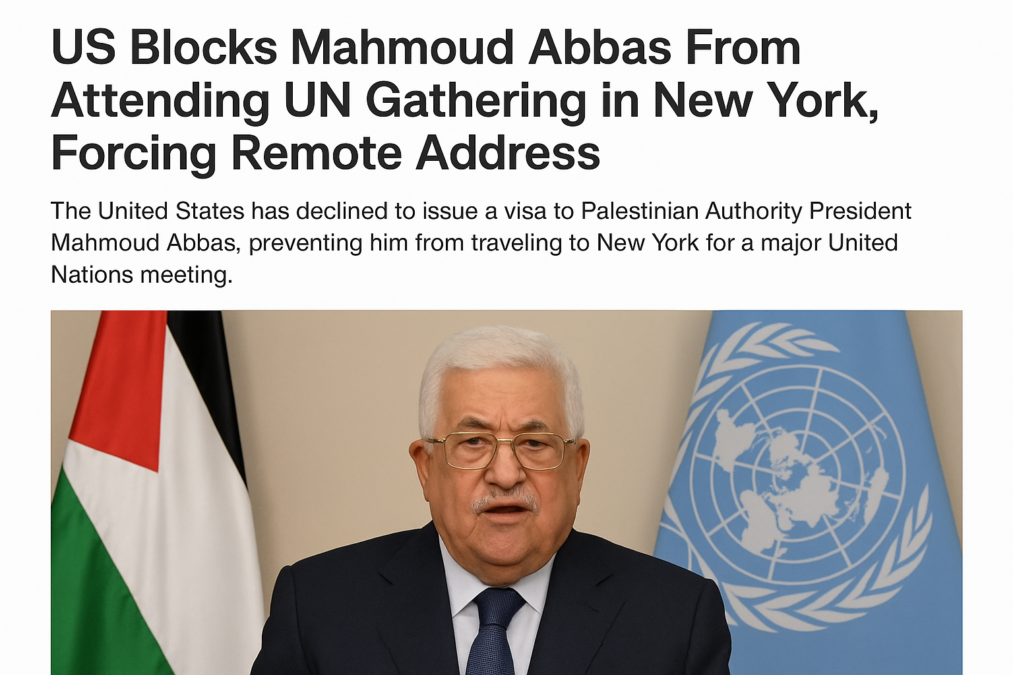
US Blocks Mahmoud Abbas From Attending UN Gathering in New York, Forcing Remote Address
The United States has declined to issue a visa to Palestinian Authority President Mahmoud Abbas. This decision prevents him from traveling to New York for a major United Nations meeting. The decision has escalated diplomatic tensions. It has also drawn criticism from several countries. They argue that the move undermines the spirit of international cooperation at the UN.
According to officials familiar with the matter, the US cited security and foreign-policy considerations in withholding the visa. The restriction comes at a sensitive time. Global attention remains fixed on the humanitarian crisis in Gaza. Additionally, peace efforts between Israelis and Palestinians have stalled.
A Broader Visa Block Affecting Dozens of Palestinian Officials
Sources within the Palestinian Authority report that the visa refusal extended beyond Abbas. It affected dozens of accompanying diplomats and senior aides. They were scheduled to participate in high-level UN discussions. Many were expected to meet with international representatives to discuss reconstruction efforts, ceasefire proposals, and the status of Palestinian statehood.
The mass refusal of visas has drawn condemnation from Palestinian officials. They accused the US of politicizing access to the UN. They believe it interferes with Palestine’s ability to participate in global diplomatic processes.
UN Members Approve Remote Participation
In response to the situation, UN member states approved a special measure allowing Abbas to deliver his speech remotely. In his video address, Abbas sharply criticized the ongoing humanitarian situation in Gaza. He reaffirmed the Palestinian leadership’s demand for an independent state with East Jerusalem as its capital.
He emphasized that Palestinians “will not leave their homeland” despite increasing displacement, conflict, and political pressure. Abbas also urged the international community to take a more active role in ensuring accountability. He called for facilitating a long-term political solution.
International Reaction and Rising Diplomatic Tensions
The US decision has caused unease among several governments. Many argue that representatives of member and observer states should be allowed to enter the United States. This is for official UN functions. They believe this is required under long-standing UN host-country obligations. This should occur regardless of political disputes.
Diplomats from various regions expressed concern about blocking access. They believe it sets a dangerous precedent. This action could enable future host nations to restrict participation of leaders they oppose. Some countries have privately described the move as an escalation that could disrupt already fragile Middle East diplomacy.
At the same time, several nations have been moving toward recognition of Palestinian statehood. This trend has put additional pressure on Washington’s policy positions.
US–Palestinian Relations at a Low Point
The visa denial represents another chapter in deteriorating relations between Washington and the Palestinian Authority. In recent months, disagreements over ceasefire negotiations, humanitarian aid conditions, and security policies have deepened mistrust.
For Palestinian officials, the decision is seen as a symbolic attempt to limit their international engagement. For the US, it reflects a recalibration of diplomatic priorities. It also shows a stricter approach to regional figures viewed as misaligned with current American strategic interests.
What Comes Next
The UN is expected to revisit host-country access protocols following pressure from several delegations. Meanwhile, Abbas and his advisers have pledged to continue seeking international recognition and support despite restrictions on in-person diplomatic outreach.
The episode has amplified debate about fairness, access, and neutrality in the UN system. People are questioning whether geopolitical interests are increasingly overshadowing the organization’s mission. The UN aims to be a forum for all nations, regardless of political alignment.