
Trump Says US Took “Last Chance” to Strike Iran as Qatar Downs Aircraft
President Donald Trump has said the United States acted. The reasoning was that it believed it faced a “last, best chance” to confront Iran. The fighting across the Middle East is intensifying. Regional states report intercepting Iranian aircraft and missiles.
Trump spoke at the White House for the first time since US forces joined Israeli strikes on Iran. He said American troops were continuing what he described as “large-scale combat operations.” These operations are aimed at dismantling Tehran’s military capabilities.
The US and Israel launched coordinated strikes on Saturday that killed Iran’s Supreme Leader, Ayatollah Ali Khamenei, marking a dramatic escalation in a conflict that has rapidly spread beyond Iran’s borders.
“Last, best chance”
Trump told reporters that Iran had ignored repeated warnings to halt its nuclear programme.
“Iran refused to cease their pursuit of nuclear weapons,” he said. He added that a nuclear-armed Iran would pose an “intolerable threat” to both the Middle East and the United States.
The president outlined what he called clear objectives. These include destroying Iran’s ballistic missile programme. Additionally, he intends to eliminate its naval capabilities. Another goal is to ensure it can never obtain a nuclear weapon. He said the operation, referred to by US officials as “Operation Epic Fury”, was progressing faster than expected.
“We projected four to five weeks,” Trump said. “We are substantially ahead of schedule. But we have the capability to go far longer – whatever it takes.”
While he spoke forcefully about military goals, Trump offered few details about Washington’s long-term political strategy for Iran. He did not address who might replace Khamenei or whether the US would support regime change.
Qatar reports aircraft and missile interceptions
As Trump was speaking, Qatar’s Ministry of Defence made an announcement. They said its air defences had shot down two Iranian SU-24 aircraft. The aircraft were approaching from Iranian airspace. The ministry also reported intercepting seven ballistic missiles and five drones targeting multiple areas within the country.
According to Qatari officials, all missiles were destroyed before reaching their intended targets.
Earlier, Iranian strikes were reported near a major gas facility in Qatar, raising fears of disruption to global energy supplies.
Elsewhere in the Gulf, the United Arab Emirates reported the interception of nine ballistic missiles. They also intercepted six cruise missiles and 148 drones. The UAE’s Ministry of Defence said 174 ballistic missiles had been detected since the start of the escalation. The vast majority of these missiles were destroyed before impact. Three people were reported killed and dozens injured, mostly with minor wounds.
Damage at US bases
Independent analysts reviewed satellite imagery. It appears to show damage at US military facilities in Bahrain and Kuwait. This occurred following Iranian retaliatory strikes.
Images of Ali al-Salem air base in Kuwait indicate that at least two aircraft shelters were destroyed and others damaged. A section near the southern runway also appears to have been hit. However, the full extent of the damage has not been officially confirmed.
The US has not released detailed assessments of the strikes on its bases. However, officials have acknowledged attempted Iranian attacks across the region.
Lebanon drawn further into conflict
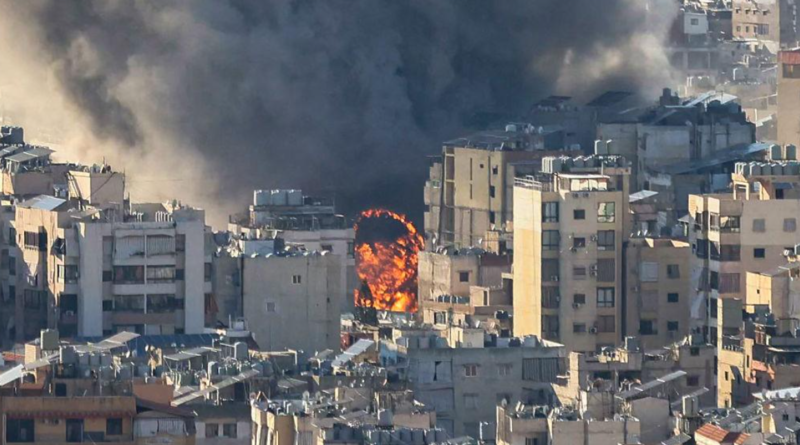
The violence has intensified in Lebanon. Israeli airstrikes have targeted positions linked to Hezbollah in Beirut and southern Lebanon.
Lebanon’s Disaster Management Unit said 52 people had been killed and more than 150 injured following Israeli strikes. The health ministry had earlier reported a lower toll.
Residents in Beirut’s southern suburbs described powerful explosions that shook buildings and sent shockwaves through largely deserted streets. Local media said the Dahieh district, long regarded as a Hezbollah stronghold, had been hit repeatedly.
Israeli officials said the strikes were launched after Hezbollah, which is backed by Iran, fired rockets into northern Israel. The Israeli military argues the response was necessary to deter further attacks and prevent a wider regional threat.
Political factions in Lebanon not aligned with Hezbollah have expressed concern. They fear the country risks being dragged into a broader regional war. Many Lebanese leaders say they are keen to avoid this after months of instability.
UK distances itself from strikes
In London, Prime Minister Keir Starmer announced a “deliberate” decision by the UK. They chose not to participate in the US-Israeli strikes.
“This government does not believe in regime change from the skies,” Starmer told MPs in the House of Commons. This signals a clear divergence from Washington’s more aggressive posture.
He indicated that Parliament would not be given a vote on the current military developments. He argued that the UK was not engaged in offensive operations.
Questions over endgame
Trump’s public remarks were notable for their emphasis on military strength and speed, but analysts say significant questions remain unanswered.
Among them are several crucial questions. How would the US respond if the conflict widens further? What constitutes victory? The removal of Iran’s supreme leader could trigger internal instability or succession struggles?
The president also indicated in a separate television interview. He mentioned that the “big wave” of operations against Iran had yet to come. This suggests that further escalation may be imminent.
Missile interceptions are reported across the Gulf. There are mounting casualties in Lebanon. Visible damage is seen at US facilities. The confrontation between Washington and Tehran now risks reshaping the regional balance of power.
For now, the White House insists it acted to eliminate what it sees as an existential threat. Whether that calculation leads to swift containment or a prolonged regional war remains uncertain.