
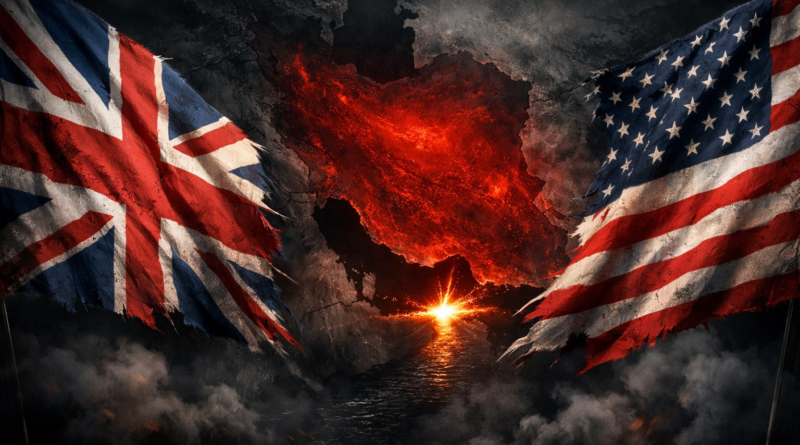
Trump attacks UK over Iran war as Britain rejects calls to join conflict
The historic “Special Relationship” between London and Washington has plunged into a profound crisis. President Donald Trump launched a blistering public attack on the United Kingdom. He was upset over the UK’s refusal to support US-led military strikes against Iran. The American President broke diplomatic protocol. He criticised Prime Minister Keir Starmer’s government as “uncooperative”. He issued a warning to the UK. They would be left to “fight for yourself” if they did not support US military objectives in the Middle East.
The escalating rift comes as the region teeters on the edge of a total conflagration. This follows the effective closure of the Strait of Hormuz. The White House demands absolute military solidarity. However, Downing Street has remained steadfast. Sir Keir Starmer insists that Britain will not be “dragged into another war.” Instead, Britain will prioritise diplomacy and the protection of sovereign national interests.
Trump’s “Fight for Yourself” Ultimatum
A series of comments made by President Trump following a high-level security briefing triggered the current diplomatic storm. Trump was visibly frustrated with the pace of international cooperation. He singled out the UK for what he perceived as a lack of resolve. “We are doing the heavy lifting to keep the world safe from a nuclear Iran. Our so-called closest ally is sitting on the sidelines,” Trump reportedly told reporters.
The President’s rhetoric turned increasingly sharp. He invoked the memory of past conflicts. He suggested that the UK had lost the “Churchillian spirit” that once defined its global presence. His warning has sent shockwaves through the Ministry of Defence and the Foreign Office. America “won’t help you anymore” if British support is not forthcoming. The President sees international alliances through a transactional lens. For him, the UK’s hesitation is not a strategic difference. It is a failure to pay its “dues” in the currency of military support.
The Battle for the Strait of Hormuz
The deepening crisis in the Strait of Hormuz is at the heart of the military tension. It is the world’s most important oil transit chokepoint. Iran has effectively blocked the narrow waterway after a series of naval skirmishes. Approximately 20% of the world’s daily oil supply and significant volumes of liquefied natural gas (LNG) pass through this waterway. The closure has already sent Brent Crude prices soaring past $120 per barrel, triggering the steepest hike in energy forecasts in a generation.
The US administration argues that only a “decisive and overwhelming” military response can reopen the Strait. This response is necessary to restore global economic order. Washington has requested the use of British sovereign bases. This includes the strategically vital installations at Diego Garcia in the Indian Ocean. It also includes RAF Akrotiri in Cyprus. These bases are intended for offensive sorties against Iranian coastal batteries and missile sites. The UK has permitted the use of bases for “defensive” purposes. This includes intercepting drones targeting regional allies. However, it has refused to allow them to be used as launchpads. It prevents their use for a full-scale invasion or “regime change” operations.
Starmer’s Doctrine: Diplomacy over Deployment
In the House of Commons, Prime Minister Keir Starmer has defended his cautious approach. He faces mounting pressure from both the White House and the Conservative opposition. The Prime Minister told MPs during a heated session, “Britain’s foreign policy will be decided in London. It will not be dictated from elsewhere.” Starmer’s refusal to join the US-led strikes stems from his strong desire to avoid the “shadow of Iraq.” This phrase refers to the 2003 invasion that remains a traumatic touchstone in British political life.
The Starmer government has argued that military escalation risks an uncontrollable regional war. This conflict could involve Lebanon, Israel, and the wider Gulf. Instead, the UK is leading a diplomatic “third way.” The UK is working with European and regional partners. They aim to find a negotiated settlement. This settlement would see the reopening of the Strait of Hormuz without the need for a ground war. “We will focus on diplomacy and protecting our national interests,” Starmer stated. He added that “blind loyalty is not the mark of a special relationship. True friendship requires the courage to say ‘no’ when a course of action is dangerous.”
A Region on the Brink of Conflagration
The risk of a wider Middle East conflict is no longer a theoretical concern. Military analysts warn that the current standoff is the most dangerous since the 1970s. US carrier groups are positioned in the Arabian Sea. Iranian proxies across the region are on high alert. A single miscalculation could ignite a multi-front war. The UK refuses to participate due to intelligence assessments. A direct attack on the Iranian mainland would lead to immediate retaliatory strikes on British interests. These interests include the thousands of UK personnel stationed in Cyprus and the Gulf.
Furthermore, the conflict has already begun to fragment Western unity. Spain has closed its airspace to US military aircraft bound for the Middle East. Several other European nations have expressed deep reservations about the legality of “pre-emptive” strikes. This fragmentation emboldens Tehran. At the same time, it strains the NATO alliance. The alliance needs to focus on the ongoing conflict in Ukraine as well.
The Economic Shockwave and Oil Markets
The impact on world markets has been immediate and devastating. The Strait of Hormuz might remain closed for a prolonged period. This situation has forced economists to slash global growth forecasts for 2026. Analysts at Goldman Sachs warn that oil could reach $150 per barrel if the blockade continues beyond mid-April. This price point would almost certainly trigger a global recession. It would also cause a massive inflationary spike.
For the UK, the economic stakes are particularly high. The UK heavily relies on international trade and energy imports. Any sustained disruption to global shipping lanes would lead to a sharp rise in the cost of living. This situation would undermine the government’s domestic economic agenda. The Treasury is reportedly preparing “emergency energy measures”. These measures aim to mitigate the impact on British households. Meanwhile, the political pressure to “do something” militarily continues to grow.
Analysis: What Happens Next?
The coming weeks will be a defining period for Keir Starmer’s premiership and the future of the Anglo-American alliance. If the UK continues to hold its ground, it may find itself increasingly isolated from its traditional security guarantor. However, if it yields to Trump’s pressure, it risks entering a conflict. This conflict comes with no clear exit strategy. It also faces significant domestic opposition.
Much will depend on the effectiveness of the UK’s diplomatic efforts. If Starmer can successfully broker a deal to de-escalate the naval blockade, his “cool head” strategy will be vindicated. If, however, Iran continues to tighten its grip on the Strait, the global economy might begin to buckle. In that scenario, the calls for military action—even without British support—may become irresistible for the Trump administration.
The “Special Relationship” has survived many storms, from the Suez Crisis to the Vietnam War. However, the current rift over Iran feels fundamentally different. This is a clash not just of policy. It is a clash of worldviews. One is based on transactional “America First” militarism. The other is based on a rules-based, diplomatic internationalism. How this tension is resolved will determine the geopolitical landscape for years to come.