
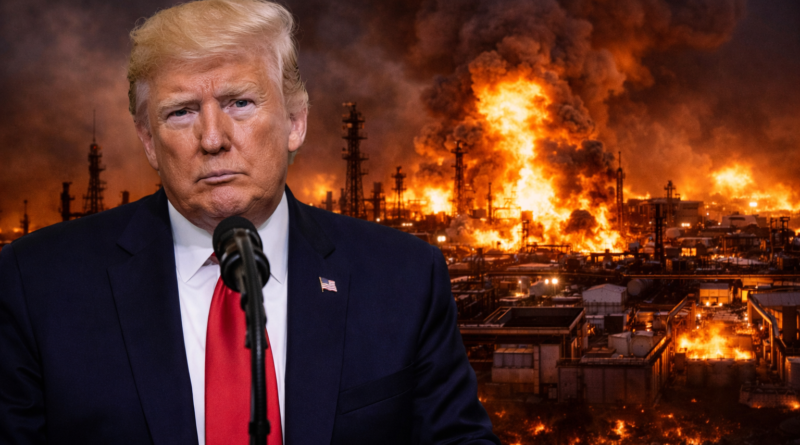
Trump Vows to ‘Obliterate’ Iranian Infrastructure as Peace Deadline Looms
In a dramatic escalation of rhetoric that has sent global oil markets into a tailspin, President Donald Trump issued a final ultimatum to the Iranian leadership on Monday, threatening to “completely obliterate” the Islamic Republic’s energy and water infrastructure if a ceasefire agreement is not reached “shortly.”
The President’s comments were delivered via his Truth Social platform. They were also echoed during high-stakes diplomatic briefings. These remarks represent the most severe threat to take direct military action. The action would target Iranian civilian and economic areas. This has been the case since the current conflict erupted four weeks ago. Iranian naval maneuvers have effectively throttled the Strait of Hormuz. It is the world’s most critical oil transit point. As a result, the White House has signaled that its patience with Tehran has reached its absolute limit.
“Washington is in serious discussions with a new and more reasonable leadership in Iran,” the President claimed in a post on Monday evening. “Progress is being made, but they must understand: the Strait of Hormuz must be opened immediately. If not, we will have no choice but to launch major strikes on their energy targets. We will take the oil, we will take the power, and we will ensure they can no longer threaten the world’s energy security.”
The 15-Point Ultimatum
The latest threats come as the White House’s 10-day deadline for Iran to respond to a U.S.-backed peace proposal draws to a close. Special Envoy Steve Witkoff confirmed last week that a comprehensive 15-point framework had been delivered to Tehran through Pakistani intermediaries.
The specific details of the 15 points remain classified. However, sources close to the administration suggest the plan demands a total cessation of hostilities. It also requires the immediate reopening of the Strait of Hormuz. This must be unconditional. Additionally, there must be a freeze on Iran’s regional proxy activities. In exchange, the U.S. has reportedly offered to lift the most recent wartime sanctions in phases. They also promised a “security guarantee” for the new Iranian leadership.
However, the response from Tehran has been far from conciliatory. Iranian state media has called the proposal “excessive and unreasonable.” Officials insist that any deal must include ironclad guarantees of Iranian sovereignty. It must also recognize Iran’s security interests in the Persian Gulf.
“We have received messages, but there are no direct negotiations,” an Iranian Foreign Ministry spokesperson stated on Monday. “The United States cannot expect us to surrender our national dignity under the threat of ‘obliteration.’ If there is any strike on our infrastructure, we will respond with an action. The White House cannot even begin to imagine this response.”
Targeting the Lifeblood of a Nation
What makes the President’s latest warning particularly chilling is the specificity of the targets mentioned. Trump explicitly listed electric generating plants, oil wells, and the strategically vital oil-export hub on Kharg Island as targets. These locations are in the crosshairs.
Kharg Island, which handles approximately 90% of Iran’s crude exports, has already seen limited U.S. strikes earlier this month. However, those operations were carefully calibrated to hit military radar and air defense installations while leaving the oil terminals intact. The President’s new rhetoric suggests that this policy of restraint is over.
Furthermore, the inclusion of desalination facilities in the threat list has sparked international outrage. These plants provide the primary source of drinking water for millions of civilians in Iran’s arid coastal regions. Legal experts at the United Nations have warned about war crimes. Deliberately targeting water infrastructure directly endangers the lives of non-combatants and could constitute a war crime under international law.
“We are looking at a potential humanitarian catastrophe of unprecedented proportions,” said Sarah Jenkins, a senior analyst at the International Crisis Group. “By targeting both the power grid and the water supply, you aren’t just hitting a government; you are effectively dismantling the basic survival mechanisms of a population of 85 million people.”
The ‘Strait of Trump’ and the Global Oil Shock
The central flashpoint remains the Strait of Hormuz. The President jokingly—and some say revealingly—referred to it as the “Strait of Trump” during a recent speech at the Future Investment Initiative in Miami.
“They have to open up the Strait of Trump—I mean, Hormuz,” he told the laughing audience of international investors. “It’s a very narrow waterway, but it’s a very important one. And we’re going to make sure it stays open, one way or another.”
The markets, however, are not laughing. Brent crude spiked above $113 a barrel on Monday following the President’s Truth Social posts. Analysts at Goldman Sachs and Morgan Stanley have warned that a full-scale conflict in the Gulf, coupled with the destruction of Iranian export capacity, could see oil prices surge past $150 or even $200 a barrel, triggering a global recession and hyper-inflation in energy-dependent economies.
“The risk premium is being baked in at an exponential rate,” noted energy economist David Miller. “Every time the President posts, the price jumps three dollars. We are currently seeing the most volatile energy market in history, and we haven’t even seen a single oil well set on fire yet.”
Regional Tensions and the NATO Factor
The conflict is already showing signs of spilling over beyond the borders of the Middle East. NATO officials confirmed on Monday that they had intercepted an Iranian-made missile heading toward Turkish airspace, though it remains unclear if Turkey was the intended target or if the missile had veered off course during a separate engagement.
In the Gulf, the U.S. has significantly bolstered its naval presence, with two additional carrier strike groups now stationed in the North Arabian Sea. Regional mediators, led by Pakistan and Egypt, are working feverishly to prevent a total breakdown of communication. Pakistan’s role as the primary intermediary has become crucial, with Islamabad hosting high-level delegations from both sides in an attempt to find a face-saving exit for Tehran.
At the same time, the “new and more reasonable” leadership Trump referred to remains a point of intense speculation. Reports suggest a quiet power struggle is taking place within the Iranian capital between hardline military commanders and a more pragmatic faction within the civil government that is terrified of the economic consequences of a total war with the United States.
A Gamble of Global Proportions
President Trump’s strategy appears to be one of maximum pressure pushed to its logical extreme. By threatening the very survival of the Iranian state’s economic and social fabric, he is betting that the leadership in Tehran will blink before the 10-day deadline expires.
“It’s the ultimate high-stakes poker game,” said a former U.S. diplomat who spoke on the condition of anonymity. “He’s telling them: ‘I will turn your country into a dark, thirsty wasteland unless you do exactly what I say.’ The problem is, if they don’t blink, he has to follow through, or his credibility on the world stage is gone. And following through means a war that could last for a decade.”
As the clock ticks down on the 15-point peace plan, the world waits with bated breath. The difference between a historic peace deal and a regional conflagration now rests on a few square miles of water in the Persian Gulf and the decisions of two leaders who seem increasingly unwilling to back down.
Inside the White House, the mood is described as “resolute.” Special Envoy Witkoff is reportedly in constant contact with the Pakistani Foreign Ministry, waiting for a signal that Tehran is ready to accept the 15 points. Outside, the global economy shudders with every headline, as the prospect of “Energy Armageddon” moves from a theoretical nightmare to a looming reality.
The Humanitarian and Legal Fallout
As the rhetoric intensifies, humanitarian organizations are sounding the alarm. The Red Cross and Médecins Sans Frontières (MSF) have issued joint statements urging both sides to respect the Geneva Conventions.
“The deliberate targeting of power grids and water treatment plants is a direct attack on the civilian population,” the MSF statement read. “In a country already struggling with the effects of sanctions and regional instability, the loss of these basic services would lead to widespread disease, famine, and death. This is not a military strategy; it is a humanitarian crime.”
The legal ramifications are equally complex. While the U.S. administration argues that the infrastructure is being used to support “hostile military activities,” international legal scholars argue that the “dual-use” nature of these facilities does not grant a blank check for their destruction.
“International law requires a principle of proportionality,” explained Dr. Elena Rossi, a professor of International Law. “The military advantage gained by hitting a power plant must be weighed against the civilian harm. When you are talking about the entire grid of a nation, that balance is impossible to maintain.”
The 48-Hour Window
With only a short window remaining before the President’s “shortly” deadline is interpreted as “now,” the diplomatic community is looking for any sign of a breakthrough. The Pakistani intermediaries have hinted at a possible counter-proposal from Tehran, but whether it will meet the stringent requirements of the 1.5-point plan remains to be seen.
For now, the oil tankers remain anchored, the carrier groups remain on high alert, and the people of Iran—and the world—wait to see if the “Strait of Trump” will be a bridge to peace or a gateway to a devastating new war.
Timeline of Escalation:
•March 1: Iran begins naval exercises in the Strait of Hormuz.
•March 5: U.S. imposes “Total Isolation” sanctions.
•March 15: Limited U.S. strikes on Kharg Island military targets.
•March 20: Witkoff delivers 15-point peace plan via Pakistan.
•March 27: Trump’s “Strait of Trump” speech in Miami.
•March 30: Trump threatens to “obliterate” energy and water infrastructure.
Economic Impact Summary:
| Asset | Price Pre-Crisis | Current Price (Mar 30) | Change |
| Brent Crude Oil | $78.50 | $113.20 | +44% |
| Gold (oz) | $2,150 | $4,563 | +112% |
| US Gas (Avg) | $3.45 | $5.89 | +70% |
| Global Shipping Index | 1,400 | 3,850 | +175% |