
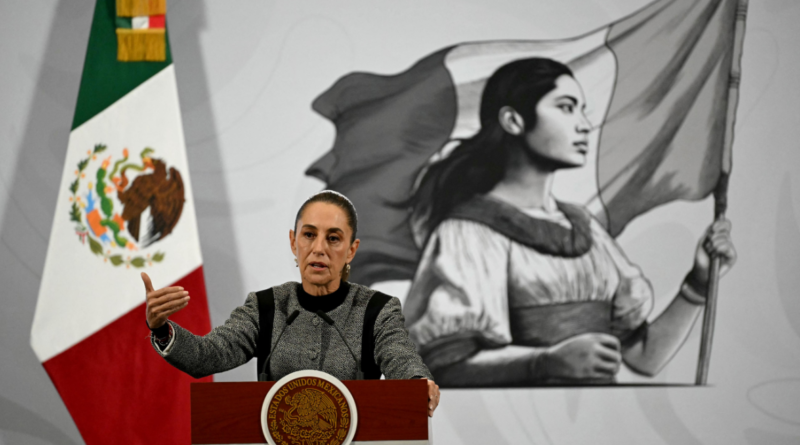
Mexican President Calls for Stronger Sexual Harassment Laws After Public Assault
Mexico’s President Claudia Sheinbaum has called for sweeping changes to the country’s sexual harassment laws after she was assaulted during a public appearance outside the presidential palace in Mexico City.
The incident, which took place on Tuesday, 4 November 2025, has sparked a national debate over women’s safety, the vulnerability of public figures, and the uneven legal protections that exist across Mexico’s 32 states.
Sheinbaum said she now wants Congress to pass legislation making sexual harassment a federal crime throughout the country. At present, the legal definition and punishment for sexual harassment vary widely from one state to another.
The president said the assault demonstrated that no woman is immune from harassment, regardless of her position or status.
“If this can happen to the president, imagine what happens every day to millions of women across Mexico,” Sheinbaum said.
Assault Outside the National Palace
The assault happened shortly before noon on Tuesday, 4 November, as Sheinbaum was walking towards an event near the Palacio Nacional in central Mexico City.
The president had just left a meeting inside the presidential palace and was making her way through a crowd of supporters gathered outside.
As is common during her public appearances, Sheinbaum stopped several times to greet people, shake hands and pose for photographs.
According to witnesses and video footage later shared online, a man who appeared visibly intoxicated approached the president from the crowd.
The man placed his arm around Sheinbaum’s shoulders, touched her inappropriately and then attempted to kiss her.
For several seconds, the president appeared surprised and tried to move away.
Members of her security detail intervened almost immediately. Officers pulled the man away from Sheinbaum, restrained him and escorted him from the area.
The incident happened in full view of journalists, supporters and television cameras.
Videos of the encounter quickly spread across social media platforms, provoking widespread anger and condemnation.
The man, whose name has not been officially released, was later arrested by authorities.
On Wednesday, 5 November, the Mexico City prosecutor’s office confirmed that he had been charged with harassment and disorderly conduct.
Officials said he remained in custody while investigators considered whether additional charges should be filed.
Sheinbaum: ‘I Did Not Understand at First’
Speaking during her regular morning press conference on Wednesday, 5 November, Sheinbaum said she did not initially realise the seriousness of what had happened.
“The man approached completely drunk,” she told reporters.
“At that moment I thought he was simply trying to get close. It was not until I later saw the videos that I understood what had really happened.”
She said she was shocked when she reviewed the footage.
The president confirmed that she had filed a formal complaint against the man.
She also announced that she would use the incident to push for broader legal reform.
“I do not want this to remain simply a personal matter,” she said.
“This is about all women in Mexico.”
Sheinbaum argued that the laws governing sexual harassment are inconsistent and fragmented.
In some states, unwanted touching or harassment in public can lead to prison sentences. In others, similar conduct may only result in a fine, while in some states there is no specific criminal offence at all.
The president said such differences create unequal protection depending on where a woman lives.
“We need one law that protects all women equally,” she said.
Current Mexican Law on Sexual Harassment
Mexico does not currently have a single nationwide criminal law covering sexual harassment in the same way in every state.
Instead, each state has its own criminal code.
As a result, definitions and punishments differ across the country.
In Mexico City, Article 179 of the local penal code defines sexual harassment as unwanted conduct of a sexual nature carried out without the victim’s consent.
This can include touching, sexual comments, intimidation, attempts to kiss someone or repeated unwanted advances.
Under Mexico City law, sexual harassment can be punished with between six months and three years in prison, as well as fines.
If the victim is considered especially vulnerable, or if the offence is committed by someone in a position of authority, the sentence can be increased.
Around 20 of Mexico’s 32 states have similar offences in their penal codes.
However, several states still treat sexual harassment mainly as an administrative or workplace issue rather than a criminal offence.
In some states, only workplace harassment is explicitly covered.
That means a woman assaulted in the street, on public transport or during a public event may have limited legal recourse.
Legal experts say this patchwork system often discourages victims from reporting abuse.
“Women do not always know whether what happened to them is even considered a crime where they live,” said María Elena Morera, a Mexican legal analyst and campaigner.
“That creates impunity.”
Sheinbaum has proposed creating a federal law that would define sexual harassment nationwide and establish minimum punishments.
According to officials close to the president, the government is considering a bill that would:
- Create a uniform definition of sexual harassment across all states
- Criminalise unwanted touching and public sexual aggression
- Increase penalties when the victim is a minor or vulnerable person
- Require states to provide support services for victims
- Introduce training for police and prosecutors dealing with gender-based crimes
The proposal is expected to be presented to Congress later in November 2025.
A Country Struggling With Violence Against Women
The incident involving the president has focused new attention on the wider problem of violence against women in Mexico.
Mexico has some of the highest rates of gender-based violence in Latin America.
According to data from the United Nations, nearly 70% of Mexican women aged 15 and older have experienced some form of violence, harassment or unwanted sexual conduct during their lifetime.
Many incidents occur in public places, including buses, trains, streets and workplaces.
Government statistics also show that thousands of cases are never reported.
Women’s rights organisations say fear, shame and distrust in the justice system prevent many victims from coming forward.
The problem is particularly severe in Mexico’s largest cities.
In Mexico City, surveys suggest that most women have experienced some form of sexual harassment while using public transport.
Many report being touched, followed, insulted or intimidated.
The issue has become even more urgent because of Mexico’s high levels of femicide.
The Mexican government and the United Nations estimate that around ten women are murdered every day in the country.
Many of those killings are linked to domestic violence, sexual violence or other forms of gender-based abuse.
In recent years, mass demonstrations have taken place across Mexico demanding stronger protections for women.
Large protests were held in Mexico City in March 2020, March 2022 and again in March 2025 on International Women’s Day.
Demonstrators accused the authorities of failing to investigate crimes against women and allowing a culture of impunity to continue.
‘If It Happened to the President, It Can Happen to Anyone’
Women’s rights groups said the assault on Sheinbaum reflected the experiences of millions of ordinary women.
Verónica Cruz, founder of the feminist organisation Las Libres, said the incident should serve as a warning.
“Every day women are subjected to intimidation and harassment,” she said.
“That this happened even to the president of the republic shows how deep the problem runs.”
Cruz said the response should not focus only on the individual man who assaulted Sheinbaum.
Instead, she argued that the country must confront broader social attitudes.
“We have normalised behaviour that should never be normal,” she said.
“Many women are told to ignore harassment or to remain silent. That has to change.”
Several feminist groups welcomed the president’s proposal for federal legislation.
They also called for stronger enforcement.
Campaigners note that even where sexual harassment is already illegal, prosecutions remain rare.
According to Mexico’s National Institute of Statistics and Geography, only a small minority of women who experience harassment report it to the police.
Among those who do report it, many cases never result in charges.
Activists say this often leaves victims feeling abandoned.
Questions Over Presidential Security
The assault has also prompted criticism of the president’s security arrangements.
Since taking office on 1 October 2024, Sheinbaum has tried to maintain a close relationship with the public.
Unlike some previous Mexican presidents, she frequently stops to greet supporters, take selfies and shake hands.
Her supporters see this as a sign that she wants to remain accessible.
Critics argue that it creates unnecessary risks.
Former anti-narcotics prosecutor Samuel González said the incident showed that the president may be too exposed.
“It sends a troubling message,” he said.
“If even the head of state can be approached in this way, then there are clearly weaknesses in the security perimeter.”
Security analyst David Saucedo said members of the presidential guard should have ensured that anyone approaching Sheinbaum was sober and not carrying anything dangerous.
“What happened could have been much worse,” he said.
“He was intoxicated, but he could also have been armed.”
Others defended the president’s decision to remain close to the public.
Supporters argued that increasing security barriers would distance Sheinbaum from the people who elected her.
The president herself insisted she did not plan to change her approach.
“As long as there is no major threat, we will continue as we have been,” she said on 5 November.
“We need to stay close to the people.”
Political Reactions Across Mexico
Political leaders from across Mexico condemned the assault.
Members of Sheinbaum’s ruling party, Morena, accused opposition figures of trying to minimise what had happened.
Several Morena lawmakers said the incident showed the need for stronger laws.
Opposition politicians also expressed support for the president.
However, some questioned whether new federal legislation alone would solve the problem.
Senator Lilly Téllez said the government should focus not only on creating new laws, but also on ensuring that police and prosecutors enforce the laws that already exist.
“Mexico does not only suffer from a lack of laws,” she said.
“It suffers from a lack of justice.”
Legal scholars have made a similar argument.
Some say Mexico already has enough legislation on paper, but the system often fails because investigations are weak and courts are slow.
Others argue that a federal law would still be important because it would create consistent standards nationwide.
What Could Happen Next
The government is expected to submit its proposed law to Congress before the end of November 2025.
If approved, the measure could become one of the most significant reforms to women’s rights legislation in Mexico in recent years.
The bill would still need approval from both houses of Congress and may also require some state legislatures to update their own laws.
Because Sheinbaum’s Morena coalition controls large parts of Congress, analysts believe the proposal has a realistic chance of passing.
Even if the law is approved, however, campaigners say deeper social change will still be needed.
For many women in Mexico, harassment is not an isolated incident but a routine part of daily life.
The president’s experience has brought that reality into sharp focus.
“What happened to Claudia Sheinbaum was not unusual,” said Verónica Cruz.
“What is unusual is that this time the victim was the president, and the entire country saw it.”
For Sheinbaum, the incident has become more than a personal experience.
She now appears determined to turn it into a political campaign.
“We cannot continue to tolerate this,” she said.
“Every woman in Mexico deserves to walk safely, without fear, no matter who she is.”