
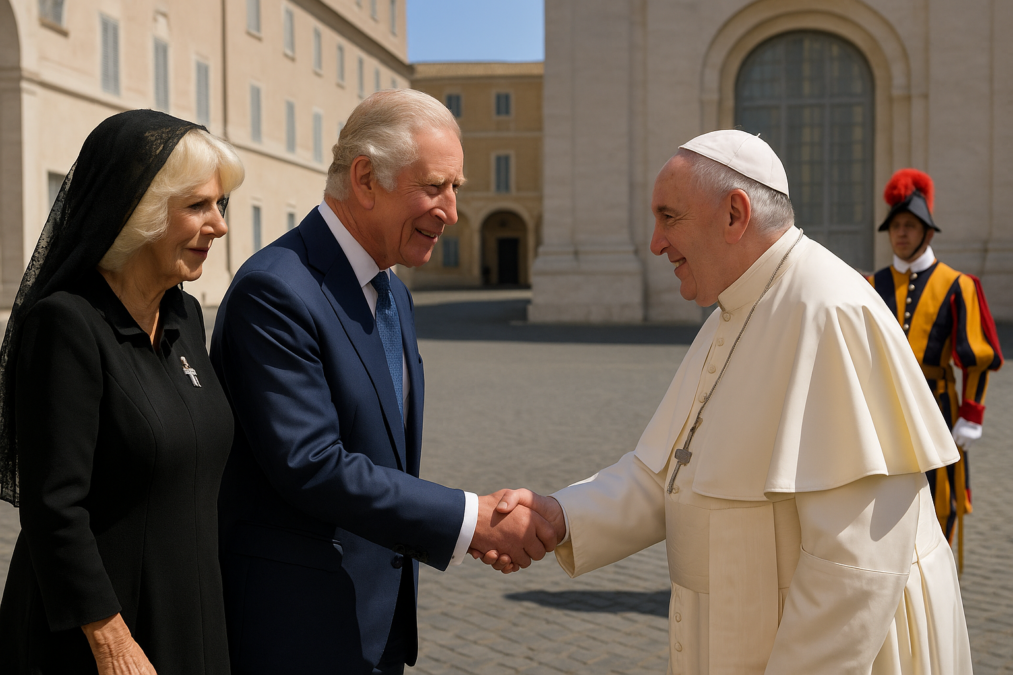
King and Queen Begin Historic Visit to Vatican City for Meeting with Pope Leo XIV
In a moment rich with historical meaning, King Charles and Queen Camilla arrived in Vatican City today. They came for a highly anticipated audience with Pope Leo XIV. This landmark visit marks the beginning of their state visit to the Holy See. The event aims to change the British monarchy’s relationship with the Church of England. It will also redefine the connection with the Roman Catholic Church after centuries of complex history.
The visit occurs amidst the solemnity of the Papal Jubilee. The King, who is the Supreme Governor of the Church of England, will participate in public prayer with the Pontiff. This makes it particularly notable. This gesture is unprecedented since the Reformation. This act of shared faith underscores a profound shift in interfaith dialogue and mutual respect between Christian communities globally.
Arrival at the Vatican
The royal motorcade, a symbol of diplomatic gravitas, entered St. Peter’s Square, a site traditionally thronged by pilgrims and visitors eager to catch a glimpse of the Pope. The procession continued to the San Damaso Courtyard. This courtyard is the ceremonial gateway to the Apostolic Palace. It is the official residence of the Pope.
Reverend Monsignor Leonardo Sapienza, Regent of the Prefecture of the Papal Household, received Their Majesties. He was accompanied by an honour guard formed by the Vatican’s renowned Swiss Guard. This elite corps is composed exclusively of Swiss Catholic citizens. It has served as the Pope’s personal security force for over five centuries. Their distinctive Renaissance-era uniforms are a familiar sight within the Vatican walls.
The national anthems of the United Kingdom and Vatican City were played. The King and Queen stood in solemn recognition. Following this, they greeted a distinguished group of Papal Gentlemen. These are lay dignitaries appointed to assist at official ceremonies within the Vatican.
Queen Camilla wore a traditional black silk dress designed by Fiona Clare. She paired it with a mantilla veil crafted by Philip Treacy. Her ensemble included the late Queen Elizabeth II’s iconic “raspberry pip” cross brooch. This was a subtle nod to continuity and heritage.
The ceremony began with a ceremonial welcome. Afterward, the royal couple entered the Apostolic Palace. They went in for a private audience with Pope Leo XIV. This meeting, while steeped in formal protocol, carries deep personal significance for the King. It coincides with the ongoing celebration of the Papal Jubilee. The Jubilee is a sacred year observed by the Catholic Church every 25 years.
Later today, the King is scheduled to participate in an ecumenical service within the hallowed confines of the Sistine Chapel. In this act, he will make history. He will become the first British monarch since the Reformation to join the Pope in public prayer. This is a powerful symbol of reconciliation and unity. This unprecedented gathering highlights the royal family’s enduring commitment to fostering interfaith understanding. It also shows mutual respect among diverse Christian traditions worldwide.
Why the Visit Is Historic
This state visit transcends mere diplomatic formality. It is a profound historical event. The visit marks a significant evolution in the often-strained relationship between the British monarchy and the Holy See. King Henry VIII initiated a schism in 1534. He broke from Rome to establish the Church of England. This act fundamentally reshaped the religious and political landscape of Britain and Europe. For nearly five centuries, the British monarch has stood as a symbol of this separation. The monarch, serving as Supreme Governor of the Church of England, represents this division.
A reigning British monarch praying publicly with the Pope in the Sistine Chapel is unprecedented. It is a gesture of reconciliation. Historically, such an encounter would have been unthinkable, given the deep theological and political divides that emerged from the Reformation. The Act of Royal Supremacy declared Henry VIII and his successors the supreme head of the Church of England. This move effectively severed ties with papal authority. Subsequent legislation, such as the Act of Settlement in 1701, solidified this separation. It banned Catholics and those married to Catholics from ascending the British throne.
Relations between the Church of England and the Roman Catholic Church have changed over the centuries. These relations have been characterized by intense conflict. They have also been marked by suspicion and gradual rapprochement. The Gunpowder Plot of 1605 is a stark reminder of the historical animosity. The Glorious Revolution of 1688 also serves as a reminder. Additionally, various penal laws against Catholics in Britain highlight this tension. However, the latter half of the 20th century saw a concerted effort towards ecumenical dialogue, particularly following the Second Vatican Council (Vatican II) in the 1960s, which fostered a more open and inclusive approach within the Catholic Church .
Queen Elizabeth II made significant strides in mending these historical divisions, becoming the first British monarch since the Reformation to make an official visit to the Holy See in 1961, and later hosting Pope John Paul II in the UK in 1982 . These visits, while groundbreaking, did not include the symbolic act of public prayer between the monarch and the Pontiff. King Charles, known for his deep interest in interfaith dialogue and environmental stewardship, is now taking this ecumenical engagement to an unprecedented level.
His participation in an ecumenical service with Pope Leo XIV in the Sistine Chapel signifies a powerful message of unity and shared Christian values. It acknowledges a common heritage and a desire to overcome historical divisions, focusing instead on areas of mutual concern such as Christian unity and global challenges like climate change. This event is not merely a symbolic gesture; it represents a tangible step towards healing centuries-old wounds and forging a new path for future collaboration between the two major Christian traditions. The King’s personal commitment to this dialogue has been evident throughout his public life, including his attendance at Catholic services and his expressed desire to be seen as a
‘Defender of Faith’ rather than ‘Defender of the Faith’ .
The Papal Jubilee and Pope Leo XIV
The King and Queen’s visit gains additional resonance by coinciding with the Papal Jubilee, a Holy Year observed by the Roman Catholic Church. Traditionally held every 25 years, a Jubilee is a special year of grace and pilgrimage, offering Catholics an opportunity for spiritual renewal, forgiveness of sins, and a deeper connection with their faith. The current Jubilee, proclaimed by Pope Leo XIV, commenced on January 10, 2026, and is set to conclude on January 10, 2027 .
Pope Leo XIV, who ascended to the papacy in May of the previous year, has quickly established himself as a pontiff deeply committed to ecumenism, interfaith dialogue, and addressing contemporary global challenges. His proclamation of the Jubilee Year, with its themes of reconciliation and hope, has been described as a “powerful sign of a new world” . The Pope’s vision for this Jubilee extends beyond the Catholic faithful, aiming to foster a sense of universal brotherhood and shared responsibility for the planet.
His leadership has been marked by a pragmatic approach to international relations and a strong emphasis on social justice, echoing some of the King’s own long-standing interests. The Pope’s engagement with other Christian denominations and non-Christian faiths has been a hallmark of his pontificate, making this meeting with the British monarch particularly timely and significant. The previous Pope, Francis, had also made strides in this area, and the King and Queen had a private audience with him shortly before his passing .
The Jubilee Year itself is steeped in centuries of tradition, dating back to the 14th century. Pilgrims from around the world travel to Rome to pass through the Holy Doors of the major basilicas, a symbolic act of spiritual cleansing and renewal. For Pope Leo XIV, this Jubilee is not merely a historical observance but a living testament to the Church’s enduring mission in a rapidly changing world. His decision to invite leaders from other Christian traditions to participate in various Jubilee events underscores his commitment to fostering greater unity and understanding among all people of faith .
The King’s presence during this sacred period, and his participation in an ecumenical service, sends a powerful message of solidarity and shared purpose. It acknowledges the common ground that exists between the Church of England and the Roman Catholic Church, particularly in areas of social concern and spiritual reflection. This convergence of royal diplomacy and religious observance elevates the visit beyond a mere political exchange, imbuing it with a profound spiritual dimension that resonates with millions worldwide.
First Monarch Since the Reformation
The King’s participation in public prayer with Pope Leo XIV in the Sistine Chapel is a moment that will undoubtedly be etched into the annals of religious and royal history. This act marks the first time a British monarch, in their official capacity as Supreme Governor of the Church of England, has prayed alongside the Roman Pontiff since the tumultuous events of the 16th-century Reformation .
To fully grasp the magnitude of this event, one must recall the historical context. The English Reformation, initiated by King Henry VIII, was not merely a theological dispute but a seismic political and social upheaval. Henry’s desire for an annulment from Catherine of Aragon, denied by Pope Clement VII, led to the Act of Supremacy in 1534, declaring the monarch, not the Pope, as the head of the Church in England. This act irrevocably altered the religious landscape of Britain, leading to the dissolution of monasteries, the persecution of Catholics, and centuries of religious strife .
Subsequent monarchs, from Elizabeth I to the present day, have upheld the Protestant succession and the monarch’s role as Supreme Governor. Laws like the Act of Settlement of 1701 explicitly barred Catholics from the throne and prohibited the monarch from marrying a Catholic . While some of these restrictions have been eased in recent years – notably the Succession to the Crown Act 2013, which removed the disqualification arising from marriage to a Roman Catholic – the monarch must still be an Anglican .
Against this backdrop of deep-seated historical and legal separation, the King’s decision to pray publicly with the Pope is a powerful symbol of a new era of ecumenical understanding. It signifies a move beyond mere diplomatic courtesy to a genuine expression of shared faith and a desire for Christian unity. This gesture is particularly poignant given the King’s personal history and his long-standing interest in interfaith dialogue. He has previously expressed a desire to be seen as a ‘Defender of Faith’ rather than ‘Defender of the Faith,’ reflecting a broader understanding of his role in a multi-faith society .
Church historians and royal experts have lauded this development as a testament to the enduring efforts of both the Church of England and the Roman Catholic Church to bridge historical divides. Dr. Eleanor Vance, a prominent church historian, commented, “This is more than just a photo opportunity; it’s a profound theological statement. It acknowledges a common spiritual heritage and a shared commitment to Christian values, despite the historical differences that have separated these two traditions for so long.” Vatican officials, speaking off the record, expressed similar sentiments, viewing the visit as a significant step towards greater Christian unity and a recognition of the Catholic Church’s global role.
The act of public prayer, especially within the symbolic heart of Catholicism, the Sistine Chapel, carries immense weight. It is a visible demonstration of reconciliation and a powerful message to millions of Anglicans and Catholics worldwide that dialogue, understanding, and shared worship are not only possible but actively encouraged at the highest levels of both churches. This moment builds upon decades of ecumenical efforts, including the Anglican-Roman Catholic International Commission (ARCIC), which has worked since the 1960s to address theological differences and foster closer ties .
The King’s participation in this service, alongside the Archbishop of York, Stephen Cottrell, and choirs from both traditions, further emphasizes the collaborative spirit of the occasion. It is a carefully orchestrated event designed to highlight common ground and mutual respect, setting a precedent for future inter-church relations and offering a beacon of hope for a more unified Christian future.
What Happens Next
The historic visit of King Charles and Queen Camilla to the Vatican is not merely a ceremonial event but a strategic diplomatic engagement with far-reaching implications for future relations between the United Kingdom and the Holy See. Beyond the symbolic act of shared prayer, the visit is expected to lay the groundwork for enhanced cooperation on a range of global issues, reflecting the shared values and concerns of both entities.
Discussions during the private audience with Pope Leo XIV are anticipated to cover critical contemporary challenges, including climate change, interfaith dialogue, and efforts to promote peace and security worldwide. Both the King and the Pope have been vocal advocates for environmental stewardship, making climate action a likely point of convergence. The Foreign, Commonwealth and Development Office has explicitly stated that the visit aims to “strengthen the UK’s relationship with this crucial and influential partner, helping to deliver on the Government’s priorities — from promoting peace and security around the world to working with our international partners to tackle climate change” .
Following the ecumenical service in the Sistine Chapel, the King and Queen are scheduled to visit the Papal Basilica of St. Paul Outside the Walls. This basilica holds particular significance for Christian unity, hosting an annual service with the Pope and leading Anglican clergy. The King will be bestowed with the title of Royal Confrater of St. Paul, and a specially crafted chair will be reserved for him and his successors during future visits, further cementing the historical ties between the British Crown and this ancient site . The basilica’s Benedictine abbey has long been associated with the English crown, with its coat of arms incorporating the insignia of the Order of the Garter, a royal medieval order of chivalry.
The King is also expected to attend a reception at the Beda College, a Catholic seminary that prepares priests from across the Commonwealth for ordination. This engagement underscores the King’s commitment to the broader Commonwealth and the role of religious institutions within it. Meanwhile, Queen Camilla will meet with six Catholic sisters from the International Union of Superiors General, whose orders are actively involved in girls’ education and healthcare initiatives globally, highlighting the humanitarian and social dimensions of the visit .
Royal experts and Vatican observers anticipate that this visit will usher in a new era of diplomatic and ecumenical engagement. Dr. Alistair Finch, a commentator on royal affairs, noted, “This visit is a clear signal that the UK and the Vatican see each other as vital partners on the global stage. It’s about leveraging soft power and moral authority to address complex international problems.” Vatican officials have also indicated a desire to deepen collaboration with the UK on humanitarian efforts and cultural exchange.
Looking ahead, the implications of this visit could be profound. It may pave the way for more frequent high-level exchanges between the British monarchy and the Holy See, fostering a more robust and collaborative relationship. For the Church of England, it reinforces its standing within the global Christian community and its commitment to ecumenical dialogue. For the Roman Catholic Church, it represents a significant step in its ongoing efforts to promote Christian unity and engage with secular powers on issues of global concern.
The symbolic acts performed during this visit, particularly the shared prayer, are likely to resonate deeply with both Anglican and Catholic communities, encouraging further grassroots ecumenical initiatives. It demonstrates that historical divisions, however deep, can be overcome through dialogue, mutual respect, and a shared commitment to common values. The visit sets a precedent for future monarchs and popes, offering a blueprint for constructive engagement in an increasingly interconnected world. The King’s personal dedication to interfaith harmony, evident throughout his public life, is a driving force behind this new chapter, suggesting a sustained effort to build bridges across religious divides.
The King and Queen’s historic visit to Vatican City, culminating in the unprecedented public prayer between a British monarch and the Pope, marks a pivotal moment in the centuries-long relationship between the British Crown, the Church of England, and the Roman Catholic Church. It is a powerful testament to the transformative potential of dialogue, reconciliation, and shared purpose in overcoming historical divides.
This visit, set against the backdrop of the Papal Jubilee and guided by the ecumenical vision of Pope Leo XIV and the King’s commitment to interfaith harmony, signals a new chapter of cooperation. It moves beyond mere diplomatic protocol to embrace a deeper spiritual and moral alignment on issues of global importance. The images of the King and Pope praying together in the Sistine Chapel will undoubtedly resonate globally, inspiring continued efforts towards Christian unity and fostering greater understanding among all faiths.
The implications extend beyond religious spheres, strengthening diplomatic ties between the UK and the Holy See and positioning both as influential voices in addressing pressing global challenges. As the world navigates an increasingly complex landscape, this historic encounter serves as a beacon of hope, demonstrating that even the most entrenched historical differences can be bridged through mutual respect, open dialogue, and a shared commitment to a more peaceful and unified future.