
Israel-Iran war: Houthis launch second missile strike and vow further attacks in major regional escalation
Yemen’s Houthi rebels have launched a second missile attack on Israel within 24 hours. They have warned that more strikes will follow in the “coming days.” The regional conflict continues to escalate.
The Iran-backed group confirmed it fired a “barrage of cruise missiles and drones” targeting what it described as “sensitive and vital” sites across Israel on Saturday evening. This follows a ballistic missile attack earlier that morning. It marks the group’s first direct intervention in the current month-long war between Israel and Iran.
Houthi military spokesperson Yahya Saree stated that the operation was coordinated with Iran and Hezbollah in Lebanon. These groups are carrying out military operations. The move significantly expands the geographical scope of the conflict. There have already been intense exchanges between Israel and Iranian forces. These include strikes on Iranian nuclear facilities and major infrastructure across the Gulf.
| Event Timeline | |
| Friday, March 27 | Houthi spokesperson Yahya Saree signals readiness to act against the “axis of resistance” escalation. |
| Saturday Morning, March 28 | First ballistic missile launched from Yemen towards southern Israel; intercepted by Israeli defenses. |
| Saturday Evening, March 28 | Second attack involving a barrage of cruise missiles and drones targeting “vital sites.” |
| Sunday, March 29 | Houthis vow to continue strikes over the coming days in support of Iran and Lebanon. |
The “Ring of Fire”
The Houthi intervention represents a significant operationalisation of the “Axis of Resistance” strategy. This is a geopolitical framework cultivated by Tehran over decades. This theory suggests that there is a coordinated network of Iranian-aligned state and non-state actors across the Middle East. The network includes Hezbollah in Lebanon, various militias in Iraq and Syria, and the Houthis in Yemen. It is designed to project Iranian power and deter adversaries. This occurs without triggering a direct, conventional war on Iranian soil.
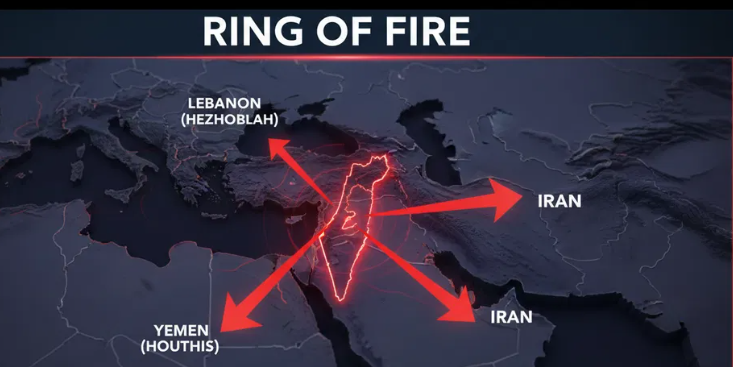
By opening a southern front, the Houthis are executing what military strategists refer to as the “Ring of Fire” doctrine. This approach aims to encircle Israel with hostile forces capable of launching coordinated, multi-directional attacks. The strategic objective is to force Israel to divide its sophisticated, yet finite, air defence resources—such as the Iron Dome, David’s Sling, and the Arrow systems, between threats from the north (Hezbollah), the east (Iran and Iraqi militias), and now the south (Yemen).
Military analysts suggest this multi-front approach is designed to overwhelm Israeli interceptors and create “strategic depth” for Iran.
“The Houthi entry into the war raises the prospects of a broader regional confrontation. This is especially concerning given their ability to strike targets far beyond Yemen. They can also disrupt critical shipping lanes,” noted a regional security expert.
Asymmetric Warfare and Multi-Domain Conflict
The nature of the Houthi attacks highlights the evolving dynamics of asymmetric warfare in the Middle East. The Houthis are a non-state actor operating in a war-torn country. They possess an arsenal capable of striking a technologically advanced state. This state is over 1,000 miles (1,600 kilometres) away.
Cruise missiles and drones were used in the second wave of attacks. This use presents a distinct challenge to Israeli air defences. This challenge is unlike the one posed by high-altitude ballistic missiles used in the first strike. Cruise missiles and loitering munitions (often referred to as “kamikaze drones”) fly at lower altitudes. They can follow unpredictable flight paths. They are more difficult for traditional radar systems to detect until they are close to their targets.
This tactic aligns with the theory of “cost-imposing strategies.” A Houthi drone may cost only tens of thousands of dollars to manufacture. In contrast, the interceptor missiles required to shoot it down can cost millions. Over time, this economic asymmetry places a significant financial burden on the defending nation, a key tenet of attrition warfare.
The Red Sea Chokepoint: Global Economic Implications
There is a direct kinetic threat to Israeli territory. The Houthi vow to continue attacks has reignited profound fears for maritime security in the Red Sea. It also heightens concerns in the Bab al-Mandab Strait. This narrow waterway is one of the world’s most critical maritime chokepoints. It handles approximately 12% of global trade. This includes vital energy shipments from the Gulf to Europe.
The geopolitical theory of “chokepoint control” explains that actors who can threaten or close these narrow passages hold a significant advantage. These actors wield disproportionate global influence. The Houthis have previously shown their willingness to use missile and drone capabilities. They have the ability to target international shipping. This tactic severely disrupted global trade after the October 7, 2023, attacks and the subsequent war in Gaza.
The Houthis are threatening to escalate their military campaign. They are not only pressuring Israel but also holding the global economy hostage. This strategy forces international powers, particularly the United States and its European allies, to divert naval resources. They do this to protect shipping lanes. This internationalises the conflict and increases the pressure on Israel to de-escalate.
Diversionary War Theory
To fully understand the Houthi calculus, one must also look at the domestic situation in Yemen. In international relations, the “diversionary war theory” suggests that leaders may start or join foreign conflicts. This is done to distract their populations from domestic crises. It also serves to consolidate internal support.
Yemen remains deeply fractured after a decade of civil war. It faces severe economic hardship and widespread poverty. Additionally, there is a fragile, UN-brokered truce. The Houthi leadership positions itself as the vanguard of the “Axis of Resistance.” They take direct action against Israel. Through these actions, they seek to bolster their legitimacy at home and across the broader Arab and Islamic world.
This anti-Israel stance is deeply woven into the group’s ideology, their official slogan includes the phrase “Death to Israel”, and acting upon it provides a powerful rallying cry that transcends domestic political divisions. It allows the Houthis to project an image of strength and defiance, distracting from their governance failures in the territories they control.
The Israeli and International Response: Navigating Escalation
The Israeli military confirmed it had identified and intercepted several launches from Yemen. However, it has not yet detailed the extent of any damage from the second wave of attacks. Intercepting these threats over the Red Sea requires immense coordination. This often happens before they reach Israeli airspace. It also requires advanced technology.
Israeli officials have previously warned that any direct attack from Yemen would be met with a “significant response.” This raises the distinct possibility of Israeli airstrikes on Houthi-controlled areas in Yemen, such as the vital port city of Hodeidah, which Israel has targeted in the past to disrupt the flow of Iranian weapons.
However, retaliatory strikes carry their own risks. The theory of “escalation dominance” explains that a state must control the pace of a conflict. It must also manage the intensity to achieve its objectives. Striking Yemen could provoke further Houthi attacks on shipping or regional US bases, drawing the United States deeper into the conflict.
The United States has maintained a heavy naval presence in the region under Operation Prosperity Guardian. This is to protect Red Sea shipping. However, it has yet to confirm if its forces were involved in intercepting the latest Houthi launches. Washington faces a delicate balancing act. It must deter further Houthi aggression. At the same time, it needs to avoid triggering a full-scale regional war that could directly draw in Iran.
The entry of Yemen’s Houthis into the current Israel-Iran conflict marks a perilous new chapter. This war shows no signs of de-escalation. The attacks are not merely isolated incidents. They are part of a broader, calculated geopolitical strategy. This strategy is designed to stretch Israeli defences, disrupt global trade, and project Iranian influence across the Middle East.
As the Houthis promise more strikes in the coming days, the international community remains on high alert. The conflict has definitively moved beyond a bilateral confrontation. It has evolved into a complex, multi-domain regional war. The actions of a rebel group in Yemen can send shockwaves through global markets. They can also alter the strategic calculus of superpowers.