
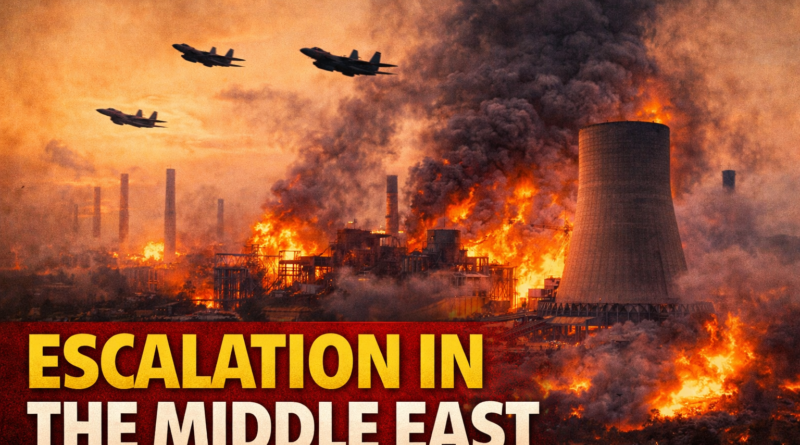
Iran Condemns US Power Plant Threats as Middle East Conflict Escalates
Tensions across the Middle East have escalated sharply. This follows Iranian President Masoud Pezeshkian’s condemnation of recent US threats targeting the country’s energy infrastructure. Pezeshkian described these threats as a sign of “desperation” amidst a rapidly expanding regional conflict. This development comes as missile strikes continue across various fronts, raising fears of a wider confrontation with severe global implications.
President Pezeshkian, in a recent statement, asserted that pressure from Washington would not undermine Tehran’s resolve. He reiterated that the Strait of Hormuz is a vital artery for global oil shipments. It remains open to international navigation. However, he issued a stern warning. Any infringement upon Iran’s sovereignty will be met with a decisive response. This declaration underscores the precarious balance of power in a region already grappling with intense military exchanges.
The Energy Ultimatum: US Threats and Iranian Retaliation
The current surge in tensions was precipitated by a stark warning from US President Donald Trump. President Trump made a critical indication. American forces might target Iranian power facilities. This action will occur if the Strait of Hormuz is not fully accessible within a short timeframe. This ultimatum has significantly raised the stakes, transforming the ongoing regional skirmishes into a potential direct confrontation over critical infrastructure.
Iranian officials have unequivocally stated that any attack on their energy infrastructure would trigger a robust retaliation. The Islamic Revolutionary Guard Corps (IRGC)-affiliated Mehr news agency notably circulated a map illustrating potential targets across the region. The map included energy facilities in the United Arab Emirates, Saudi Arabia, Qatar, and Kuwait. It was accompanied by the ominous message, “Say goodbye to electricity!” This graphic demonstration shows Iran’s readiness to expand the conflict scope. It targets regional energy assets, increasing the risk of a broader economic and geopolitical crisis.
The Strategic Importance of the Strait of Hormuz
The Strait of Hormuz, a narrow maritime chokepoint, is arguably the world’s most critical energy corridor. A substantial portion of global oil shipments, alongside liquefied natural gas (LNG), transits through this waterway daily. Any disruption to its free passage carries immediate and profound consequences for international markets and supply chains. The recent closure of the Strait has already led to a significant impact on global energy supplies. Approximately 20% of the world’s oil and LNG supply has been affected. This disruption has caused Brent crude prices, the international benchmark, to surge by over 50%, reaching approximately $112 per barrel.
Iran warns repeatedly about restricting access to the Strait of Hormuz. These warnings arise particularly in response to perceived threats to its own infrastructure. This underscores the strategic leverage Iran holds. Military analysts suggest that an escalation involving energy facilities will lead to the broader targeting of regional infrastructure. This escalation further destabilizes global energy markets. It also triggers an international economic downturn.
Missile Strikes and Escalation
The conflict’s expansion is evident in the recent missile strikes that have targeted sensitive areas. Emergency services in Southern Israel reported over 160 injuries and one fatality following missile strikes near Dimona, a city in close proximity to Israel’s primary nuclear research facility. The attack near Dimona is widely interpreted as a significant escalation, signaling a “new stage of battle” where, as Iranian Parliament speaker Mohammad Bagher Ghalibaf asserted, “Israel’s skies are defenceless.” This incident has intensified concerns about the potential for nuclear facilities to become targets in the escalating conflict.
Concurrently, Tehran has experienced fresh air strikes, with air defense systems activated across parts of the capital. These exchanges highlight the multi-front nature of the confrontation. The conflict extends beyond the immediate vicinity of the Strait of Hormuz and reaches into the heart of both nations.
Regional Firestorm: Beyond Iran and Israel
The conflict’s widening scope now encompasses several regional actors, transforming it into a complex, multi-front confrontation. Israeli forces have conducted air strikes in Lebanon, targeting infrastructure and positions linked to Hezbollah, a powerful political and paramilitary organization. Lebanese officials have voiced concerns that attacks on key bridges could be a precursor to a ground operation, further exacerbating the humanitarian crisis and civilian displacement in the region.
Saudi Arabia and the United Arab Emirates have confirmed intercepting drones and missiles aimed at their territories. This indicates that the conflict’s reach extends to other Gulf states. This broader involvement underscores the interconnectedness of regional security and the potential for rapid, widespread destabilization.
The Civilian Toll: A Growing Humanitarian Crisis
Amidst the intensifying strikes, civilians across the region face increasing uncertainty and hardship. Residents in Tehran are apprehensive about potential disruptions to essential services, including electricity and water, should power plants be targeted. In Israel, communities have reported significant structural damage to homes and public buildings. Medical services are overwhelmed with treating a growing number of injured individuals. The human cost of the conflict continues to mount. International organizations express grave concern over the humanitarian impact. They worry about the potential for further escalation.
Adding to the civilian plight, Iran has been experiencing a 23-day internet blackout, the longest in the country’s history. This information vacuum happens alongside state media’s focus on perceived victories. The suppression of details regarding US and Israeli attacks makes it difficult for citizens to access accurate information. It also hinders their ability to communicate freely.
Global Reaction and Diplomatic Efforts
The international community has reacted with alarm to the escalating tensions. The G7 nations have demanded an “immediate and unconditional cessation of all attacks by the Iranian regime.” This reflects widespread concern among major global powers. Similarly, the European Union has urged for “maximum restraint.” They emphasize adherence to international law. The EU stresses the need to prevent further escalation that could affect Europe and beyond.
Despite the ongoing hostilities, there are cautious signs of potential diplomatic engagement. Rafael Grossi leads the International Atomic Energy Agency (IAEA). He has indicated that communication channels between Iran and the United States can still be re-established. This offers a glimmer of hope for future negotiations. However, Grossi has also warned that military strikes will set back Iran’s nuclear program. Yet, they are unlikely to eliminate it entirely. This underscores the complexity of the nuclear dimension of the conflict. The UN experts have also called for de-escalation and accountability, stressing that there is no viable alternative to diplomatic dialogue.
Capabilities and Risks
The military capabilities of both sides remain a critical factor in the conflict’s trajectory. Some military officials suggest Iran possesses missiles capable of reaching parts of Europe. However, experts note that the long-range accuracy of such threats remains limited. These threats are not an immediate concern. The recent strikes near Dimona show Iran’s capacity to target sensitive Israeli sites. This challenges the perception of Israeli air superiority.
Conversely, the US and Israeli forces have shown their air power. They have carried out strikes on various Iranian targets. These include natural gas facilities and fuel reserves. The ongoing debate over missile capabilities continues. The effectiveness of air defense systems is questioned. This situation highlights the unpredictable nature of modern warfare. It also underscores the constant risk of miscalculation.
Future Scenarios
The combination of threats to energy infrastructure, ongoing missile exchanges, and expanding regional involvement indicates that the conflict is entering a critical phase. Analysts warn that without rapid de-escalation, the crisis could lead to several severe outcomes:
•Disruption of Global Energy Markets: A prolonged closure of the Strait of Hormuz or attacks on regional energy facilities would severely impact global oil and gas supplies, leading to sustained price hikes and potential economic recession.
•Expansion into Additional Countries: The involvement of Lebanon, Saudi Arabia, and the UAE suggests a high risk of the conflict spreading further, drawing in more regional and international actors.
•Increased Risks of Broader International Confrontation: The direct threats between the US and Iran, coupled with the involvement of allies, raise the specter of a wider international conflict with unpredictable consequences.
Conversely, a best-case scenario would involve a diplomatic breakthrough. The IAEA or other international bodies could facilitate this. It would lead to a ceasefire and renewed negotiations. However, given the current volatility and entrenched positions, such an outcome appears challenging.
The Middle East stands at a perilous crossroads. Tensions between Iran and the US are escalating. Threats to vital energy infrastructure and retaliatory missile strikes fuel these tensions. This situation has created an environment of extreme volatility. Multiple regional actors are involved in this conflict. It significantly impacts global energy markets. These factors underscore the far-reaching consequences of this conflict. Diplomatic channels remain a faint hope. However, the immediate outlook suggests a high risk of further escalation. There will be profound humanitarian and economic repercussions for the region and the world. The international community’s concerted efforts towards de-escalation and dialogue are more critical than ever to avert a catastrophic wider war.))