
Dubai Under Attack: Missiles, Drones and a Region on the Brink of War
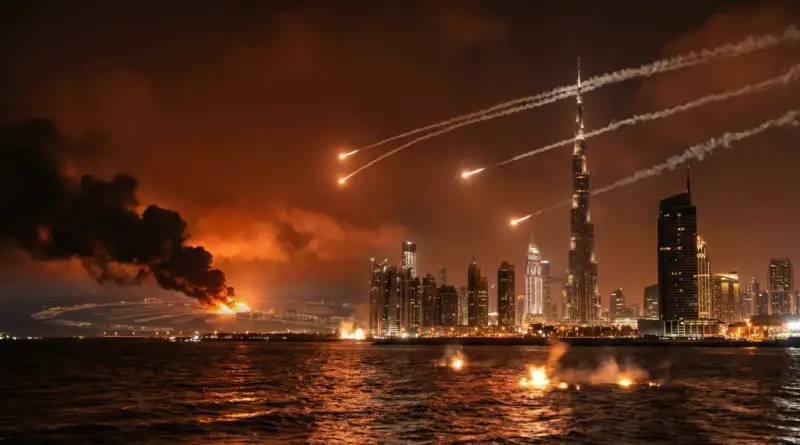
For two consecutive days, the gleaming desert metropolis of Dubai , a city that has spent decades positioning itself as the world’s most ambitious symbol of peace, prosperity, and cosmopolitan ambition, has been rocked by missiles and drones. The attacks, launched by Iran as part of a sweeping retaliatory campaign following a joint US-Israeli military operation that killed Supreme Leader Ayatollah Ali Khamenei, have shattered the city’s carefully cultivated image of invulnerability and left millions of residents, expatriates, and tourists in a state of profound shock.
Thick black smoke billows from iconic landmarks. The piercing wail of air raid sirens echoes across skyscraper canyons. Fiery white trails of missile interceptions arc across the night sky. These once-unthinkable scenes have become a terrifying new reality. Dubai’s famed skyline showcases human engineering and financial ambition. Now, it serves as the backdrop to a conflict. This conflict has turned one of the world’s most visited cities into a frontline of a rapidly escalating regional war.
Geographic Context: Understanding Dubai’s Strategic Vulnerability
To grasp the attacks’ scale and significance, understanding Dubai’s geography is crucial. Additionally, knowing its place in the regional order is essential. Dubai is the second-largest emirate in the United Arab Emirates. It is situated on the southeastern coast of the Arabian Peninsula. It lies directly across the Persian Gulf from Iran. The two countries are separated by only approximately 200 kilometres (125 miles) of open water at the narrowest point. A modern ballistic missile can cover this distance in under three minutes.
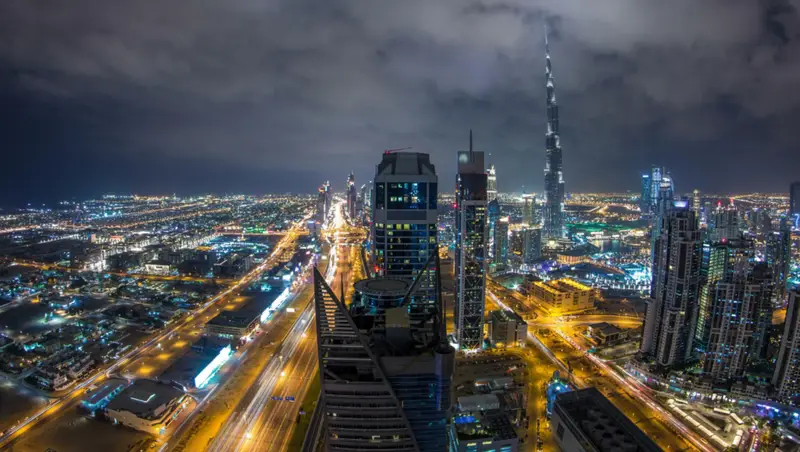
The city itself is a sprawling coastal conurbation stretching roughly 35 kilometres along the Gulf coastline. The Palm Jumeirah is one of its most iconic features. This palm-tree-shaped artificial archipelago juts 5 kilometres into the Gulf. It was constructed between 2001 and 2006. The Palm Jumeirah is home to some of the world’s most exclusive hotels and residences. The Fairmont The Palm hotel sits at the heart of the Palm’s trunk. It is at approximate coordinates 25°06’N, 55°08’E. The hotel is directly exposed to the Gulf waters. This week has demonstrated its exposure to any projectile launched from Iranian territory to the north.
Further south along the coast, approximately 35 kilometres southwest of central Dubai, lies the Jebel Ali port complex. It is the world’s largest man-made harbour. It is also the ninth busiest port globally. Operated by DP World, the port handles over 14 million twenty-foot equivalent units (TEUs) of cargo annually. It serves as the primary gateway for goods entering and leaving the Middle East. The port connects trade routes between Asia, Europe, and Africa. Its strategic and economic importance is immense. A sustained disruption to Jebel Ali would send shockwaves through global supply chains far beyond the region.
Dubai International Airport (DXB) is located in the Garhoud district on the northeastern edge of the city. It is approximately 4 kilometres from the Dubai Creek. This airport is the world’s busiest international airport. It handles over 90 million passengers annually in normal times. It serves as the hub of Emirates airline. Emirates is one of the world’s largest carriers. The airport is also a critical transit point for long-haul flights connecting Europe, Asia, Africa, and the Americas. Its closure has had immediate and cascading consequences for global air travel.
The Scale of the Attack: A Military Barrage of Historic Proportions
The UAE’s Ministry of Defence has released detailed figures that underscore the extraordinary scale of Iran’s retaliatory campaign. On Saturday alone, Iran fired 137 ballistic missiles and 209 kamikaze drones at UAE territory. Of these, 152 ballistic missiles were destroyed and 195 drones were intercepted. However, 14 drones fell within the country’s territory and waters, causing the fires, structural damage, and casualties that have dominated global headlines .
The drones used in the attack are believed to be primarily the Shahed-136 and its upgraded variant, the Shahed-136B. These are Iranian-designed loitering munitions. They fly at low altitude to evade radar detection before diving onto their targets. These are the same weapons that Iran supplied to Russia for use in Ukraine. Their deployment against Gulf states marks a significant and alarming escalation in their operational use.
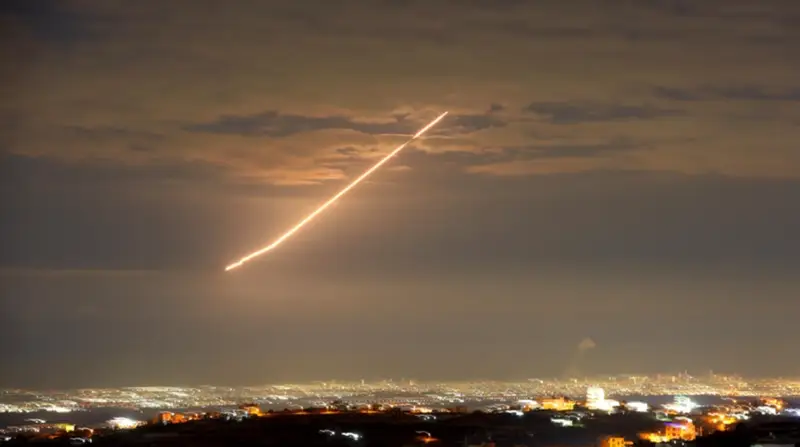
To intercept this barrage, the UAE activated its layered missile defence architecture. At the highest tier, the country operates the Terminal High Altitude Area Defense (THAAD) system. It was developed by Lockheed Martin and acquired from the United States. THAAD is designed to intercept ballistic missiles during the terminal phase of their flight — as they descend toward their targets — using a “hit-to-kill” kinetic interceptor that destroys incoming missiles through direct impact rather than an explosive warhead. At the lower tier, the UAE deploys the MIM-104 Patriot system, which handles shorter-range threats and aircraft. Together, these systems form a formidable shield. However, the sheer volume of projectiles launched by Iran meant that some inevitably broke through.
The debris from intercepted missiles and drones fell at high velocity. This fall from altitudes of several kilometers itself became a lethal hazard. This debris caused the fires at the Burj Al Arab. It also caused damage to Dubai International Airport and fires at the Jebel Ali port. The UAE Ministry of Defence confirmed that two people were injured in Dubai when shrapnel from intercepted drones fell over two residential houses.
A City Under Fire: Landmark by Landmark
The Fairmont The Palm Hotel
The Fairmont The Palm is a 381-room luxury resort. It is located on the south side of the Palm Jumeirah’s trunk. It was struck directly by a large explosion. Social media videos, verified by international news agencies, showed fires breaking out near the hotel’s entrance and lobby. Thick smoke was rising above the palm fronds. Four people were injured in the blast. The hotel charges upwards of $500 per night for a standard room. It was evacuated. Firefighters worked to bring the blaze under control.
The Burj Al Arab
The Burj Al Arab is the iconic sail-shaped hotel. It has become the defining image of Dubai’s ambition. The hotel suffered a “minor fire” on its outer facade. This happened after debris from an intercepted drone struck the structure. Authorities were quick to state that the fire was contained and no injuries were reported at the hotel itself. Nevertheless, the symbolic impact of seeing smoke rising from what is arguably the most recognisable building in the Arab world was immense .
Dubai International Airport (DXB)
Dubai International Airport sustained damage to part of its terminal infrastructure in what authorities described as an “incident.” Four members of airport staff were injured. The airport, which handles flights from over 240 destinations worldwide, was immediately closed to all incoming and outgoing traffic. Emirates airline operates its entire global network from DXB. The airline announced the suspension of all operations until at least Monday afternoon. The closure has stranded hundreds of thousands of passengers and disrupted the travel plans of millions more .
Jebel Ali Port
The port is located in the Jebel Ali Free Zone (JAFZA). This is a vast industrial and commercial district that is home to over 9,500 companies from 100 countries. The port sustained a fire in one of its berths after debris from an aerial interception fell onto the facility. The fire was visible for miles. Thick black smoke rose high enough to be seen from the city centre. The city centre is approximately 35 kilometres away. The disruption to port operations has added to the already severe strain on regional supply chains .
Etihad Towers, Abu Dhabi
In the UAE’s capital, Abu Dhabi, debris from an intercepted drone struck the Etihad Towers complex. The complex is a group of five towers on the Corniche waterfront. These towers house offices, residences, and, critically, the Israeli embassy and several other international diplomatic missions. A woman and her child sustained minor injuries in the incident, according to Abu Dhabi’s state media office.
Al-Salam Naval Base, Abu Dhabi
The UAE Ministry of Defence confirmed an incident involving two Iranian drones. The drones targeted a warehouse at the Al-Salam naval base in Abu Dhabi. The attack caused a fire in two containers storing general materials. No casualties were reported. The ministry condemned the strike as a “blatant act of aggression.” They called it a “flagrant violation of national sovereignty and international law.” The UAE added that they reserve the right to respond to the escalation. They will take all necessary measures to protect its territory, people, and national interests.
The Human Cost: Three Dead, Dozens Injured, Thousands Stranded
The UAE’s Ministry of Defence has confirmed that three people have been killed since the strikes began, and 58 others have been injured. The three fatalities have been identified as nationals of Pakistan, Nepal, and Bangladesh , a sobering reflection of the reality that Dubai’s population is approximately 90% expatriate, drawn from across South Asia, Southeast Asia, the Arab world, and beyond. The vast majority of those living and working in the city are foreign nationals who came in search of economic opportunity and now find themselves caught in a conflict not of their making .
For the residents and tourists caught in the crossfire, the experience has been profoundly disorienting. The constant threat of attack has forced many to stay indoors. This is a stark contrast to the city’s usually frenetic street life.
“It’s still relatively calm as there are only loud noises every few hours. “This place feels eerie,” said Satya Jaganathan, a 35-year-old resident. “This is not the Dubai we are used to.” Her weekend hiking plans were abruptly cancelled. Her sister’s family lives in a high-rise apartment close to the Jebel Ali port. They had to seek shelter in their building. Debris rained down on the surrounding area.
Becky Williams, another resident, described watching approximately 15 missile interceptions from her balcony. She saw a series of blinding flashes and rolling booms that shook the windows of her apartment. “You can hear the interceptions happening in the air,” she said. She expressed a cautious confidence in the UAE military’s ability to defend the country.
British tourist Judy Trotter was due to fly back to London on Saturday. She arrived at the airport to find all flights cancelled. She was among approximately 1,000 stranded passengers bussed to a hotel. At the hotel, they were warned to stay away from the windows. “There is a lot of glass in the hotel which is worrying,” she said. “I’ve met people who were very upset about their travel plans, there were thousands of people in the airport. I met people who told me they were missing funerals.”
Kate Fischer, a holidaymaker from Buckinghamshire in England, described her family as “very frightened.” She and her partner packed a “grab bag” with passports and essential documents as their children slept, and soaked bathrobes and towels in water in case they needed to escape a fire during the night. “It’s a very surreal experience being surrounded by everyone trying to enjoy their holiday and trying to entertain their children whilst we can see visible smoke from nearby areas that have been hit by drones or missiles,” she said.
Reality television personality Vicky Pattison, who had been holidaying in Dubai with her husband Ercan Ramadan, found their outbound flight to Australia cancelled. She wrote on Instagram: “We’re thinking of everyone who is feeling unsettled and unsafe right now.”
The Spark: ‘Operation Epic Fury’ and the Death of a Supreme Leader
The immediate trigger for this unprecedented escalation was a joint US-Israeli military operation codenamed “Operation Epic Fury” by the Pentagon and “Roaring Lion” by the Israeli military. The strikes were launched in the pre-dawn hours of Saturday, 28 February 2026, following the collapse of nuclear negotiations between Washington and Tehran. The most recent round of talks had concluded just two days earlier, on Thursday, in Geneva, without agreement .
The operation was launched from the USS Gerald R. Ford carrier strike group operating in the region, with waves of Tomahawk cruise missiles, air-launched precision weapons, HIMARS rockets, and long-range standoff munitions targeting key military and nuclear facilities across Iran. Explosions were reported in Tehran, the nearby city of Karaj, Isfahan, Qom, and Kermanshah. The strikes targeted Islamic Revolutionary Guard Corps (IRGC) facilities, air defence capabilities, missile and drone launch sites, military headquarters, and nuclear-related facilities .
In a move that sent shockwaves across the globe, the operation killed Iran’s Supreme Leader, Ayatollah Ali Khamenei, 86, at his compound in Tehran. Khamenei, who had ruled the Islamic Republic for 37 years, since the death of the revolution’s founder, Ayatollah Ruhollah Khomeini, in 1989, was the second and final supreme leader in Iran’s history. His death represents the most consequential political event in Iran since the 1979 Islamic Revolution itself .
The operation also killed the military’s chief of staff, General Abdul Rahim Mousavi, and a number of other senior officials. Three US service members were killed in action during the operation, and five others were seriously wounded, according to US Central Command .
The strikes also targeted Iran’s nuclear infrastructure. This built on a previous US-Israeli operation in June 2025, codenamed “Operation Midnight Hammer.” This operation had decimated Iran’s enrichment facilities at Fordow and Natanz. It also destroyed metallurgical facilities at Isfahan. The current wave of strikes appears to have targeted peripheral nuclear capabilities, including administrative hubs, dual-use scientific research facilities, the Iran Atomic Energy Agency headquarters in Tehran, and the explosive research testing facility at Parchin .
President Donald Trump, who oversaw the assault from his Mar-a-Lago residence in Palm Beach, Florida, announced the operation in a video statement, saying: “We are going to destroy their missiles and raze their missile industry to the ground.” He also called on the Iranian people to “take over your government” once the bombing was complete, and told IRGC forces to “lay down your arms.”
Iran’s Retaliation: A Region Set Ablaze
Iran’s response was swift, overwhelming, and geographically vast. The Islamic Revolutionary Guard Corps announced it was carrying out retaliatory attacks on 27 military bases where US soldiers are deployed, the Israeli Tel Nof Airbase, the Israeli army’s command headquarters at HaKirya in Tel Aviv, and a large defence industrial complex. Iran’s parliamentary speaker, Mohammad Bagher Qalibaf, declared in a televised address: “You have crossed our red line and must pay the price. We will deliver such devastating blows that you yourselves will be driven to beg.”
The retaliatory strikes spread across an extraordinary geographic arc, from the Gulf to the Levant:
United Arab Emirates: As detailed above, 137 ballistic missiles and 209 drones were launched at the UAE, targeting Dubai, Abu Dhabi, and the Jebel Ali port complex. Three people were killed and 58 injured .
Qatar: Iranian forces launched 65 missiles and 12 drones at Qatar, most of which were intercepted by Qatari air defences. However, 16 people were injured in the salvos, with one in critical condition. Witnesses in Doha reported hearing several loud bangs and seeing thick black smoke rising on the horizon in the south of the city, near the industrial zone .
Bahrain: An Iranian drone flew into a high-rise building in Manama in what appeared to be a targeted attack, engulfing the skyscraper in flames. The country’s national security agency headquarters was also struck by an Iranian missile. Social media footage appeared to show a missile hitting the massive US Naval Support Activity Bahrain — the home of the US Navy’s Fifth Fleet — which is one of the most important American military installations in the region .
Kuwait: Sirens were heard across Kuwait City as Iranian missiles and drones targeted the country. Kuwaiti air defences successfully intercepted the attack. However, the incident prompted the Foreign Ministry to invoke Article 51 of the UN Charter. This is the right to self-defence.
Jordan: In the northern city of Irbid, fires blazed as missile shrapnel fell from the sky after Jordanian defence systems intercepted ballistic missiles that entered the country’s airspace. Further interceptions were reported over the capital, Amman .
Oman: In a significant escalation, Oman, which had been serving as the primary mediator in negotiations between Iran and the United States — was struck for the first time. Two drones hit the commercial port of Duqm, located in the Al Wusta Governorate in central Oman, approximately 550 kilometres south of Muscat. One drone struck a mobile workers’ accommodation unit, injuring one foreign worker, while debris from the second landed near fuel tanks without causing further casualties. The attack was condemned by the Gulf Cooperation Council as an assault on “the very principle of mediation” .
Iraq: A drone crashed near Erbil International Airport in northern Iraq, in the semiautonomous Kurdistan Region where US forces remain deployed as part of an international coalition. A large plume of smoke was reported rising from the area .
Israel: Iran launched missiles directly at Israel, with air raid sirens sounding repeatedly across the country, including in Tel Aviv. At least nine people were killed and 27 injured in a missile strike on the Israeli city of Beit Shemesh, located approximately 30 kilometres west of Jerusalem .
The Geographic Chokepoint: The Strait of Hormuz and the Global Energy Crisis
The conflict has several concerning aspects. Beyond the immediate human suffering, it threatens the global energy supply through the Strait of Hormuz. This narrow waterway, located between the UAE and Oman on the southern shore and Iran on the northern shore, is just 33 kilometres (21 miles) wide at its narrowest point, with the navigable shipping lane only 3 kilometres (2 miles) wide in each direction. Despite this extraordinary narrowness, it is the single most important maritime chokepoint in the world.
The US Energy Information Administration reports that about 20 million barrels of oil transited the Strait of Hormuz each day in 2024. This oil was worth around $500 billion in the annual global energy trade. This represents roughly 30% of the world’s total seaborne crude oil. Additionally, nearly 20% of global liquefied natural gas (LNG) shipments pass through the strait. Qatar accounts for the vast majority of these volumes. It is now under Iranian attack. The crude oil passing through originates from Iran, Iraq, Kuwait, Qatar, Saudi Arabia, and the UAE. It flows primarily to Asian markets. China, India, Japan, and South Korea together account for 69% of all crude oil flows through the strait.
Since the conflict began, an EU official confirmed that vessels crossing the strait had been receiving VHF radio transmissions. The IRGC stated that “no ship is allowed to pass the Strait of Hormuz.” Iran has not formally closed the strait. Such a decision would require ratification by the Supreme National Security Council. However, the threat alone has been sufficient to cause a dramatic disruption. Shipping data shows that at least 150 tankers have dropped anchor in open Gulf waters beyond the strait. These include crude oil and LNG vessels. They are waiting for the situation to resolve. Shipping giant Maersk has paused all Trans-Suez sailings through the Bab el-Mandeb Strait. They have suspended all vessel crossings in the Strait of Hormuz. The company is rerouting ships around the Cape of Good Hope. This adds weeks to journey times and significant costs.
At least three tankers have already been damaged in the Gulf since the conflict began. An oil tanker was struck off the coast of Oman on Sunday. This incident signals a clear escalation toward targeting energy assets. Brent crude oil had already risen nearly 20% year-to-date to $72.48 per barrel before the conflict began. Analysts at Kpler warn that a prolonged disruption could push prices into triple digits. Ali Vaez, director of the Iran project at the International Crisis Group, stated: “Closure of the Strait of Hormuz would disrupt roughly a fifth of globally traded oil overnight.” Prices wouldn’t just spike. They would gap violently upward on fear alone. The shock would reverberate far beyond energy markets. It would tighten financial conditions. It would fuel inflation. Fragile economies would be pushed closer to recession in a matter of weeks.
The Travel Catastrophe: Over 3,400 Flights Cancelled
The conflict has triggered one of the most significant disruptions to global air travel since the COVID-19 pandemic. As of Sunday, over 3,400 flights to and from the Middle East have been cancelled. Hundreds of thousands of passengers are stranded at airports across the world.
Airspace over Iran, Israel, Iraq, Qatar, Bahrain, Kuwait, Syria, and the UAE has been closed entirely. There is a partial closure over Saudi Arabia. Jordanian and Lebanese airspace remains technically open but with severely limited flight activity. Flights between Europe and Asia that would normally route over the Gulf or Iran are being diverted via Saudi Arabia or the Caucasus, adding hours to journey times .
Emirates, the world’s largest long-haul airline by scheduled international passengers, has suspended all operations in and out of Dubai. This suspension is expected to last until at least Monday afternoon. Etihad Airways has suspended flights out of Abu Dhabi. British Airways has cancelled services to Tel Aviv and Bahrain until Wednesday and warned that flights to Abu Dhabi, Amman, Bahrain, Doha, Dubai, and Tel Aviv could be affected for several days. Virgin Atlantic has suspended services between London and Riyadh and Dubai, and warned that flights to India, Saudi Arabia, and the Maldives may take longer due to rerouting. Qatar Airways has suspended all operations pending the reopening of Qatari airspace .
The UK Foreign Office has issued stark travel warnings. It advises against all but essential travel to Bahrain, Kuwait, Qatar, and the UAE. British nationals already in those countries have been advised to shelter in place. Government officials are creating contingency plans. These plans are for the potential evacuation of UK nationals from the Middle East. The timeline remains unclear due to the closed airspace.
Diplomatic Fallout: A Region Divided and a World Alarmed
The attacks have triggered a wave of diplomatic condemnation and alarm across the region and beyond.
Saudi Arabia condemned the Iranian strikes in the “strongest terms,” calling them a “blatant Iranian aggression and flagrant violation of the sovereignty” of the UAE, Bahrain, Qatar, Kuwait, and Jordan. The kingdom affirmed its “full solidarity” with the affected countries and placed “all its capabilities” at their disposal. Saudi Crown Prince Mohammed bin Salman spoke by phone with Turkish President Recep Tayyip Erdogan, who warned that unless “the necessary intervention is made,” the conflict could have “serious” regional and global implications .
Qatar called the Iranian strikes on its territory “a direct assault on national security.” They described it as “a flagrant violation of its national sovereignty.” Qatar’s Foreign Ministry strongly condemned the attacks. It noted that the country had “long advocated dialogue with Iran.” The ministry warned that renewed attacks “do not reflect goodwill and threaten the foundations of mutual understanding.”
Kuwait invoked Article 51 of the UN Charter, the right to self-defence. It did so in its formal response. Kuwait called the attacks “a blatant violation” of its sovereignty and airspace.
United Nations Secretary-General António Guterres condemned both the US-Israeli strikes on Iran and Iran’s retaliatory strikes, warning at an emergency UN Security Council meeting: “We are witnessing a grave threat to international peace and security. Military action carries the risk of igniting a chain of events that no one can control in the most volatile region of the world.”
Iran’s Foreign Minister Abbas Araghchi tried to justify the attacks on Gulf states. He insisted that his country had “no intention to attack” them directly. Instead, they were “attacking the American bases in the act of self-defence.” The Gulf states firmly rejected this framing. They noted that many of the strikes hit civilian and commercial areas. These areas were far from any US military installation.
Iran’s Leadership Crisis: A Nation in Transition
The death of Ayatollah Ali Khamenei has plunged Iran into a profound and unprecedented political crisis. Khamenei was only the second supreme leader in the Islamic Republic’s 47-year history. His death has triggered a constitutional succession process. This process has never before been tested in a time of active war.
Iran’s government has announced the formation of a three-person interim leadership council to oversee the transition. President Masoud Pezeshkian declared seven days of public holidays and 40 days of national mourning, and denounced Khamenei’s killing as “a great crime” and “a declaration of war against Muslims.” Tens of thousands of mourners filled the streets of Tehran. They gathered in other cities as well. The scenes were full of grief and fury.
Analysts caution that the leadership transition does not automatically mean regime change. Iran’s security apparatus, the IRGC, the Basij militia, and the intelligence services, remains intact and operational. It has demonstrated both the capability and the willingness to continue prosecuting the retaliatory campaign. This is possible even in the absence of a supreme leader. A US official told Al Jazeera that Washington expects the conflict to “last for weeks, not just days”. The conflict will continue until Washington can guarantee Iran does not possess nuclear weapons or ballistic missiles.
The Road Ahead: Diplomacy or Escalation?
As the conflict enters its third day, the world faces a stark and terrifying choice. We must choose between de-escalation through urgent diplomacy and a slide into a wider regional war. This conflict has potentially catastrophic global consequences.
President Trump told The Atlantic on Sunday that he had agreed to speak with Iranian representatives: “They want to talk, and I have agreed to talk, so I will be talking to them.” He lamented that Iran had not agreed to his nuclear demands earlier, saying: “They should have done it sooner. They should have given what was very practical and easy to do sooner. They waited too long.” However, he also warned that the US would hit Iran “with a force that has never been seen before” if the attacks continued, and told CNBC that the operation was “ahead of schedule” and “moving along very well” .
For Dubai, a city that has spent five decades transforming itself from a small pearl-fishing village, the attacks represent an existential challenge. It has become one of the world’s most visited and economically dynamic cities. They threaten its identity and its future. The immediate task is to protect its people, restore its infrastructure, and reopen its skies. The longer and harder task will be to rebuild the sense of security. Confidence has been violently and suddenly shattered.
The coming days will be decisive. The world watches, holds its breath, and hopes.
Key Facts at a Glance
| Category | Detail |
| Conflict trigger | Joint US-Israeli “Operation Epic Fury” kills Iran’s Supreme Leader Khamenei, 28 Feb 2026 |
| Iranian missiles fired at UAE | 137 ballistic missiles; 152 destroyed by UAE defences |
| Iranian drones fired at UAE | 209 kamikaze drones; 195 intercepted; 14 fell on UAE territory |
| UAE casualties | 3 killed (Pakistani, Nepalese, Bangladeshi nationals); 58 injured |
| Dubai landmarks hit | Fairmont The Palm, Burj Al Arab, Dubai International Airport, Jebel Ali Port |
| Other Gulf states attacked | Qatar, Bahrain, Kuwait, Oman, Jordan, Iraq, Israel |
| Flights cancelled globally | Over 3,400 as of Sunday; Emirates, Etihad, BA, Qatar Airways suspended |
| Strait of Hormuz | Effectively closed; 150+ tankers anchored; Maersk rerouting via Cape of Good Hope |
| Oil price impact | Brent crude at $72.48/barrel pre-conflict; analysts warn of triple-digit surge |
| US casualties | 3 service members killed; 5 seriously wounded in Operation Epic Fury |
| Iran leadership | Khamenei killed; 3-person interim council formed; 40 days of mourning declared |