

China Executes 11 Members of Myanmar-Based Scam Gang
China has executed 11 members of a powerful crime syndicate. They were linked to massive online scam operations based in Myanmar. This case has drawn international attention. It has renewed scrutiny of cybercrime networks in Southeast Asia.
The group, known as the Ming family crime organisation, operated from northern Myanmar near the Chinese border. They ran industrial-scale fraud schemes. These schemes targeted victims across China and other parts of Asia. Authorities say the gang stole billions of dollars through fake investment platforms. They used romance scams, cryptocurrency fraud, and impersonation schemes.
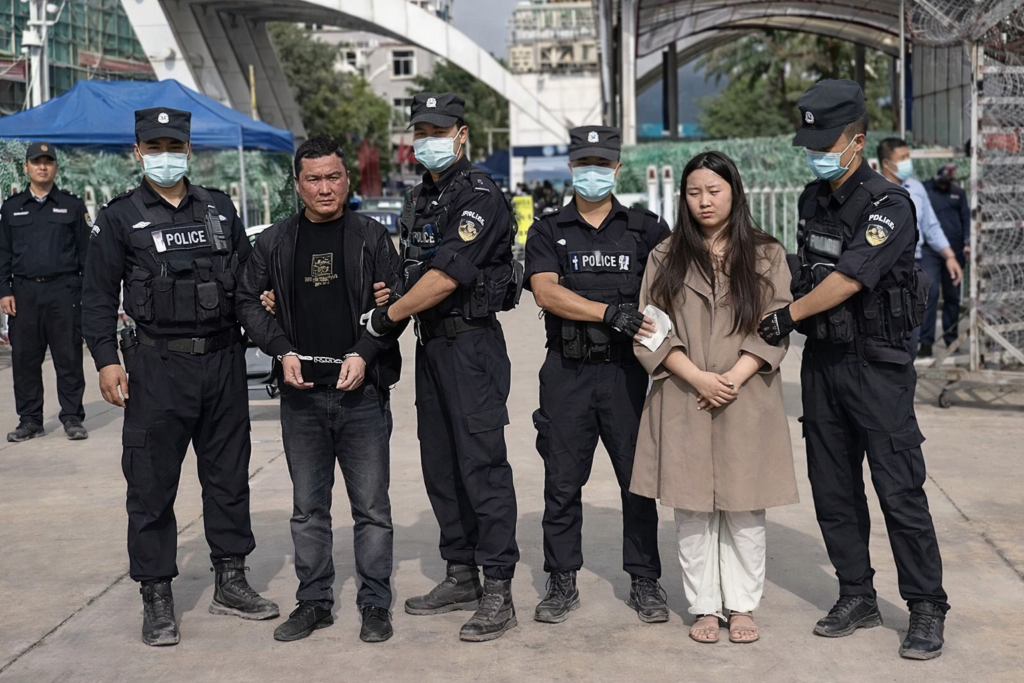
Chinese prosecutors said the group’s activities went far beyond financial fraud. Court documents described a system of human trafficking and forced labour. Thousands of workers were allegedly lured or abducted. They were then forced to work inside heavily guarded scam compounds.
Victims who failed to meet daily scam targets were reportedly subjected to beatings, electric shocks, starvation and prolonged confinement. Some deaths inside the compounds were also linked to abuse and untreated illness, according to Chinese investigators.
Harsh sentences after cross-border operation
The executions followed a major joint law enforcement effort involving China and regional authorities. After negotiations with armed groups in Myanmar, key leaders of the syndicate were handed over to Chinese custody. This transfer occurred in late 2024 and early 2025.
Chinese courts convicted the defendants of:
- Organising and leading criminal gangs
- Large-scale telecom and internet fraud
- Human trafficking
- Illegal detention
- Money laundering
- Intentional injury and related violent crimes
The death sentences were approved by China’s Supreme People’s Court and carried out in recent days, state media reported.
Chinese officials said the punishment reflected the “extreme seriousness” of the crimes and the scale of harm caused to society.
Scam cities in Myanmar
Northern Myanmar has become notorious in recent years for hosting vast scam complexes, sometimes described as “scam cities”. These operations flourished in regions controlled by militias. This situation allowed criminal networks to operate with little interference from the central government.
The Ming family syndicate is believed to have worked with:
- Local armed groups
- Corrupt officials
- Private militias
This protection enabled them to build fortified compounds. These compounds were complete with dormitories, security forces, and surveillance systems. Trafficked workers were forced to conduct scams around the clock in these facilities.
Victims came from multiple countries, including China, Thailand, Vietnam and Malaysia. Many were promised legitimate jobs before being trapped inside the facilities.
China’s message to criminal networks
Beijing has made the fight against telecom fraud a national priority. It is viewed as a major threat to economic stability and social trust. In recent years, Chinese authorities have frozen billions of dollars in scam-linked assets and arrested tens of thousands of suspects.
The executions are widely seen as:
- A warning to organised cybercrime gangs
- A signal of China’s willingness to pursue criminals abroad
- A demonstration of zero tolerance for human trafficking and scam operations
Officials say further arrests and extraditions are expected as pressure increases on crime hubs in Myanmar, Cambodia and Laos.
Human rights concerns
International human rights organisations have criticised China’s use of the death penalty. They argue that executions violate the right to life. They are also calling for greater transparency in judicial proceedings.
China maintains that the defendants received fair trials. Capital punishment is reserved for the most serious crimes. These crimes involve extreme violence and public harm.
A growing global problem
Online scam networks operating from Southeast Asia have expanded rapidly in recent years. They exploit weak governance, conflict zones, and advances in digital technology. The United Nations has warned about the rise of cyber-fraud and forced labour inside scam compounds. These now represent one of the fastest-growing forms of organised crime in the region.
Experts say the case highlights the need for:
- Stronger regional cooperation
- Victim rescue and rehabilitation
- Financial tracking of criminal profits
- Tighter regulation of online payment systems
What happens next
Chinese authorities say investigations are continuing into other syndicates linked to similar operations. Thousands of trafficked workers have been rescued in recent months, but officials admit many compounds are still active.
The execution of the 11 gang members marks one of the strongest actions yet against the transnational scam industry. It sends a clear signal that China intends to dismantle these networks by force of law.