Iran Warns of Retaliation Unless Israeli Strikes on Lebanon End
Iran retaliation fears have grown after Tehran warned it could respond unless Israeli strikes in Lebanon end, raising concerns over the fragile regional ceasefire.
Iran has warned that it will respond forcefully. This warning comes if Israel does not immediately halt its military campaign in Lebanon. There are fears that a fragile ceasefire between Washington and Tehran could quickly unravel.
The warning came from Iran’s Revolutionary Guard. They said continued Israeli strikes on Lebanese territory would bring what they described as a “regret-inducing response”. The statement was directed not only at Israel. It was also directed at the United States. Tehran accused the United States of supporting Israeli operations while publicly promoting diplomacy.
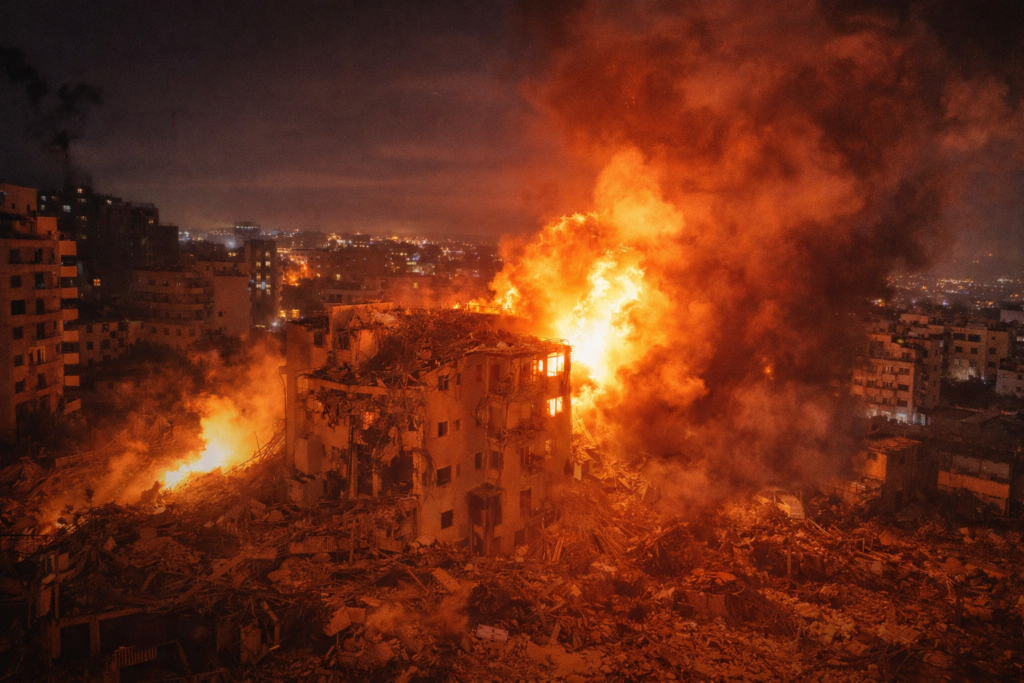
The threat followed one of the most intense days of Israeli bombardment in Lebanon since the conflict with Hezbollah escalated months ago. Israeli forces said they had carried out around 100 strikes in just 10 minutes, targeting what they described as Hezbollah military positions across southern Lebanon, the Bekaa Valley and areas near Beirut.
Lebanese officials said the scale of the attacks was unprecedented in recent weeks. The country’s health ministry reported that at least 112 people had been killed and more than 800 wounded.
The renewed violence has cast doubt. People question whether the recently announced two-week ceasefire between Iran and the United States can survive. Washington and Tehran agreed to temporarily pause direct hostilities. However, Israel and the US have made clear that the arrangement does not include Hezbollah or Lebanon.
Lebanon Left Outside the Ceasefire
Israeli Prime Minister Benjamin Netanyahu said the truce with Iran had no effect on Israel’s campaign against Hezbollah.
Speaking from Jerusalem, he insisted that Israel remained ready to resume wider military operations if necessary.
“Our finger remains on the trigger,” he said. He added that Israel had dealt “the greatest blow” to Hezbollah since the beginning of the ground operation in Lebanon.
Netanyahu said Israeli aircraft had struck 100 targets in only a few minutes and warned that military action would continue.
He also rejected suggestions that Israel had been sidelined in the negotiations between Washington and Tehran. According to Netanyahu, the temporary ceasefire was coordinated closely with the United States.
The Israeli leader sought to project unity with President Donald Trump, saying the two men speak daily.
Yet despite those assurances, there are signs of tension beneath the surface.
Many analysts believe Israel would have preferred to continue the campaign against Iran for longer. Netanyahu had repeatedly argued that Israel’s objective was to weaken Iran’s military capabilities. He also stated it was to eliminate Iran’s ability to threaten Israel with missiles and drones.
Those goals appear far from complete.
Only days earlier, Netanyahu had claimed that Israel had effectively neutralised the Iranian threat. In his latest remarks, however, he adopted a more cautious tone. He said only that Iran had been “set back by many years”.
That shift in language has fuelled speculation that Israeli officials know the ceasefire may not last.
Heavy Bombardment Across Lebanon
Wednesday brought the heaviest Israeli attacks Lebanon has experienced in this stage of the conflict.
For around ten minutes, residents across much of the country reported hearing almost continuous explosions.
Strikes hit southern Lebanon, eastern areas close to the Syrian border, and districts near the Lebanese capital.
In Beirut, one of the most serious attacks destroyed part of a residential tower block. Hours later, rescue workers were still searching through the wreckage.
Concrete slabs, twisted metal and shattered glass covered the streets. Families waited nearby, hoping for news of missing relatives.
Among the debris were signs of ordinary life interrupted without warning: children’s schoolbooks, family photographs, clothes and damaged furniture.
Emergency teams said many of those trapped beneath the rubble were civilians.
Abdelkader Mahfouz, whose brother was injured in the attack, described the scene outside the destroyed building.
“There were body parts everywhere,” he said. “Only ordinary people are being harmed. What can people do? We cannot stop this.”
The destruction has deepened anger and division within Lebanon.
Some Lebanese blame Hezbollah for dragging the country into another devastating conflict. Others accuse Israel of inflicting collective punishment on the population.
Many fear the country is once again being pushed towards a wider war that it cannot survive.
Lebanon has already been struggling with a severe economic crisis, political paralysis and the lasting effects of previous wars. The latest bombardment has added new pressure to a country where public services are stretched and thousands have already been displaced.
The Lebanese army has warned residents not to return to southern areas despite the ceasefire between Iran and the US.
Military officials said Israeli attacks were still continuing and that the situation remained too dangerous.
Iran Issues New Threats
Iran’s Revolutionary Guard accused Israel of using the ceasefire with Tehran as cover to intensify attacks on Lebanon.
The organisation said that if Israeli strikes continued, Iran would intervene.
The statement suggested Tehran sees Hezbollah as part of the same regional conflict and not as a separate issue.
That directly contradicts the position taken by the United States.
White House Press Secretary Karoline Leavitt said repeatedly that Lebanon was not part of the ceasefire agreement.
According to the White House, the deal applies only to direct hostilities involving Iran and the United States.
“Lebanon is not included,” Leavitt said. “That has been communicated clearly to all parties.”
She added that President Trump had spoken with Netanyahu and that Israel remained an essential partner in the next phase of negotiations.
The difference between the American and Iranian positions highlights the uncertainty surrounding the truce.
While Washington is trying to contain the conflict and move towards negotiations, Tehran appears ready to broaden the confrontation if Israeli attacks continue.
Diplomats fear that could rapidly collapse the ceasefire and trigger a wider regional war.
New Talks Planned in Pakistan
The White House has announced that Vice-President JD Vance will lead a US delegation to Pakistan for fresh negotiations aimed at extending the ceasefire and preventing further escalation.
The talks are due to begin in Islamabad on Saturday.
Vance will be joined by Trump adviser Steve Witkoff and Jared Kushner, the president’s son-in-law.
US officials say the next round of discussions will focus on several issues, including Iran’s nuclear programme, the future of the Strait of Hormuz and possible arrangements to expand the ceasefire.
Leavitt described Vance’s role as “very significant”, saying he had been involved in all major discussions so far.
Pakistan has emerged as a potential mediator because it maintains relations with both Washington and Tehran.
Officials hope the talks will create a path towards a more permanent agreement.
However, expectations remain low.
The ceasefire is only temporary and there are already reports of violations.
Since the pause was announced, there have been claims of continued attacks in the United Arab Emirates, Kuwait and southern Iran.
Iranian media has also reported that air defences in some areas were briefly activated again.
The White House said it could not immediately confirm those reports.
Leavitt described the situation as “fragile” and acknowledged that communications inside Iran remain difficult.
Strait of Hormuz at the Centre of the Dispute
Another major source of tension is the Strait of Hormuz, the narrow waterway through which a large share of the world’s oil supply passes.
Iran has declared that the strait remains closed and warned that any ship attempting to pass through without permission could be “targeted and destroyed”.
That warning has alarmed governments and energy markets around the world.
The strait is one of the most important shipping routes on the planet. Any disruption could push up oil prices, threaten global trade and increase the risk of direct military confrontation.
The United States insists the route must reopen immediately.
Leavitt said President Trump wants the Strait of Hormuz opened “without any limitations”.
She rejected suggestions that Iran could charge fees or impose conditions on shipping traffic.
According to the White House, private communications from Tehran suggest that Iran may ultimately be willing to reopen the route despite its public threats.
Leavitt said reports claiming the strait remained fully closed were inaccurate and argued that traffic through the area had already increased.
Nevertheless, there is little certainty.
Iran and the United States appear to be giving completely different accounts of what has been agreed.
Trump has even reportedly discussed the possibility of the US receiving revenue from shipping through the Strait of Hormuz, an idea that would almost certainly be rejected by Iran.
For now, negotiators are expected to make the reopening of the strait one of their top priorities during the Islamabad talks.
Nuclear Dispute Remains Unresolved
At the heart of the conflict remains the issue of Iran’s nuclear programme.
The United States says Iran must give up its stockpile of highly enriched uranium as part of any lasting agreement.
The White House has described this as President Trump’s “red line”.
Leavitt said Iran had initially offered a ten-point proposal that the US considered completely unacceptable because it would still have allowed Tehran to continue enriching uranium.
According to the White House, that proposal was rejected.
Officials now say Iran has submitted a revised offer that could form the basis for future negotiations.
The details of the revised plan have not been made public.
But US officials insist that Iran will not be allowed to continue activities that could eventually lead to the development of a nuclear weapon.
Iran, meanwhile, continues to deny that it wants to build such a weapon.
Tehran says its nuclear programme is intended for civilian purposes.
However, Israeli and American officials argue that Iran had been moving closer to the capability needed to produce a bomb.
Leavitt said recent military operations had severely damaged Iran’s missile systems, naval forces and command structure.
She claimed that Iran’s military-industrial infrastructure had been largely destroyed and that its navy had suffered devastating losses.
Iran has not confirmed those claims.
Independent verification is difficult because of restrictions on access and communications.
Growing Questions Over the Future
Even if the ceasefire survives the coming days, the wider crisis remains far from resolved.
There are still several unanswered questions.
Will Hezbollah launch new attacks if Israel continues bombing Lebanon?
Will Iran decide that the strikes are enough to justify direct intervention?
Can Washington persuade Israel to reduce its military campaign while negotiations continue?
And will the talks in Pakistan produce a broader agreement, or simply delay another round of fighting?
There is also growing concern about the wider political consequences.
Trump is facing criticism over his handling of the conflict and over his increasingly tense relationship with NATO.
Later on Wednesday he was due to meet NATO Secretary General Mark Rutte at the White House.
The meeting comes at a difficult time for the alliance.
Trump has accused NATO of failing to support the United States during the conflict with Iran. He has repeatedly questioned America’s role within the alliance.
Leavitt suggested the president may discuss whether the US should reconsider its future involvement in NATO.
Such comments are likely to increase anxiety among European allies already worried by the growing instability in the Middle East.
For now, ordinary civilians remain trapped in the middle of the crisis.
In Lebanon, rescue workers continue to search through damaged buildings.
In Israel, communities remain on alert in case Hezbollah retaliates.
Across the Gulf, shipping companies and governments are watching the Strait of Hormuz closely.
And in Tehran and Washington, officials are preparing for another round of high-stakes negotiations.
The next few days may determine the region’s direction. It could move towards diplomacy. Alternatively, it slip back into a wider and far more dangerous war.