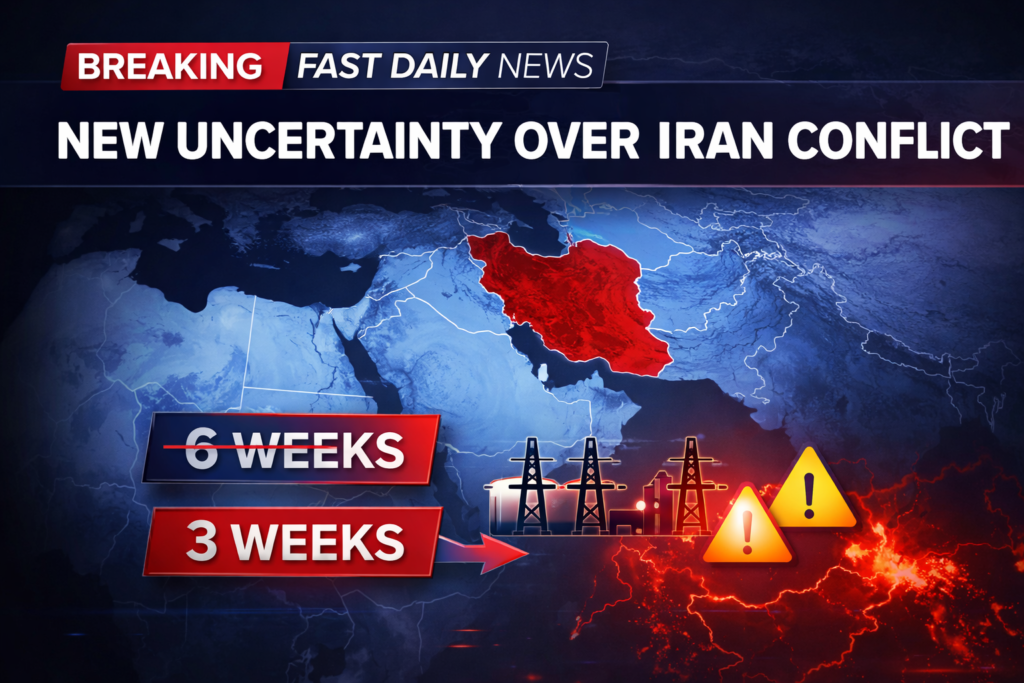
Trump’s Iran War Timeline Shifts Again as White House Gives New Deadline
The Trump Iran war timeline has shifted once again after the White House announced a new deadline for the ongoing military campaign. As the conflict enters another critical phase, questions continue to grow over U.S. objectives, the length of the operation, and what comes next.
The smoke clears from another night of precision strikes over Tehran. A different fog is settling over the White House. Six weeks have passed since the United States began its most significant military intervention in the Middle East in decades. Questions are dominating the briefing room. What is the United States hitting? When will the mission actually be over?
The first cruise missiles were launched on February 28, 2024. The administration has dubbed this event “Operation Epic Fury.” Since then, President Donald J. Trump and his top advisors have offered a dizzying array of timelines, benchmarks, and exit strategies. The mission was initially described as “as long as necessary.” At various points, it was promised to end in “four weeks,” “three weeks,” and “very shortly.”
Yet, as of April 3, 2026, the conflict appears to be entering a more dangerous phase. The President speaks of victory being “weeks away.” Meanwhile, the Pentagon is bracing for a wider infrastructure war. Additionally, the rescue of a downed U.S. pilot on Friday has served as a grim reminder that the “Stone Age” is still capable of fighting back.
The Evolution of an Estimate
The history of the “Epic Fury” timeline is a study in shifting expectations. On the night the war began, President Trump’s rhetoric was somber and open-ended. He told the nation that the U.S. and its allies would continue their campaign. They will persist “as long as necessary” to neutralize the threat posed by the Iranian regime.
Within forty-eight hours, a change occurred. The “America First” instinct to avoid “endless wars” began to pull the narrative in a different direction. By March 1, the President spoke to reporters in the Oval Office. He mentioned that the campaign would take “about four weeks.” Just twenty-four hours later, that estimate grew slightly to “four or five weeks.” He added a caveat that it could last “far longer” if the regime proved stubborn.
By the second week, the White House messaging shifted toward optimism. The President claimed the military was “ahead of schedule” and that there was “practically nothing left” to strike. This prompted a brief rally in global markets, which hoped for a quick resolution. The four-week mark passed in late March. The “ahead of schedule” narrative began to clash with the reality. Continued Iranian resistance and the closure of the Strait of Hormuz were evident.
| Date | Trump’s Stated Timeline | Context |
| Feb 28 | “As long as necessary” | Launch of Operation Epic Fury |
| Mar 1 | “About four weeks” | Initial optimism after first wave of strikes |
| Mar 2 | “Four or five weeks” | Introduction of caveats for a longer stay |
| Mid-March | “Ahead of schedule” | Claims that Iranian navy was “annihilated” |
| Mar 25 | “Very close” | Shifting focus to “decisive phases” |
| Apr 1 | “Two to three weeks” | Infrastructure threats and “Stone Age” rhetoric |
A Cabinet of Contrasts
The inconsistency in the President’s public statements has been mirrored, and at times exacerbated, by his senior staff. The Trump Administration’s “War Cabinet” often looks like they are reading from different scripts. This has led to confusion among allies. It has also confused adversaries alike.
Defense Secretary Pete Hegseth has consistently taken the most hawkish and open-ended stance. In early March, the President hinted at a quick exit. Meanwhile, Hegseth was telling reporters at the Pentagon that the campaign was “only just the beginning.” The Pentagon’s official account reiterated this message on March 9. In a social media post that went viral, they declared: “We have only just begun to fight.”
Hegseth has defended the lack of a fixed date as a matter of strategic necessity. “Don’t tell your enemy what you’re willing to do or not do,” he said during a heated briefing this week. He dismissed the President’s shifting numbers. These ranged from three to eight weeks. He described it as tactical ambiguity rather than a lack of planning.
In contrast, Secretary of State Marco Rubio has played the role of the “cautious optimist.” Rubio has repeatedly emphasized that while the “finish line” is visible, it is not yet within reach. His focus has been on the diplomatic and long-term security benchmarks. These include the permanent denial of a nuclear weapon. Another goal is the total dismantling of the missile industrial base.
“The President clearly laid out every single objective on the first night of this operation. Each objective is being met,” Rubio said on March 26. “But success is defined by results, not by the calendar.”
The “Stone Age” Strategy and New Escalations
The latest shift in the timeline occurred on Wednesday night during a televised address from the White House. President Trump, appearing more aggressive than in previous weeks, suggested that the war would enter its final, most destructive phase.
“Over the next two to three weeks, we’re going to bring them back to the Stone Ages,” the President declared. This rhetoric was accompanied by a significant expansion of the target list. During the first five weeks, the administration insisted on limiting strikes. They were restricted to “narrowly defined military targets” like missile silos, naval bases, and drone factories.
Now, the President is threatening to target Iran’s civilian infrastructure, including bridges, electricity networks, and the broader energy grid. Many analysts view this “total war” approach as a strategy to cause the regime’s collapse. They believe it needs to happen before the war’s domestic political cost becomes too high.
The risks of this escalation were highlighted on Friday when a U.S. F-15 fighter jet was downed over Iranian territory. While one crew member was successfully rescued in a daring “hot extract” mission, a second remains missing. The incident has challenged the narrative that the Iranian military is “effectively destroyed.” Vice President JD Vance made this claim just days earlier.
Market Volatility and the Hormuz Factor
The uncertainty surrounding the war’s end has sent shockwaves through the global economy. Oil prices, which many expected to stabilize after the initial “shock and awe” phase, have instead remained stubbornly high.
Following the President’s Wednesday address, Brent crude surged past $111 a barrel. Investors are increasingly concerned. The “two to three weeks” timeline is considered overly optimistic. This is especially true if Iran continues to successfully harass shipping in the Strait of Hormuz.
“Markets hate uncertainty more than they hate war,” says Dr. Elena Rossi, an energy analyst. “When the White House says ‘three weeks’ on Monday, it sends one message. Then, when it indicates ‘six months’ of infrastructure rebuilding on Friday, it creates a risk premium. This uncertainty is crushing the global recovery.”
Historical Echoes: The “Short War” Trap
Historians point out that the Trump Administration’s struggle with timelines is a recurring theme in American military history. Presidents have a long track record of underestimating the duration of conflicts. Their predictions have often been overly optimistic. Consider the “light at the end of the tunnel” during the Vietnam War. Another example is the “Mission Accomplished” banner on the USS Abraham Lincoln in 2003.
Professor Eric Min of UCLA notes that while shifting timelines are common, the Trump Administration changes them frequently. This frequency is unusual. It is unprecedented. “Usually, you see a timeline shift once every few months as the situation on the ground changes,” Min says. “Here, the timeline changes within the same week. Sometimes, it even changes within the same day. It depends on which official is speaking.”
The danger, according to military experts, is that these shifting deadlines can lead to “mission creep.” The administration constantly redefines what “victory” looks like. It ranges from sinking the navy to razing the entire industrial base. This approach can make it impossible to ever truly declare the war over.
What Lies Ahead?
The war reaches its six-week mark on April 11. The administration is under increasing pressure to provide a concrete set of conditions for a ceasefire. The White House has listed four primary objectives:
1.The total destruction of the Iranian Air Force and Navy.
2.The dismantling of the ballistic missile and drone manufacturing base.
3.The severance of all support for regional proxies.
4.A guaranteed, verifiable end to the Iranian nuclear program.
While Admiral Brad Cooper, Commander of U.S. Central Command, insists that “undeniable progress” is being made, the reality on the ground remains complex. The downing of the F-15 and the continued strikes on Gulf refineries suggest that the Iranian regime still possesses “asymmetric” capabilities that cannot be easily bombed into submission.
For now, the American public is left with a President who promises a quick victory. Meanwhile, a military establishment is preparing for a long, grinding campaign of attrition. Whether the war ends in “two to three weeks” or turns into another “endless war” is uncertain. One thing is clear: the timeline for “Operation Epic Fury” is written in sand, not stone.
Timeline of “Operation Epic Fury” Statements
•Feb 28: War begins; Trump says “as long as necessary.”
•Mar 1: Trump estimates “about four weeks.”
•Mar 4: Hegseth calls it “just the beginning.”
•Mar 9: Trump claims navy “annihilated”; mission “ahead of schedule.”
•Mar 18: Stephen Miller says goal is to “neuter the regime.”
•Mar 30: Rubio lists four specific objectives for completion.
•Apr 1: Trump sets new “two to three week” deadline for “Stone Age” phase.
•Apr 3: U.S. jet downed; search for missing crew member continues.