Europe Bomb Threats Disrupt Flights as Jets Scramble
A wave of Bomb threats across Europe targeting passenger aircraft has caused widespread disruption.
It forced airlines to divert flights, authorities to deploy military fighter jets, and passengers to undergo emergency checks.
Moreover, investigators are now examining whether the incidents are connected.
A series of bomb threats against commercial passenger aircraft has disrupted air travel across Europe for third day this week.
Moreover, Bomb threats across Europe raise concerns about aviation security and the possibility of a coordinated disruption campaign.
At least 15 flights were reported to have been affected on Thursday, 5 November, while more than 20 threats have been recorded across the week, according to international news agencies.
Aircraft traveling between the United Kingdom, Ireland, France, Italy, Bulgaria, Poland, Romania, Finland, Denmark and several other European countries have been subjected to security alerts.
Some flights were diverted to alternative airports, including a French military airbase, while others continued to their planned destinations under the escort of military fighter jets.
Despite the scale of the disruption, authorities have reported no explosives discovered on the affected aircraft. Passengers and crew have been reported safe.
The British government has described the incidents as malicious hoaxes, while European authorities are investigating their origins and whether the threats form part of a wider operation.
However, investigators have not publicly identified those responsible or established that the incidents are connected.
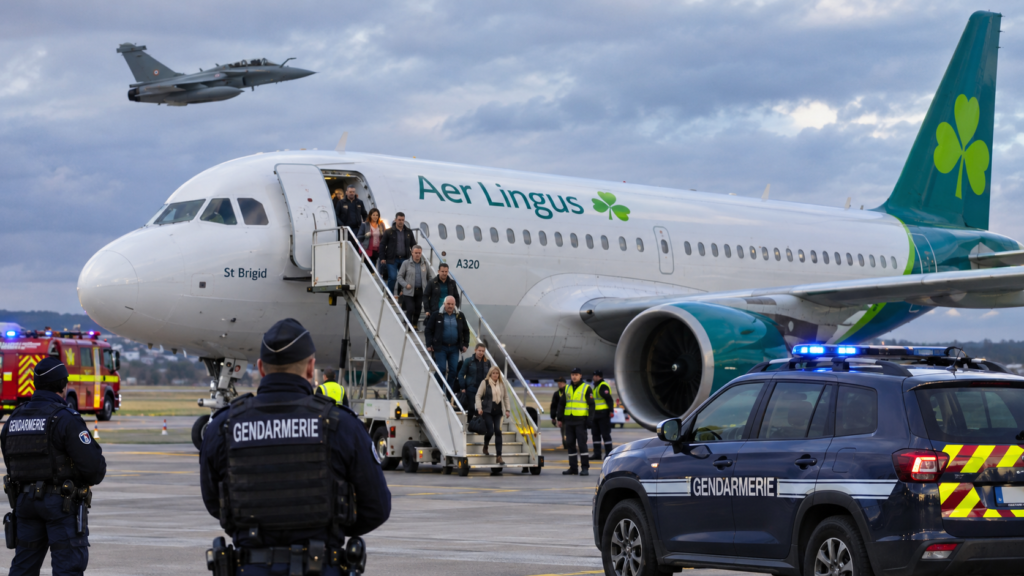
Aer Lingus Flight Diverted to French Military Airbase
One of Thursday’s most significant incidents involved an Aer Lingus passenger aircraft traveling from Dublin, Ireland, to Rome, Italy.
Flight EI402, operated by an Airbus A320, departed Dublin Airport at approximately 6:24am before receiving a security alert during its journey.
Instead of continuing towards the Italian capital, the aircraft changed course and was diverted to Évreux-Fauville Air Base in Normandy, northern France.
French military aircraft were deployed to escort the passenger plane to the airbase.
According to the office of French Prime Minister Sébastien Lecornu, the aircraft was carrying 151 passengers and six crew members.
All 157 people were brought to safety after the aircraft landed.
Military bomb disposal specialists were deployed to examine the plane, while passengers underwent security checks.
French authorities subsequently opened an aviation security investigation.
Flight-tracking information showed the aircraft changing direction while flying near Paris before proceeding towards Évreux.
Aer Lingus confirmed that the aircraft had landed safely and said arrangements would be made to help passengers continue to their intended destination.
The diversion represented a major interruption to what should have been a routine European passenger service.
It also demonstrated the seriousness with which authorities respond to bomb threats, even when the available information does not establish that a dangerous device is present.
Three Ryanair Flights Targeted in Bulgaria
Bulgaria was among the countries most heavily affected by Thursday’s incidents.
Three Ryanair flights traveling towards Sofia were subjected to bomb threats, prompting security operations involving the Bulgarian Air Force.
The aircraft had departed from London Stansted, Madrid and Copenhagen.
The flights from Madrid and Copenhagen continued to Sofia Airport, where they landed safely.
However, the aircraft traveling from London Stansted was diverted to Plovdiv Airport, in Bulgaria’s second-largest city.
Bulgarian military fighter jets were deployed to escort the three aircraft through national airspace.
Following their arrival, security teams inspected the planes to determine whether any explosive devices or suspicious materials were present.
The Bulgarian authorities subsequently confirmed that the inspections had identified no explosives.
Airport operations returned to normal after the security procedures were completed.
The disruption nevertheless created complications for passengers, particularly those aboard the London flight, who arrived at an airport different from their intended destination.
Bulgarian officials said the airline was arranging transport to Sofia for the affected passengers.
The incidents followed earlier bomb threats involving flights to Bulgaria, making the country one of the principal destinations affected during the week’s disruption.
Italian Fighter Jets Escort Finnair Aircraft
Italy also experienced security alerts involving international passenger services.
A Finnair aircraft traveling from Helsinki to Rome was escorted by Italian Air Force fighter jets after a bomb threat was reported.
The aircraft, operating flight AY1761, continued to Rome’s Fiumicino Airport, where it landed safely.
Italian authorities deployed specialist personnel to inspect the aircraft following its arrival.
No explosive materials were discovered.
Finnair confirmed that the threat was unfounded and said established security procedures had been followed.
A second flight associated with Finnair, traveling from Helsinki to Vienna and operated by Jettime, was also targeted by a threat.
That aircraft landed safely in Austria.
Separately, two flights arriving at Milan Malpensa Airport were subjected to security checks.
They included an Aegean Airlines service from Thessaloniki, Greece, and a Ryanair flight from Porto, Portugal.
The aircraft landed safely, and the alerts were subsequently found to be baseless.
The incidents highlighted the geographical extent of the threats, affecting aircraft traveling between countries with different aviation authorities and security arrangements.
Wizz Air Flights Affected in Poland and Romania
Wizz Air was another airline affected by Thursday’s alerts.
One of its aircraft, traveling from Milan to Warsaw, was diverted to Vienna after a security threat was received.
The airline said the decision was taken in accordance with established safety procedures.
Austrian authorities inspected the aircraft, with no dangerous materials identified. The flight subsequently continued towards Warsaw.
Another Wizz Air aircraft traveling from Milan to Bucharest received a bomb threat but continued to its planned destination.
The aircraft landed safely at Henri Coandă International Airport in the Romanian capital.
Romania’s intelligence service confirmed that a security response had been activated following the alert.
Airport authorities and security personnel carried out the necessary inspections, which revealed no threat.
Normal airport operations were maintained.
The Romanian incident was particularly significant because it added another country to the growing number of European states dealing with similar warnings within a relatively short period.
However, the existence of comparable threats does not, by itself, establish that they originated from the same individual or organization.
Security Alerts Reach Poland, Belgium and the Czech Republic
Other European airports were also placed on alert.
A LOT Polish Airlines flight traveling from Warsaw to Brussels landed safely after a security warning.
Authorities inspected the aircraft and reported finding no suspicious materials.
Another LOT flight, scheduled to travel from Warsaw to Paris, was stopped before departure after a possible threat was reported.
The aircraft was directed away from its planned departure and subjected to security checks.
One runway at Warsaw’s Chopin Airport was temporarily closed while the relevant procedures were carried out.
In the Czech Republic, police responded to bomb threats affecting four aircraft traveling to Prague.
The planes were allowed to land, after which specialist teams conducted inspections.
Czech police reported that nothing suspicious had been discovered.
Although officers assessed the threats as having low credibility, they stressed that appropriate security measures were necessary.
Copenhagen authorities also investigated alerts involving arriving aircraft and reported no danger to passengers or airport staff.
The number of countries affected illustrates how aviation security incidents can quickly become international matters, requiring communication between airlines, airports, police and national governments.
A Pattern Emerging Since Monday
Thursday’s disruption followed a series of similar incidents earlier in the week.
On Monday, 2 November, a Wizz Air aircraft traveling from London Luton to Sofia was diverted to Budapest following a bomb threat.
A Hungarian military fighter jet was deployed to escort the aircraft.
The plane landed safely and underwent security checks.
Further incidents followed on Tuesday, 3 November, when several European passenger services were targeted.
Among them was a Ryanair aircraft traveling from Manchester to Murcia, Spain.
Spanish authorities activated security procedures, with passengers disembarking while officers inspected the aircraft.
Additional Ryanair flights from Dublin and Lisbon were searched after arriving at Rome’s Fiumicino Airport.
Security personnel examined the aircraft and associated baggage before the alerts were cleared.
A flight traveling from Dublin to Sofia was also inspected after receiving a threat, with Bulgarian authorities confirming that no explosives had been discovered.
Poland experienced further disruption when a LOT aircraft from London made an unscheduled landing at Warsaw-Modlin Airport.
Airport operations were temporarily suspended while authorities examined the situation.
The recurrence of similar incidents within three days has prompted questions about whether the threats could be linked, although investigators have yet to establish any connection.
Why Are Fighter Jets Being Deployed?
The deployment of military aircraft has been one of the most visible aspects of the European response.
France, Italy, Bulgaria and Hungary have all been involved in military escort operations during the recent alerts.
When an aircraft receives a serious security warning, airlines and aviation authorities must assess the information and determine the safest response.
Depending on the circumstances, a passenger plane may continue to its original destination, divert to an alternative airport or receive assistance from military aircraft.
Fighter jets can provide an escort, help authorities monitor an aircraft and support an organized security response.
However, their deployment does not necessarily mean that an explosive device has been confirmed on board.
Once the aircraft has landed, specialist teams can examine the cabin, baggage compartments and other relevant areas while passengers and crew are kept in a safe location.
These procedures can be time-consuming, even when the threat ultimately proves to be false.
Aviation authorities must balance the need to protect passengers with the importance of avoiding unnecessary disruption.
European Union Activates Security Coordination
The European Union has become involved in coordinating information about the incidents.
EU Transport Commissioner Apostolos Tzitzikostas confirmed that a European aviation-security information-sharing mechanism had been activated.
The European Commission is maintaining contact with affected member states and the European Union Aviation Safety Agency.
National authorities have been encouraged to cooperate closely with airport operators, airlines and law enforcement organizations.
The commissioner emphasized that investigations were continuing and that it was too early to determine whether the reported incidents were connected.
He also said European officials did not yet have information establishing whether a cyberattack was involved.
The response reflects the difficulties posed by threats affecting several countries simultaneously.
Although individual governments are responsible for investigating incidents within their jurisdictions, information-sharing may help authorities recognize patterns or identify common sources.
Who Is Behind the Threats?
The identity and motivation of the person or people responsible remain unknown.
No individual, organization or government has been publicly identified as responsible for the reported incidents.
Aviation security experts have suggested several possible explanations.
One possibility is that the threats originated from an individual or group seeking to disrupt airline operations.
Another is that an initial incident encouraged others to make similar threats.
Investigators may also consider whether the warnings represent an organized campaign.
The incidents have occurred during a period of heightened European concern about cyberattacks, sabotage and other forms of disruption sometimes described as hybrid warfare.
Such operations can involve attempts to interfere with civilian infrastructure or public services without conventional military action.
However, there is currently no publicly established evidence connecting this week’s aviation threats to Russia, Iran or any other state.
The timing of the incidents has attracted attention, but similarity and timing alone are insufficient to establish responsibility.
Any conclusion about the source of the threats would require evidence gathered through the ongoing investigations.
What Does This Mean for Passengers?
Although the alerts have not resulted in a confirmed bomb attack, their consequences for travelers have been significant.
Passengers on diverted aircraft may face lengthy delays, missed connecting flights and unexpected arrivals at unfamiliar airports.
Airlines may have to arrange replacement aircraft, alternative transport or accommodation, depending on the circumstances.
Security inspections can also affect other departures when aircraft, airport facilities or airline crews are temporarily unavailable.
The financial impact can extend beyond the individual flights targeted.
Additional fuel, airport handling, passenger assistance and disrupted aircraft schedules can all create costs for airlines.
For passengers planning to travel, the most important step is to check the latest information directly with their airline before leaving for the airport.
Travelers whose flights are delayed or diverted should retain booking information and any relevant receipts.
Passenger rights and assistance entitlements depend on the circumstances and the aviation rules governing the journey.
There has been no general announcement requiring travelers to avoid European air travel because of the incidents.
What Happens Next?
The immediate priority for European authorities is identifying the source of the threats and determining whether they are connected.
Investigators are expected to examine available communications and other evidence associated with the warnings.
Airlines and airports will continue to apply established security measures whenever credible concerns arise.
While the discovery of no explosives on the affected aircraft is reassuring, the repeated warnings have demonstrated how false alerts can disrupt an extensive international transport network.
European authorities now face the task of establishing whether the incidents are separate hoaxes or part of a deliberate campaign.
Until those investigations produce verified findings, questions about responsibility and motive remain unanswered.
For passengers, the central fact is that the affected aircraft have landed safely and no explosive devices have been found in the reported inspections.
The continuing investigation will determine whether Europe’s unusual series of aviation security alerts represents an organized threat or a succession of unrelated hoaxes.
Sources and reporting
This article is based on reporting published on 5 November 2026 by Reuters, the Associated Press and Agence France-Presse (AFP), including statements attributed to European governments, aviation authorities and affected airlines.