
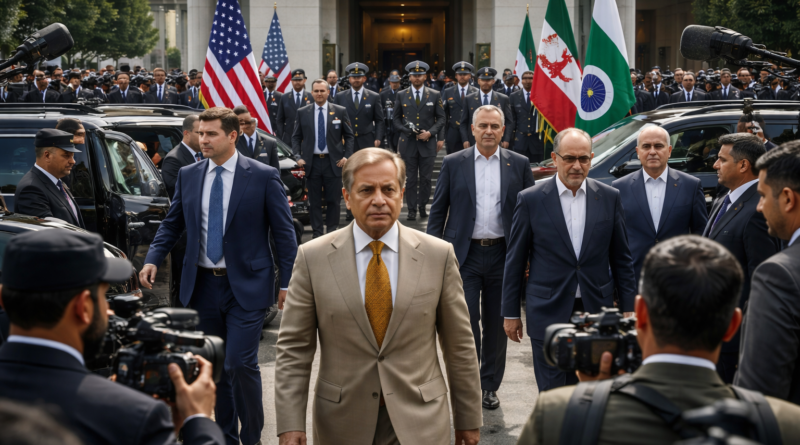
US and Iran Hold Historic Direct Talks in Pakistan as Fragile Ceasefire Faces First Test
The United States and Iran have opened the highest-level direct talks between the two countries in nearly half a century, in a dramatic diplomatic effort that could determine whether the Middle East steps back from the brink of a wider regional war.
Senior American and Iranian officials met face-to-face in Islamabad, Pakistan, on Saturday, 11 April 2026, only days after a fragile two-week ceasefire came into effect following six weeks of conflict.
The negotiations are the first direct in-person talks between Washington and Tehran since the 1979 Iranian Revolution.
For decades, contact between the two countries has usually taken place indirectly through intermediaries such as Oman, Switzerland, Qatar or European diplomats. Even during the negotiations that led to the 2015 nuclear agreement, most exchanges took place through foreign ministers and lower-level officials.
Now, for the first time in nearly 47 years, top representatives from both governments are sitting in the same room.
The meeting has been described by diplomats as historic, but also highly uncertain.
The war between the United States and Iran may have temporarily paused, yet fighting continues elsewhere in the region. Israeli strikes in Lebanon are still being reported, the Strait of Hormuz remains only partially open, and deep mistrust still divides the two sides.
Islamabad Becomes the Centre of Global Diplomacy
The talks are taking place in Pakistan’s capital after weeks of quiet mediation by Pakistani Prime Minister Shehbaz Sharif and military leaders.
Islamabad emerged as a neutral meeting place after several countries in the Gulf and Europe struggled to bring the two sides together.
Pakistan has spent the past month maintaining contact with Washington, Tehran, Saudi Arabia and other regional governments.
Officials in Islamabad argue that Pakistan’s close relations with both the United States and Iran made it one of the few countries able to broker direct contact.
On the morning of Saturday, 11 April, the Pakistani capital was placed under heavy security.
Roads around the convention centre and diplomatic district were sealed off. Police and military vehicles lined the streets. Hotels hosting the delegations were closed to the public, while helicopters circled above the city.
Hundreds of journalists from around the world gathered at a media centre established by Pakistani authorities.
Inside the centre, giant screens displayed images of Prime Minister Shehbaz Sharif separately greeting the American and Iranian delegations.
The US delegation was led by Vice President JD Vance, who arrived in Islamabad early on Saturday morning.
He was joined by White House envoy Steve Witkoff and Jared Kushner, President Donald Trump’s son-in-law and former adviser.
The Iranian delegation included Parliament Speaker Mohammad Bagher Ghalibaf, Foreign Minister Abbas Araghchi and representatives of Iran’s Supreme National Security Council.
Before the talks began, both delegations held separate meetings with Sharif.
The Pakistani prime minister reportedly urged both sides to “seize this historic opportunity” and warned that the region could not survive another round of escalation.
First Direct Contact Since 1979
The significance of the meeting lies not only in the war itself, but in the history behind it.
Relations between the United States and Iran collapsed after the 1979 revolution and the seizure of the US embassy in Tehran.
Since then, the two countries have spent decades locked in a cycle of sanctions, proxy conflicts, threats and failed diplomatic efforts.
There have been moments of contact. President Barack Obama spoke by telephone with Iranian President Hassan Rouhani in 2013. The two sides also worked together during negotiations over Iran’s nuclear programme.
However, there has never before been a direct meeting between officials at this level during an active military conflict.
That alone makes the Islamabad talks extraordinary.
Yet there is also enormous pressure.
The conflict that began in late February has already caused thousands of deaths across Iran, Iraq, the Gulf and Lebanon.
Oil prices surged after Iran restricted traffic through the Strait of Hormuz, one of the world’s most important energy routes.
Global markets were shaken, while governments across Europe, Asia and the Middle East warned that a wider war could follow.
The ceasefire announced on 8 April created a brief opening for diplomacy.
But it was only intended to last for two weeks.
Unless the talks in Pakistan produce progress, both sides could return to open confrontation.
What Happened Before the Talks?
The road to Islamabad began with a sudden diplomatic breakthrough earlier this week.
On 8 April, the United States and Iran agreed to a temporary ceasefire after Pakistan proposed a framework for talks.
Iran had previously rejected an American-backed 45-day ceasefire proposal, arguing that it did not address the wider conflict in the region.
Instead, Tehran put forward its own 10-point peace plan.
Iran’s proposal included:
- A permanent ceasefire rather than a temporary pause
- The reopening of the Strait of Hormuz under Iranian supervision
- The lifting of some US sanctions
- The release of billions of dollars in frozen Iranian assets
- An end to Israeli military operations in Lebanon
- Guarantees regarding Iran’s nuclear programme
- International reconstruction support for areas damaged by the war
The United States did not accept all of those demands, but both sides agreed to a short ceasefire while negotiations continued.
Even then, the truce remained fragile.
Only hours after the ceasefire came into effect, Israel launched fresh air strikes in southern Lebanon.
Iran responded by warning that it would abandon the ceasefire unless attacks on Lebanon stopped.
That dispute has become one of the most difficult issues in Islamabad.
The Key Demands on the Table
Although the talks are officially about extending the ceasefire, the agenda is much broader.
The United States wants Iran to guarantee freedom of navigation through the Strait of Hormuz.
Washington is also demanding limits on Iran’s nuclear activities and wants Tehran to stop supporting armed groups across the region.
The White House believes that any long-term agreement must include:
- A permanent reopening of the Strait of Hormuz
- Limits on Iran’s uranium enrichment programme
- An end to attacks by Iranian-backed groups
- Stronger international monitoring
Iran, however, says it will not accept an agreement that appears to be a surrender.
Tehran insists that it has the right to control access to the Strait of Hormuz and says any deal must include sanctions relief.
Iran is also demanding that the United States use its influence over Israel to halt attacks in Lebanon.
Iranian officials arrived in Islamabad saying there could be “no meaningful peace” while Israeli operations continued.
According to Iranian media, Tehran also wants around six billion dollars in frozen assets to be released.
There are also reports that Iran wants a guarantee that the United States will not seek regime change or future military action.
For Washington, these demands are difficult.
The Trump administration has repeatedly argued that Iran has been weakened by the war and should make concessions.
President Trump has publicly insisted that Iran is “losing big” and has said the United States is already clearing sea mines from the Strait of Hormuz.
Iran denies that American ships have entered the strait.
The sharp contrast between the two sides’ public statements highlights how far apart they remain.
JD Vance Faces a Difficult Mission
The decision to send Vice President JD Vance to Islamabad has attracted attention in Washington.
Vance has often presented himself as more cautious about foreign wars than some other figures in the administration.
Before travelling to Pakistan, he said he was willing to negotiate “with an open hand” if Iran acted in good faith.
Diplomats believe Vance may have been chosen because he is seen as less confrontational than President Trump.
Yet he also faces a difficult task.
Throughout Saturday, President Trump continued posting on social media, making aggressive comments about Iran and claiming Tehran had already been defeated.
Some analysts said those statements risked making the negotiations harder.
The American delegation itself also drew criticism.
Alongside Vance are Steve Witkoff and Jared Kushner, both close to Trump but not traditional diplomats.
Critics argue that neither has extensive experience dealing with Iran.
Supporters of the administration say their presence signals that Trump is serious about reaching an agreement.
Whatever the case, Vance now carries the burden of trying to transform a temporary truce into a more lasting arrangement.
Iran Sends a Powerful Delegation
Iran has also sent one of the most senior delegations it has assembled in years.
Mohammad Bagher Ghalibaf, the speaker of parliament and a former commander in the Revolutionary Guards, is regarded as one of the most influential figures in Iran.
He is joined by Foreign Minister Abbas Araghchi and representatives of the security establishment.
The broad makeup of the delegation suggests that Iran wants any agreement to have the support of multiple centres of power.
That matters because Iranian politics has become increasingly uncertain following the war.
Several senior military figures have been killed in recent strikes, while Iran’s new Supreme Leader, Mojtaba Khamenei, has not appeared publicly for days.
Iranian officials insist that their negotiators will defend the country’s interests.
President Masoud Pezeshkian wrote on social media on Saturday that Iran’s delegation would “negotiate bravely” and that the government would stand by the Iranian people whatever the outcome.
In Tehran, people spent the day waiting for news from Islamabad.
State television carried live coverage from Pakistan, while newspapers described the talks as one of the most important moments in Iranian diplomacy in decades.
Fighting Continues Despite the Talks
Even as diplomats met in Pakistan, violence continued elsewhere.
In southern Lebanon, Israeli air strikes reportedly killed at least 10 people on Saturday.
Lebanese officials said two of the dead were emergency workers.
Israeli forces also carried out demolitions in border towns, while Hezbollah responded with rocket fire.
The continuing fighting has created fears that the ceasefire could collapse before the negotiations are finished.
Lebanese Prime Minister Nawaf Salam announced on Saturday that he had postponed a planned visit to the United States and the United Nations because of the worsening situation.
At the same time, protests linked to the conflict were taking place far from the Middle East.
In London, police arrested several people during a demonstration against the British government’s ban on Palestine Action.
These events underline how the crisis has spread beyond the battlefield.
What Could Happen Next?
After nearly two hours of talks on Saturday afternoon, both delegations agreed to meet again later in the evening.
Pakistani officials described the atmosphere as “serious but constructive”.
No agreement has yet been announced.
However, diplomats say even the fact that the two sides met directly is an important step.
Several possible outcomes are now being discussed:
- The current two-week ceasefire could be extended
- The United States and Iran could agree on a roadmap for further negotiations
- Iran could reopen the Strait of Hormuz more fully
- The United States could release some frozen Iranian assets
- A wider regional agreement involving Lebanon could begin
But failure remains possible.
If the talks collapse, the war could quickly resume.
That would likely mean new attacks in the Gulf, further disruption to global oil supplies and an even wider regional conflict.
For now, the world is watching Islamabad.
The city has suddenly become the centre of one of the most important diplomatic efforts of the century.
Whether the talks lead to peace or simply delay another round of fighting may become clear in the days ahead.