
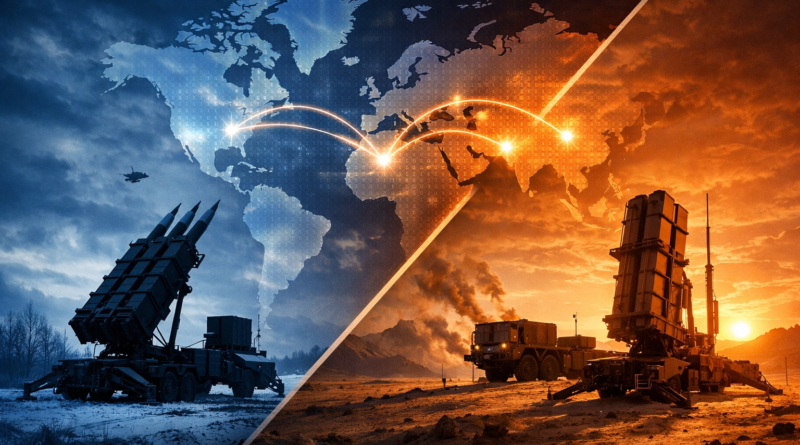
Ukraine Missile Shortage Warning as Middle East War Strains Global Weapons Supply
The geopolitical landscape of 2026 has taken a dramatic and concerning turn. The conflict in the Middle East is escalating into a full-scale regional crisis. This involves Iran, Israel, and the United States. The effects are being felt thousands of miles away in the trenches of Eastern Europe. Ukrainian President Volodymyr Zelensky has issued a stark warning. The diversion of military resources and global attention toward the Persian Gulf is creating a critical “missile deficit.” This situation could jeopardize Ukraine’s ability to defend itself against Russian aggression.
This article provides an in-depth analysis of the growing crisis. It examines the technical shortages of air defense systems. It also looks at the strengthening of the Russia-Iran military axis and the shifting diplomatic tides in Washington and London.
How the Middle East Conflict is Draining Ukraine’s Defense Reserves
For over four years, Ukraine has relied on a steady pipeline of Western military aid to repel Russian forces. However, the sudden eruption of hostilities in the Middle East has placed unprecedented strain on this supply chain. The primary concern is the availability of sophisticated air defense interceptors. These interceptors are now in high demand across two major theaters of war simultaneously.
President Zelensky’s recent address highlighted a harsh reality: the global stockpile of interceptor missiles is finite. At the onset of the Middle Eastern escalation, many missiles were used quickly. This occurred over a few days to intercept Iranian drone and missile swarms targeting US assets and Israeli cities. This rapid depletion has sparked fears. The Western industrial base is already struggling to meet Ukraine’s needs. It cannot keep pace with the requirements of two high-intensity conflicts.
| Key Military Asset | Current Status | Primary User(s) | Impact of Middle East Conflict |
| Patriot PAC-3 | Critical Shortage | Ukraine, Israel, US | High demand for intercepting ballistic missiles. |
| NASAMS | Limited Supply | Ukraine, US Bases | Diversion to protect US assets in the Gulf. |
| 155mm Artillery | Chronic Deficit | Ukraine, Israel | Competition for production slots in US/EU factories. |
| Interceptor Drones | Rapid Scaling | Ukraine | Ukraine is now sharing this tech with allies. |
Zelensky’s Warning: The Looming Shortage of Patriot Missiles
The Patriot missile system has been the backbone of Ukraine’s defense against Russian hypersonic and ballistic missiles. Without a consistent supply of PAC-3 interceptors, major Ukrainian cities like Kyiv, Kharkiv, and Odesa remain vulnerable to devastating strikes. Zelensky’s warning is not merely rhetorical; it is based on the logistics of modern warfare.
During a recent interview, Zelensky noted that the “question is not if, but when” the current stockpiles will be exhausted. This will happen if the Middle East war continues at its current intensity. The Patriot system is notoriously expensive. It is slow to produce. A single interceptor costs millions of dollars. It takes months to manufacture. The US and its allies face a difficult choice. They must decide between defending their own bases in Jordan or Iraq, or supplying Ukraine. This changes the strategic calculus. It inherently disadvantages Kyiv.
“We are seeing a situation where the same shields are needed in two different parts of the world. But there is only one forge producing them at the speed we need.” — Volodymyr Zelensky
The Russia-Iran Alliance: A New Axis of Destabilization
One of the most concerning developments of 2026 is the deepening military and intelligence cooperation between Moscow and Tehran. For years, Iran has supplied Russia with “Shahed” loitering munitions to terrorize Ukrainian cities. Now, the relationship has evolved into a reciprocal partnership that threatens global security.
Russia is providing Iran with real-time satellite imagery. They are also providing targeting information to assist in attacks on American military assets in the Middle East. This “intelligence-for-hardware” swap allows Iran to increase the precision of its strikes. It provides Russia with a strategic distraction. This distraction draws US resources away from Europe.
Furthermore, reports indicate that Russia has shared advanced drone technology and electronic warfare capabilities with Iranian forces. This collaboration creates a dangerous synergy. Iran tests these technologies against Western systems in the Middle East. The data is fed back to Russia to refine their tactics in Ukraine. Zelensky has correctly identified this as a “regime of hostility” that seeks to undermine the international order through coordinated chaos.
Why Ukraine Fears “Losing the Americans”
In the realm of international relations, attention is a currency as valuable as ammunition. The Middle East escalation has reduced Ukraine’s prominence in Western media. It has also diminished Ukraine’s role in Western political discourse. The “CNN effect” once kept the plight of Ukrainians at the forefront of the American public’s mind. Now, it has shifted its focus to the burning oil refineries of the Gulf. It has also turned to the naval skirmishes in the Strait of Hormuz.
Kyiv’s greatest fear is that it will become a “forgotten war.” If the American public and policymakers perceive the Middle East as the more immediate threat to US interests, the political will to sustain multi-billion dollar aid packages for Ukraine will vanish. The support for these packages will disappear. They no longer want to support these packages. This is particularly due to the risk of direct American casualties. Zelensky’s recent diplomatic blitz is a desperate attempt to remind the world that the two conflicts are inextricably linked. He argues that if Russia achieves victory in Ukraine, Iran will gain boldness. Likewise, if Iran wins in the Middle East, it will boost Putin’s influence.
How Rising Energy Prices Fuel Russia’s War Machine
The conflict in the Middle East has had an immediate and predictable impact on global energy markets. As tensions rise in the Gulf, oil prices have surged, surpassing $120 per barrel in recent weeks. For the Kremlin, this is an unexpected but welcome economic lifeline.
Russia continues to export significant quantities of oil and gas despite Western sanctions and price caps. They achieve this through “shadow fleets” and alternative markets. The spike in prices has dramatically increased Russia’s federal revenue. This increase provides the funds necessary to sustain its war economy. It also allows Russia to bypass the effects of international isolation.
| Economic Indicator | Pre-Escalation (2025) | Current (March 2026) | Impact on Russia |
| Brent Crude Oil | $75 / barrel | $122 / barrel | Significant revenue increase. |
| Natural Gas (EU) | Stable | Volatile / High | Increased leverage over Europe. |
| Russian Ruble | Weakened | Stabilized | Improved domestic economic sentiment. |
Zelensky has pointed out that every dollar added to the price of oil increases Putin’s budget. He can spend more on missiles to fire at Ukrainian schools and power plants. The instability in the Middle East is, in effect, a massive indirect subsidy for the Russian military.
Trump, Starmer, and the Future of Western Unity
The diplomatic landscape has been further complicated by the domestic politics of the Western allies. In Washington, President Donald Trump has adopted a pragmatic, “America First” approach to the conflict. Trump has positioned himself as a potential negotiator. He maintains open channels of communication with Moscow. He questions the long-term sustainability of US aid to Kyiv.
This stance has created friction with London. Prime Minister Keir Starmer has remained a steadfast supporter of Ukraine. He emphasizes that British support is “ironclad” regardless of the shifting focus in the Middle East. Public disagreements have arisen between Trump and the UK government over various policy issues. These disagreements have raised concerns about the cohesion of the NATO alliance.
Zelensky has called for a “unified strategy” between the US and the UK. He urges Trump and Starmer to set aside their differences. They must recognize that the defense of democracy is a collective responsibility. He warned that a fractured West is exactly what Putin wants. The Iranian leadership also counts on this division to achieve their respective goals.
Why the Defense of Kyiv and Tel Aviv are Linked
Addressing British lawmakers, Zelensky drew a direct parallel between the threats faced by Ukraine and Israel. He described both nations as “frontline states.” They defend the democratic world against authoritarian regimes. These regimes use terror as a primary tool of statecraft.
Zelensky frames the conflict in this way. He aims to bridge the gap between supporters of Ukraine and supporters of Israel. He argues that the drones falling on Tel Aviv are the same drones falling on Kyiv. The missiles are being manufactured in Iran. These missiles are used to destroy Ukrainian infrastructure. This narrative ensures any increase in military aid to the Middle East is matched by a commitment to Ukraine. This approach prevents a “zero-sum” competition for resources.
Navigating a Shifting Geopolitical Landscape
As we move further into 2026, the world finds itself at a crossroads. The interconnected nature of modern conflict means that instability in one region inevitably bleeds into another. For Ukraine, the challenge is twofold. It must continue to hold the line on the battlefield. It must also engage in a diplomatic war. This is crucial to remain relevant in a world distracted by a new crisis in the Middle East.
The warning from President Zelensky is clear: the West cannot afford to choose between theaters. If Ukraine does not receive the missiles it needs today, the result will be a much larger conflict tomorrow. This conflict will also be more costly. Energy prices are rising. Alliances are shifting. Therefore, clear-eyed, resolute leadership in Washington, London, and Brussels is urgently needed.
Ukraine’s message to its allies is clear. “Do not let the shadows of the Middle East obscure the light of freedom in Europe.” Whether the West heeds this warning will determine the course of history for the remainder of the decade.