Colombia Earthquake: Powerful 7.4 Quake Leaves Widespread Destruction
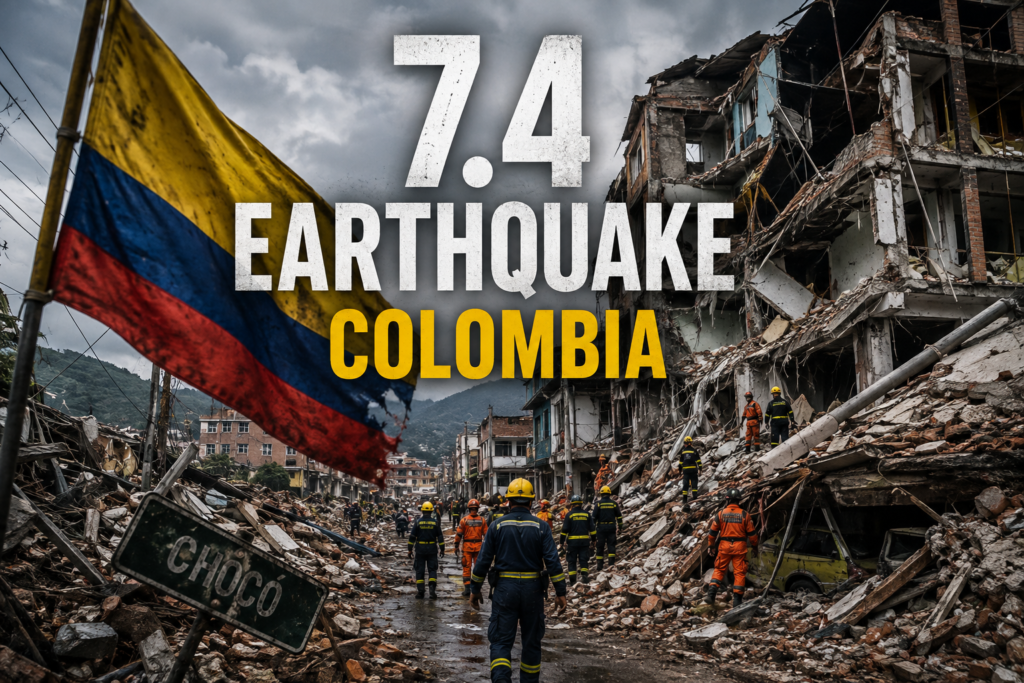
The Colombia earthquake, a powerful 7.4-magnitude tremor that struck the western part of the country on Monday, has caused widespread destruction and prompted a national disaster declaration. At least 265 people have died, while rescue teams continue searching through damaged buildings and rubble for survivors.
What happened
The Colombia earthquake was felt across a wide area, including major cities far from the epicentre.
The magnitude 7.4 quake struck at 07:34 local time on Monday, 10 August 2026, with its epicentre roughly five kilometres from the town of San José del Palmar in Chocó department, around 240km west of the capital, Bogotá. Shaking lasted between 90 seconds and two minutes at stations nearest the epicentre and was felt as far away as Bogotá and Medellín — reaching an estimated 10.5 million people at strong-to-very-strong intensity, according to the US Geological Survey.
Colombia’s president, Abelardo De La Espriella, has declared a state of national disaster. Five capital cities — Cali, Pereira, Quibdó, Manizales and Armenia — remain under the country’s highest alert level. More than 70 aftershocks have been recorded since the initial quake.
Why it was so destructive so far from its epicentre
Unlike many of the region’s shallow, highly destructive quakes, this one struck at a depth of around 100-110km, inside the Nazca Plate as it subducts — slides — beneath the South American Plate. Geologists call this an “intermediate-depth” or intraslab earthquake: the rupture happens deep within the descending oceanic plate rather than at the shallower boundary between the two plates.
That depth is also why the shaking was felt so widely. Deeper earthquakes tend to produce less violent shaking directly above the epicentre than shallow ones of the same size, but the energy spreads out and can be felt across a much larger area — in this case reaching cities more than 250km away, including Cali. The USGS says the rupture likely occurred on a steeply-dipping fault, part of the same tectonic collision that, over millions of years, has pushed up the Andes.
Colombia’s western coast sits on one of the most seismically active plate boundaries in the world; the Nazca Plate converges with South America at roughly 65mm a year. The country’s largest recorded earthquake, a magnitude 8.5, struck the same general region in January 1906.
The damage, city by city
Cali — Colombia’s third-largest city has been among the hardest hit. As of Tuesday afternoon, more than 200 people remained unaccounted for, according to the mayor’s office, though 87 people had been rescued alive by that point. A fire broke out at a jail in nearby Buenaventura during the quake, killing at least four people. The mayor imposed an overnight curfew and deployed soldiers to patrol the worst-affected districts, saying the measure was needed to keep rescue operations safe. Rescuers have pulled several dramatic survivor stories from the wreckage there, including a baby freed from a collapsed apartment building.
Pereira — In this city in Colombia’s coffee-growing region, at least 92 buildings have collapsed. Fifteen people are known to be trapped and a further 37 reported missing. It was here that rescuers spent roughly ten hours freeing 32-year-old Daniela Largo from beneath four slabs of fallen concrete — digging two separate tunnels, one to pass down oxygen and a second to pull her out — 36 hours after the quake struck. Sixteen people were also evacuated after being trapped for six hours in an aerial cable car system above the city.
Chocó — Close to the epicentre, the province has reported at least 13 deaths and 119 injuries. In the provincial capital, Quibdó, eight people were killed, 36 injured, ten reported missing and 42 structures collapsed.
Nationally — Officials say roughly 1,600 buildings have been damaged or destroyed, along with 18 health centres, 52 schools, 17 community centres and 18 roads. Seven airports suspended operations in the immediate aftermath. Power, water and telecommunications have been disrupted across the hardest-hit region.
The human toll
The confirmed death toll has climbed steadily as rescue teams reach areas that were initially cut off — from just over 100 in the hours after the quake to more than 265 by Tuesday. Colombian authorities have warned the figure is likely to keep rising; thousands of people were reported missing in the first 24 hours, though many have since been located.
Among the survivor stories to emerge, Daniela Largo’s rescue in Pereira has drawn particular attention. A neighbour heard her calling for help from beneath the rubble; emergency crews used a small camera to locate her before spending hours tunnelling through the collapsed concrete. She was reunited with her 12-year-old son, who had been waiting for her at home. President De La Espriella described her rescue as “news which fills us with hope.”
The international and government response
The United States has pledged $15.5 million to Colombia for shelter, food, protection and earthquake damage assessments. The Colombian government has mobilised firefighters, military personnel and national police disaster-response units from across the country, with teams from Bogotá deployed to help in Pereira and Cali.
Rescue efforts are continuing into a second night, with crews working in shifts through the hardest-hit neighbourhoods in Cali and Pereira in the search for anyone still trapped.
What happens next
Colombian authorities say the death toll is expected to continue rising as search teams reach remote and mountainous parts of Chocó department, where access has been slower due to the terrain. Aftershock activity is ongoing, and officials have warned residents in the affected region to stay alert for further tremors and, in steep Andean terrain, secondary landslide risk.