
UK and European Allies Say Alexei Navalny Was Killed With Rare Frog-Derived Poison
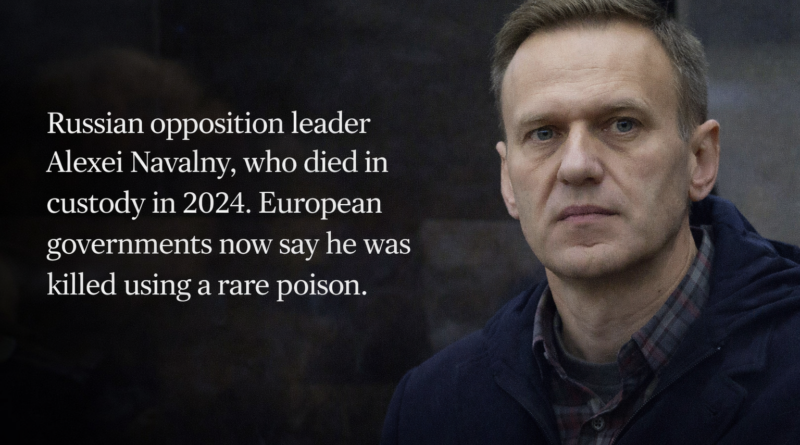
Russian opposition figure Alexei Navalny was killed using a highly unusual toxin derived from a South American dart frog, according to findings released by the United Kingdom and several European allies. The conclusion was announced two years after Navalny’s death in Russian custody. It directly attributes responsibility to the Russian state. This marks one of the strongest international accusations yet over the circumstances surrounding his death.
The UK Foreign Office said toxicological analysis was conducted on biological material from Navalny’s body. It identified epibatidine, a powerful neurotoxin. This neurotoxin is known for its extreme potency and rarity. Officials said there was no credible or innocent explanation for the presence of the substance. Only the Russian government had the capability, access, and motivation to deploy such a toxin during Navalny’s imprisonment.
The findings were disclosed during the Munich Security Conference. UK Foreign Secretary Yvette Cooper addressed diplomats, defence officials, and political leaders from across the world. Britain, Sweden, France, Germany, and the Netherlands issued a joint statement. Officials described it as a coordinated and evidence-based assessment.
A coordinated accusation
Speaking at the conference, Cooper said the conclusions were the result of extensive forensic work. This work was conducted over a two-year period by laboratories in multiple European countries.
“Only the Russian state had the means, motive, and opportunity to deploy this lethal toxin against Alexei Navalny. This occurred during his detention in Russia,” she said. “The use of such a substance shows a disregard for human life. It is a calculated try to eliminate political opposition. The methods used are designed to obscure responsibility.”
The joint statement said epibatidine does not occur naturally in Russia. It is not produced by captive dart frogs. This makes accidental exposure impossible. The toxin comes from certain species of poison dart frogs native to South America. Synthesizing or extracting it requires specialised scientific expertise.
“There is no innocent explanation for the presence of this toxin in Navalny’s body,” the statement said. “We therefore hold the Russian state responsible for his death.”
Navalny’s death in custody
Navalny was widely regarded as Russia’s most prominent opposition leader. He died on 16 February 2024. This occurred while he was held at a penal colony inside the Arctic Circle. He was 47.
Russian authorities said at the time that he collapsed after feeling unwell. It happened following a short walk. He not be resuscitated. The explanation was immediately met with scepticism from Navalny’s supporters. International human rights organisations and Western governments were also sceptical. Many of them pointed to his previous poisoning. They also noted the harsh conditions of his imprisonment.
Navalny had been serving multiple sentences totalling more than three years on charges widely described by critics as politically motivated. He had been transferred shortly before his death to one of Russia’s most remote and severe prison facilities, a move supporters said further endangered his health.
History of poisoning allegations
The accusation that Navalny was poisoned was not new. In 2020, he survived an earlier assassination attempt involving the nerve agent Novichok, a substance linked by Western investigators to Russian state security services. He was airlifted to Germany for treatment and later recovered.
Despite international warnings, Navalny returned to Russia in 2021, where he was arrested at the airport upon arrival and subsequently jailed. From prison, he continued to criticise President Vladimir Putin, document alleged corruption and urge Russians not to abandon political opposition.
His widow, Yulia Navalnaya, has consistently maintained that her husband was murdered by poisoning and has rejected official Russian accounts of his death.
New forensic evidence
According to officials involved in the investigation, the discovery of epibatidine was made through advanced toxicological testing conducted on biological samples secretly removed from Russia and analysed in European laboratories. While full technical details have not been made public, governments involved said the results were independently verified.
Epibatidine is known to be thousands of times more potent than morphine and can cause rapid neurological collapse even in extremely small doses. Experts say it could be administered in a way that mimics sudden illness, making detection difficult without targeted testing.
The UK Foreign Office said it had formally notified the Organisation for the Prohibition of Chemical Weapons (OPCW), arguing that the use of such a toxin constitutes a breach of the Chemical Weapons Convention, to which Russia is a signatory.
Reaction from Navalny’s family
Yulia Navalnaya, who attended the Munich conference, said the findings confirmed what she had believed since the day her husband died.
“I knew from the beginning that Alexei had been poisoned,” she said in a statement. “Now there is proof. I am grateful to the European states that carried out this painstaking work over two years to uncover the truth.”
Navalnaya said that while no investigation could bring her husband back, international recognition of responsibility was vital to prevent similar acts in the future.
In September last year, she had revealed that laboratories in two countries had analysed smuggled samples and concluded that Navalny had been murdered. At the time, she withheld details, saying the evidence needed to be formally verified and released through official channels.
Diplomatic consequences
European governments said the findings would have significant diplomatic consequences, though no immediate sanctions were announced alongside the statement. Officials indicated that further measures were under discussion, including potential new sanctions targeting individuals and institutions linked to Russia’s prison system and security services.
French Foreign Minister Jean-Noël Barrot said his country honoured Navalny’s legacy as someone who “paid with his life for his commitment to a free and democratic Russia”.
German officials said the case reinforced longstanding concerns about the safety of political prisoners in Russia and the use of banned substances against perceived enemies of the state.
Silence from Moscow
The Kremlin has not responded to the latest allegations. Russian officials previously dismissed claims that Navalny was poisoned, calling them politically motivated and unsupported by evidence.
President Vladimir Putin avoided mentioning Navalny by name during his lifetime and referred to him only briefly after his death, describing it as “a sad event” without further comment.
Russian authorities have not released independent forensic findings or allowed international investigators full access to evidence surrounding Navalny’s death.
A symbol of repression
Navalny’s death has become a symbol of the broader crackdown on dissent in Russia. Over the past decade, independent media outlets have been shut down, opposition figures jailed or exiled, and public protest severely restricted.
Human rights organisations say Navalny’s case illustrates how imprisonment, isolation and targeted violence are used together to neutralise political threats while maintaining plausible deniability.
By alleging the use of a rare and exotic toxin, European governments argue that the case fits a pattern of sophisticated methods previously used against Russian dissidents at home and abroad.
Ongoing calls for accountability
While the new findings stop short of triggering an international tribunal, diplomats said they strengthen the legal and moral case for continued pressure on Moscow.
“This is not only about Alexei Navalny,” Cooper said. “It is about accountability, deterrence and the protection of fundamental human rights.”
As international attention returns to Navalny’s death, his supporters say the focus must now shift from establishing what happened to ensuring consequences follow.
For many, the findings serve as a stark reminder that political opposition in Russia continues to carry extreme personal risk, and that justice, even when delayed, remains central to the fight against impunity.