Spain train crash: At least 68 killed in Urda collision
The Spain train crash prompted three days of national mourning after two high-speed trains collided near Urda.
Additionally, the incident killed at least 68 people and injured more than 100.
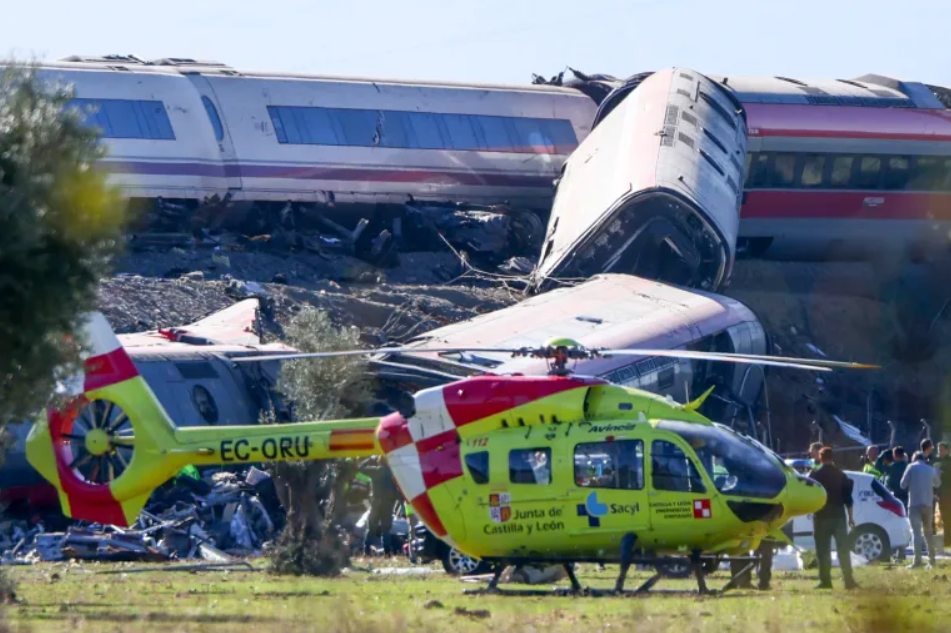
A Renfe AVE train struck the rear of an Iryo service on the Madrid–Seville route on Wednesday morning, sending carriages off the tracks in Toledo province, south of Madrid.
Emergency teams worked through the night at the scene. The death toll remained provisional as rescuers searched the wreckage and hospitals treated the injured. El País
The Spain train crash context marks this disaster as Spain’s second fatal collision on its high-speed railway network this year. Following the Adamuz crash in January, this marks another major incident.
Moreover, across the wider railway system, a review by the Associated Press identified four fatal rail incidents in 2026. They include a commuter train crash and a collision at a level crossing.
What happened near Urda?
The trains were traveling south from Madrid towards Seville when the collision happened shortly before 09:00 local time on 28 October.
Renfe confirmed that its affected service had departed Madrid’s Puerta de Atocha station at 08:00 and was scheduled to reach Sevilla Santa Justa at 10:39. It collided with the Iryo train between Los Yébenes and Urda. Renfe’s initial statement
Iryo said its service, numbered 6076, had left Madrid at 07:54 carrying 147 passengers and five staff members. The company confirmed that the impact struck the rear of its train near kilometer marker 118. Iryo statement
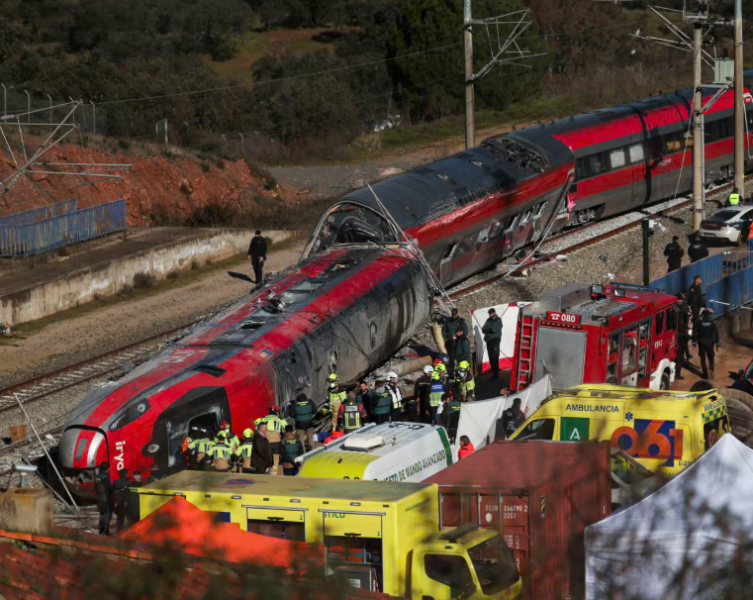
Initial reports put the combined passenger total above 500, although published figures differed. Images released by the Guardia Civil showed derailed carriages on the embankment beside the railway and extensive damage to the front of the Renfe train. RTVE
Local residents joined the emergency response, while a sports centre in Urda was used to receive survivors and provide treatment. Relatives traveled to the area seeking information about people who had been on board. ABC News
How serious was the crash?
The reported death toll makes Urda Spain’s deadliest railway accident since the derailment near Santiago de Compostela on 24 July 2013.
In that disaster, an Alvia train traveling from Madrid to Ferrol left the tracks on a curve at Angrois. Eighty people were killed and 145 injured, according to Spanish public broadcaster RTVE. RTVE historical review
Urda’s provisional toll of 68 also exceeds the 46 deaths reported after the Adamuz collision earlier this year. The two disasters together account for at least 114 deaths.
Urda is the deadliest accident recorded on Spain’s dedicated high-speed network since it opened in 1992. The distinction matters: the 2013 Santiago derailment involved an Alvia service on a conventional section of its route. EFE identifies Adamuz and Urda as the first two fatal accidents on the dedicated high-speed network. EFE
How many rail accidents has Spain had this year?
There have been two fatal high-speed rail collisions and at least four documented fatal railway incidents in 2026. The broader figure includes accidents involving commuter services and road vehicles at crossings.
The four fatal incidents identified in the reporting are:
| Date | Location | What happened | Reported deaths |
|---|---|---|---|
| 18 January | Adamuz, Córdoba | An Iryo service from Málaga to Madrid derailed and collided with a Renfe Alvia travelling towards Huelva. EFE | 46 |
| 20 January | Gelida, near Barcelona | A Rodalies commuter train struck a retaining wall that had fallen onto the railway during heavy rain. One person died and 41 were injured. Spanish government record | 1 |
| 12 February | Talavera de la Reina, Toledo | A Madrid–Badajoz passenger train struck a car at a level crossing. The car’s occupant died. RTVE | 1 |
| 28 October | Urda, Toledo | A Renfe AVE struck the rear of an Iryo train on the Madrid–Seville route. EFE | At least 68 |
Those four incidents account for at least 116 deaths, using the reported tolls above.
There have also been non-fatal accidents. On 20 January, a separate train derailed near Maçanet de la Selva in Catalonia without reported injuries. On 22 January, a crane arm struck a train on the Cartagena–Los Nietos line, leaving six people with minor injuries. HuffPost’s Catalonia chronology, El País
That brings the incidents described here to at least six rail accidents, four of them fatal. It is not a complete national tally of every railway accident or operational incident.
What caused the collision?
Investigators are examining a failure of the railway’s automatic safety system and the instructions given to drivers afterwards.
Transport Minister Óscar Puente said a computer malfunction caused the LZB safety system to fail at about 08:30 along a 63-kilometer section of track. Several trains stopped automatically.
According to his initial account, the Renfe service was authorized to resume normal running at about 08:36, despite a red signal and the Iryo train remaining ahead on the same track.
Puente said the train should instead have followed a restricted procedure requiring the driver to travel slowly enough to stop if an obstruction became visible. The precise speed before impact had not been established in that account. Euronews
Some details remain disputed. Sources close to Iryo told Onda Cero that its driver was waiting for authorization to move when the train was struck, challenging suggestions that permission had already been given.
The investigation has yet to establish final responsibility. The minister’s reconstruction remains an initial account of events. Onda Cero
National mourning and support for families
Spain has declared official mourning from 29 to 31 October for the Spain train crash. Additionally, flags will fly at half-mast on public buildings and naval vessels for the three-day period. Official state bulletin
Renfe said family assistance centers had been established in Madrid, Córdoba and Seville, with psychological support available. Stations in Madrid Atocha, Sevilla, Córdoba and Málaga were to remain open around the clock to help those affected.
The operator’s assistance number is 900 10 10 20. Iryo has opened a separate line on 900 001 403 for passengers and relatives. Renfe, Iryo
Which train services are affected?
High-speed services between Madrid, Ciudad Real and Andalusia were suspended following the collision.
Renfe announced special services on conventional tracks linking Madrid, Ciudad Real and Puertollano, with journeys expected to take about 90 minutes longer. It also said an alternative transport plan for the Madrid–Andalusia corridor would begin on Friday, 30 October.
Passengers affected by the suspension can change or cancel their tickets without charge. Details of replacement services are being provided through the operators’ official channels. Renfe travel update