How Many Earthquakes Shook the World in July 2026?
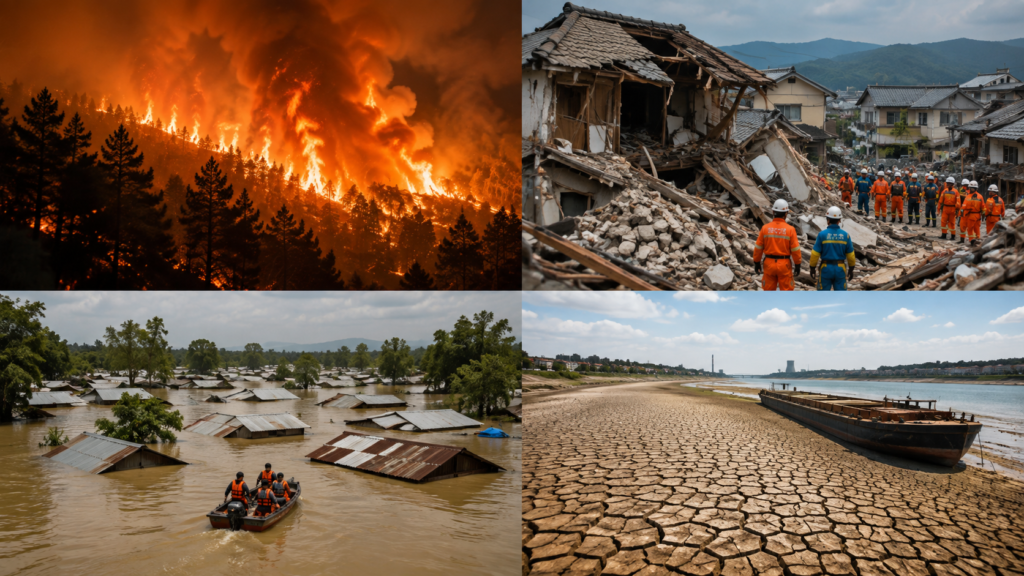
July 2026 natural disasters affected communities across several continents, with powerful earthquakes, destructive wildfires, severe flooding and prolonged heatwaves causing widespread disruption and loss. From Europe to Asia and North America, emergency services responded to a series of major events that damaged infrastructure, displaced thousands of people and claimed hundreds of lives.
Western Europe experienced an intense heatwave that fuelled widespread wildfires in several countries, including France, Spain and Portugal. Across South Asia, heavy monsoon rains triggered severe flooding and landslides, leaving more than 200 people dead and forcing hundreds of thousands from their homes. Meanwhile, large wildfires continued to burn across parts of the western United States, while a powerful earthquake struck southern Japan near the end of the month, adding to an already challenging period of extreme weather and natural hazards.
A shallow earthquake in southern Japan on 28 July added a fourth crisis, killing 38 people in a region that was simultaneously under an extreme-heat warning.
The atmospheric backdrop was a strengthening El Niño. NOAA’s Climate Prediction Center issued a formal El Niño Advisory on 9 July, confirming that the coupled ocean-atmosphere system in the tropical Pacific was intensifying. The pattern suppressed Atlantic hurricane activity to almost nothing while helping to load the atmosphere over Europe and East Asia with record heat.
The scale of that warmth was already evident before July began. According to the Copernicus Climate Change Service, June 2026 was the second-warmest June ever recorded globally, at 16.54C, and the warmest June on record for western Europe. Copernicus had not yet published its July bulletin at the time of writing, leaving the month’s global ranking undetermined.
July 2026 Natural Disasters: Earthquakes
Global seismic activity in July was close to the long-term average in volume, but two events stood out: a powerful offshore tremor near the Mexico-Guatemala border that caused no casualties, and a much smaller but far more destructive quake beneath southern Japan.
Data compiled by VolcanoDiscovery from the U.S. Geological Survey, the European-Mediterranean Seismological Centre, the German Research Centre for Geosciences and national agencies recorded 17,384 earthquakes worldwide between 1 and 27 July. The aggregate did not extend to the final four days of the month and therefore excludes the Japanese earthquake and its aftershock sequence. Total seismic energy release over the period was estimated at 8.7 x 10¹⁵ joules, equivalent to a single magnitude 7.4 event.
| Magnitude | Events recorded, 1–27 July 2026 |
|---|---|
| 9.0 and above | 0 |
| 8.0–8.9 | 0 |
| 7.0 and above | 1 |
| 6.0 and above | 9 |
| 5.0 and above | 190 |
| 4.0 and above | 1,621 |
| 3.0 and above | 5,368 |
| 2.0 and above | 10,195 |
| Total | 17,384 |
The strongest earthquake of the month struck off the Pacific coast of Chiapas, Mexico, on 17 July. According to the U.S. Geological Survey, the magnitude 7.3 tremor occurred at 14:49 UTC at a depth of between 10 and 15 kilometres, with an epicentre about 48 kilometres south-west of Aquiles Serdán, near the town of Puerto Madero. It was initially reported at magnitude 7.4 before being revised.
The quake was felt strongly from southern Mexico to El Salvador, shaking buildings in Guatemala City and prompting residents to run into the streets. The U.S. Tsunami Warning System issued a threat notice for coastlines within about 300 kilometres of the epicentre, cancelling it roughly three hours later. Authorities in Mexico and Guatemala reported no fatalities and no significant damage, and the event was closed without further incident, Euronews reported.
Eleven days later, a considerably weaker but far deadlier earthquake struck Kyushu, in southern Japan. The Japan Meteorological Agency, which has formally named the event the 2026 Kumamoto earthquake, recorded a magnitude of 7.1 on its own scale, while the U.S. Geological Survey assessed it at moment magnitude 6.8. The quake hit at 16:27 local time on 28 July at a depth of 10 kilometres, with the epicentre five kilometres east of the city of Uto in Kumamoto Prefecture. It was caused by strike-slip rupture on the north-eastern section of the Hinagu fault, a structure Japanese seismologists had identified in January as carrying the highest 30-year rupture probability of any fault in the country.
Shaking reached the maximum level of 7 on Japan’s seismic intensity scale. The Japan Meteorological Agency issued a tsunami advisory for the coasts of the Ariake and Yatsushiro seas, warning of waves of around one metre, and lifted it later the same evening. The Pacific Tsunami Warning Center confirmed there was no threat to Hawaii or American Samoa.
As of 4 August, the Kumamoto prefectural disaster response headquarters had confirmed 38 deaths, with more than 120 people injured. Two of those deaths were still being assessed to determine whether they were caused by the earthquake. Two incidents accounted for the largest clusters of fatalities. At least seven people were killed when an explosion tore through the Aeon Mall in the town of Kashima roughly 80 minutes after the tremor, collapsing part of the second floor and trapping workers inside. A further eight died at a Nippon Paper Industries mill in the city of Yatsushiro, where a chimney collapsed, the Japan Times reported.
Around 400 shelters were opened for some 19,000 people at the peak of the emergency. By 1 August, 229 centres were still housing 9,228 evacuees, according to Xinhua; a week after the quake the figure had fallen to just over 7,500. Damage assessments remain incomplete and inconsistent: prefectural authorities put the number of damaged homes at 12,276, while Jiji Press reported more than 13,000.
Utility disruption was extensive. Roughly 6,000 households remained without electricity and about 72,000 without running water at the start of August. JR Kyushu confirmed damage at more than 200 locations on the Kyushu Shinkansen line, including broken rails. Services between Hakata and Kumamoto resumed on 31 July, but officials said restoring the Kumamoto to Shin-Minamata section during August would be difficult. Stone walls at Kumamoto Castle, rebuilt after the 2016 earthquakes, collapsed again.
Comprehensive economic loss estimates have not been published, but early sectoral figures indicate substantial damage. A survey conducted through tourism organisations found that accommodation bookings for about 66,000 people were cancelled between the earthquake and 31 July, causing estimated losses of 900 million yen, News On Japan reported. The figure excludes the Yatsushiro area, where the survey could not be completed, and is expected to rise.
Recovery is being hampered by extreme heat. Construction of temporary housing began on 3 August in Uki and Hikawa, and prefectural officials moved to install portable air conditioning in shelters after a woman in her seventies who had been sleeping in her car died of suspected heatstroke, the first death judged likely to be disaster-related.
Elsewhere, a magnitude 6.0 earthquake struck between 75 and 82 kilometres west of Sola, Vanuatu, on 24 July at a depth of about 44 kilometres. It was felt on nearby islands but caused no reported damage.
Floods and landslides
The monsoon dominated the month’s flood record, driving a single connected emergency across South Asia. According to the Center for Disaster Philanthropy, rains and flooding since early July hit Afghanistan, Bangladesh, India, Myanmar and Pakistan, displacing hundreds of thousands of people and damaging homes, farmland, roads and water systems. Tens of thousands of homes were destroyed or damaged and thousands of acres of cropland were lost, along with large numbers of livestock. Rohingya refugee camps in Bangladesh and displacement sites in Myanmar were among the areas affected.
Pakistan recorded the highest national death toll. Briefing Prime Minister Shehbaz Sharif on 28 July, the National Disaster Management Authority said 110 people had been killed and around 360 injured since the monsoon began on 26 June, with nearly 800 houses damaged, the Express Tribune reported. An updated NDMA situation report on 31 July put the figures at 109 dead and 362 injured. The toll had stood at 81 as recently as 23 July, including 35 children.
Khyber Pakhtunkhwa was worst affected with 55 deaths, followed by Punjab with 36. More than half the fatalities were caused by house or roof collapses. In Punjab, a senior irrigation official described the situation as “very alarming”, telling Al Jazeera that around 400 square kilometres across the Lahore and Gujranwala divisions were under water. At least 17 flood relief camps were established in Lahore.
In the mountainous north, flash floods and glacial lake outburst floods severed road access to parts of Gilgit-Baltistan for four consecutive days, stranding thousands of residents and tourists and cutting drinking water supplies. The NDMA warned that rapidly melting glaciers made further outburst floods likely over the following month, and the Pakistan Meteorological Department forecast another active monsoon spell from 29 July.
India’s deadliest single flood event unfolded in the north-eastern state of Assam. Officials said on 24 July that at least 50 people had been killed and 700,000 displaced after days of heavy rain caused the Brahmaputra to overflow, flooding villages and sweeping away homes. Nearly 300,000 people were moved into government-run relief camps, with food and supplies delivered by helicopter airdrop in the worst-hit districts, the Associated Press reported.
Days earlier, torrential rain across northern and north-eastern India killed at least 25 people over the weekend of 18 to 19 July. Fifteen died in the Poonch, Rajouri and Doda districts of Indian-administered Kashmir, nine were killed by landslides in Nagaland and one drowned in Assam, Al Jazeera reported. Three major Hindu pilgrimages, the Amarnath Yatra, Vaishno Devi and Shiv Khori, were suspended, and a landslide near Gaurikund halted movement on the Kedarnath trek. In a separate incident on the same weekend, an under-construction tunnel collapsed in Sikkim, killing 20 workers, with rescue efforts impeded by continuing rain.
In Bangladesh, a landslide triggered by heavy rain killed 22 people, including three children in the Cox’s Bazar camp housing Rohingya refugees. Floodwaters submerged croplands, homes, businesses and roads, leaving at least 300,000 people stranded, according to reporting cited by the Center for Disaster Philanthropy. A United Nations flash update issued on 11 July put the number of people affected nationally at 1.1 million.
Flooding also proved deadly in southern China. Authorities said on 9 July that 39 people had been killed after Tropical Storm Maysak dumped heavy rain over Guangxi. Most of the deaths occurred in Hengzhou, where the partial collapse of a reservoir dam sent water surging into the city and claimed 26 lives, said Ding Wei, vice mayor of Nanning, the Associated Press reported. Dozens of rivers overflowed across southern and central China during the same period.
In the Philippines, the combined effects of Tropical Cyclone Noul and an enhanced south-west monsoon affected around 58,000 families, or 269,000 people, between 20 and 27 July. The National Disaster Risk Reduction and Management Council reported three deaths and one person missing, both figures pending validation, along with damage to 14 road sections and five bridges and 671 houses damaged, of which 246 were destroyed outright, according to the AHA Centre.
The United States recorded its own extreme rainfall event in early July. On 10 and 11 July, a one-in-1,000-year downpour struck Lesterville, Missouri, washing away every road leading to Camp Taum and forcing the evacuation of 200 campers and counsellors by helicopter. A building collapsed nearby and 17 people were swept into floodwaters, all of whom were later rescued or accounted for. Emergency crews carried out 90 water rescues after the Black River rose to a record 28.7 feet. One person died.
Wildfires
July 2026 was the most destructive wildfire month on record for both France and Spain, and one of the worst ever recorded in the American Pacific North-West.
In France, the fires were concentrated in the south-west, in the Gironde and Landes departments, where pine forest and vast tracts of bracken burned through communities including Lège-Cap-Ferret, Le Porge, Lacanau and Saint-Jean-d’Illac. Interior Minister Laurent Nuñez said on 25 July that fires had consumed nearly 98,000 hectares nationally, describing the figure as a “historic record” and warning that a number of blazes remained uncontrolled, Al Jazeera reported. By the end of the month the Interior Ministry counted 13,566 fires across more than 116,000 hectares since January, the highest annual total in modern French records, according to PBS News.
Around 30 fires burned simultaneously at the peak. More than 250,000 people were evacuated across France, 220,000 of them in Gironde alone, in what French media described as the largest evacuation operation carried out in the country since the Second World War. A further 4,000 were moved from Atlantic coast tourist sites on 28 July as returning heat threatened firefighters’ hold on the largest blaze west of Bordeaux. The prefecture said 93 firefighters had been injured.
The response involved 1,400 firefighters, 1,500 military personnel and 1,700 internal security officers, with about 2.5 million filtering face masks distributed to protect residents and frontline staff from smoke, CNN reported. Industrial disruption was significant: Safran, Dassault Aviation and ArianeGroup all suspended production and evacuated facilities, while oyster farming in Arcachon Bay and the regional tourism industry were badly hit.
Early loss estimates are among the largest ever recorded for a European wildfire event. The credit ratings agency Morningstar DBRS put France’s total economic losses at between 10 billion and 15 billion euros, with insured losses running into several billion, Reuters reported. Because wildfires are not covered by France’s state-backed natural disaster compensation scheme, private insurers are expected to shoulder most of the recovery bill, and analysts said the fires could become the costliest wildfire event in French history.
Spain suffered both the deadliest and the largest fires. The first struck on the evening of 9 July near Los Gallardos in Almería province, Andalusia, burning through dry esparto grass, pasture and low scrub in a semi-arid area near the Sierra de Los Filabres during a heatwave. It killed 13 people, injured at least 17 and left 10 missing, forcing the evacuation of more than 1,600 residents. It is the deadliest wildfire in Andalusian history and the third deadliest recorded in Spain.
Most of the victims were foreign nationals living in a remote expatriate community, and most died after ignoring shelter-in-place instructions, said Antonio Sanz, head of Andalusia’s emergency services. Seven were killed on foot after abandoning their cars, and some attempted to escape along a dry riverbed that Sanz said “turned into a death trap”, the Associated Press reported. The fire consumed more than 3,200 hectares of forest and farmland and was fought by around 150 firefighters and 220 soldiers from Spain’s military emergency unit. The cause has not been officially confirmed; witnesses reported a downed power line, a claim denied by the electricity provider Endesa, which said the line was inactive and did not belong to it.
Later in the month, fires in central and eastern Spain reached a far greater scale. A blaze burning through hilly rural terrain in Ávila, west of Madrid, grew beyond 50,000 hectares to become the largest fire in Spanish records, roughly five times the area of Barcelona. On 25 July, the interior ministry reported nearly 10,000 hectares burned in the Madrid region and between 13,000 and 15,000 hectares in Ávila province. Carlos Novillo, the Madrid regional government’s emergency management chief, said the fire near the capital was “at its peak and is currently beyond the capacity of firefighters to contain”. A separate fire in the eastern province of Castellón forced further mass evacuations. More than 75,000 people were evacuated in Spain and around 30,000 ordered to shelter in place as of 26 July.
Sara Aagesen, Spain’s minister for the ecological transition, said 153,000 hectares had burned nationally during the year, six times the area lost in the first half of 2025.
Taken together, the European Forest Fire Information System estimated that more than 300,000 hectares had burned across France and Spain, with over 300,000 people displaced in what the European Union described as one of the largest evacuation operations in the continent’s history. NPR put the combined figure at roughly 330,000 by 28 July. At least three people died in the late-July fires, including two firefighters. The blazes were largely contained but not fully extinguished as of 3 August, with Spain entering its fourth heatwave of the summer.
A Financial Times analysis estimated economic losses of 3.1 billion euros across the five worst-affected eurozone countries, France, Spain, Portugal, Greece and Romania, with nearly 500,000 hectares burned since the start of the fire season. That figure covers only the cost of restoring burned land and excludes damage to homes, businesses, crops and tourism. Sarah Meier, a climate economist at ETH Zurich, warned the true cost could be more than three times higher.
In the United States, Oregon endured the worst fire season in its modern history. The state had burned nearly 1.8 million acres by 29 July, closing on the record of 1.93 million acres set in 2024, with August and September, traditionally the most dangerous months, still ahead, Oregon Public Broadcasting reported. The record was broken days later.
Seventy-six large fires had burned by late July, most sparked by a series of lightning storms. The Big Grass fire near Jordan Valley reached about 280,000 acres, expanding by 60,000 acres in three days and crossing into Idaho. The Rowe Creek Complex near Fossil exceeded 205,000 acres and the Coleman Creek fire near Juntura around 130,000. The Grasshopper Fire east of Mount Hood grew past 18,000 acres with no containment, prompting evacuations in Wasco County and the invocation of Oregon’s Emergency Conflagration Act. On the Warm Springs Reservation, where evacuation orders forced tribal government offices to close, the Bench Fire destroyed eight homes and five other buildings. More than 12,000 people were under evacuation notices at the end of the month.
In Colorado, the Aspen Acres Fire in Pueblo and Custer counties, ignited on 29 June, had burned 91,000 acres and was only 12 per cent contained by 6 July, with at least 180 structures destroyed and evacuation orders covering 11,000 people. It ranks among the ten largest fires in the state’s history.
The Spokane Complex fires in eastern Washington, which forced around 65,000 evacuations and destroyed more than 600 structures, began on 1 August and therefore fall outside this reporting period.
Heatwaves
France recorded the most striking climate statistic of the month. According to the monthly climate assessment published by Météo-France on 4 August, July 2026 was the hottest month of any month ever measured in the country since records began in 1900, with a national average temperature of 24.9C. It surpassed the August 2003 heatwave, which averaged 24.8C, and July 2006, at 24.4C.
The anomaly against the 1991-2020 baseline reached 3.8C for mean temperatures and 5.2C for maximums, the second-highest monthly anomaly on record after February 1990. France’s second heatwave of the year ran from 4 to 19 July and was the third longest ever observed. The month was also the third driest July on record, with a rainfall deficit of nearly 70 per cent, and the second sunniest, with a 35 per cent sunshine surplus. By the end of July, surface soils were drier than at the equivalent point in either 2022 or 2025 and had reached levels equivalent to the lowest ever recorded. Not a single day passed without several departments being placed on high wildfire alert; on 12 July, 70 departments were under that warning.
In the United States, heat was again the deadliest weather hazard. A Washington Post analysis published on 26 July counted at least 70 deaths from the month’s heat domes, though epidemiologists cautioned that the country’s slow and inconsistent approach to assessing heat mortality makes that a significant undercount.
The first of three heat domes killed at least 44 people during the week of 4 July, including 29 in New Jersey, the highest state toll in 15 years. Atlantic City reached 106F on Independence Day, tying its all-time record, and Reagan National Airport in Washington set back-to-back records with 102F on 3 July and 103F on 4 July. Severe thunderstorms that broke up the dome between 4 and 6 July caused more than 1.3 million power outages and four deaths, and may have produced the largest hailstone in Connecticut’s history. A third heat dome built over the central and western states in late July, placing 80 million Americans under heat advisories with little overnight relief. The contiguous United States recorded its second-hottest first half of any year, according to NOAA’s National Centers for Environmental Information.
East Asia’s heat intensified through the second half of the month. In Japan, temperatures reached at least 40C for five consecutive days in some areas in late July, the longest such streak on record, prompting the country’s weather agency to introduce a new designation for days above that threshold. Japan’s disaster management agency reported that more than 18,000 people were taken to hospital with heatstroke symptoms during the week of 20 to 26 July alone, CNN reported. Kumamoto Prefecture, still recovering from the earthquake, recorded its highest temperature on record in early August.
In South Korea, the Interior and Safety Ministry reported around 2,220 cases of heat-related illness and 19 deaths since mid-May, along with the loss of about 17,140 livestock and 160,000 farmed fish. The national all-time record of 42.5C was set at Yangsan on 2 August, at the culmination of a heat build-up that began in late July and the highest reading in 122 years of observations. President Lee Jae Myung instructed officials to treat the heatwave as a national disaster. North Korean authorities issued heat advisories across large parts of the country.
Spain recorded 1,028 heat-related deaths during 2026 as a whole, following more than 1,000 excess deaths attributed to heat in June alone.
Drought
Drought was the connective tissue linking Europe’s heat to its fires. A rapid assessment by World Weather Attribution concluded that the European drought amounted to a compound crisis driven by prolonged rainfall deficits and extreme heat, with the summer of 2026 emerging as one of the most significant heat and drought events the continent has seen in recent years. Agricultural impacts included historic crop losses and France’s lowest maize harvest in 50 years.
The Rhine and the Danube fell to record low levels. Cargo vessels on the Rhine and its tributaries in Germany and the Netherlands were forced to carry significantly reduced loads or risk running aground in shallow navigation channels, the Associated Press reported from Waddinxveen on 30 July. Dutch water authorities banned farmers in some areas from pumping canal water for irrigation, and growers warned of smaller fruit harvests and higher prices. Salinity intrusion worsened across reclaimed land in the western Netherlands.
Dike patrols became a daily routine. Teams working for regional water corporations walked the country’s flood defences prodding the dried surface with metal rods and scanning for patches of green grass that could indicate a leak, checking for cracks caused by the drought in embankments designed to hold water back rather than survive without it. In some areas the receding water left houseboats resting on sandy river beds.
Drought also affected parts of South-East Asia. Indonesia’s national disaster agency reported drought conditions in West Java, Central Java, East Java and North and South Sulawesi through July.
Tropical cyclones
The western Pacific produced the month’s most powerful storm by a wide margin, while the Atlantic remained almost entirely dormant.
Typhoon Bavi, known in the Philippines as Inday, reached Category 5-equivalent intensity near the Mariana Islands on 5 July. The Japan Meteorological Agency estimated maximum sustained winds of 205km/h and a central pressure of 910 hectopascals, while the U.S. Joint Typhoon Warning Center assessed peak one-minute sustained winds of 285km/h and a pressure of 901 hectopascals. It made landfall on Rota, in the Northern Mariana Islands, at peak intensity, ranking among the strongest tropical cyclones ever to strike a United States territory. Guam recorded hurricane-force winds and at least four injuries, with restoration work complicated by damage left unrepaired since Typhoon Sinlaku in April.
Bavi never made landfall in the Philippines, but its enormous circulation intensified the south-west monsoon and produced days of torrential rain. The storm triggered landslides and flooding that killed 23 people and left 18 missing, with the Office of Civil Defense reporting more than 562,000 people affected. Casualty figures were revised repeatedly through the following week.
The typhoon then brushed past northern Taiwan, where more than 14,000 people were evacuated from mountainous areas, over 170,000 households lost power and hundreds of flights were cancelled. Taiwan’s fire department recorded 113 injuries, most of them from falls from motorcycles and bicycles on wet roads, a figure later revised to 134. More than 200 flights were cancelled in Japan as the storm passed the Sakishima and Okinawa islands. No deaths were reported in either territory.
Bavi made its final landfall in the coastal city of Taizhou, Zhejiang province, at about 11:20pm local time on 11 July, with maximum sustained winds of around 144km/h, CNBC reported. Chinese authorities evacuated between 1.7 million and 2.8 million people ahead of the storm, depending on the source, and no deaths were confirmed on the mainland. The storm weakened to a severe tropical storm on 12 July, crossed into Anhui province and dissipated on 16 July.
Two other systems affected the region. Tropical Storm Maysak made landfall in southern China in early July, driving the Guangxi flooding that killed 39 people. Tropical Cyclone Noul struck the Philippines between 20 and 27 July, and Tropical Depression Luis brought flooding to Albay and Zamboanga City at the very end of the month, affecting around 4,000 people.
The Atlantic told the opposite story. NOAA had forecast a below-normal season of eight to 14 named storms, and Colorado State University lowered its outlook in July to nine named storms, four hurricanes and one major hurricane, predicting basin accumulated cyclone energy at just 40 to 45 per cent of the long-term average because of increasing confidence in a strong El Niño. In its early-August update, the university maintained that forecast, noting that only Tropical Storms Arthur and Bertha had formed.
Bertha brushed the Gulf Coast in July, producing an unusual combination of alerts: southern Louisiana was placed under a tropical storm warning and an extreme heat warning simultaneously for the first time since 2005, with Lake Charles recording a heat index of 121F. No hurricane made landfall on the United States coastline during the month.
Tornadoes and severe storms
The United States recorded two significant tornado events in July, both in the Midwest.
On 21 July, a tornado outbreak swept southern Illinois, producing 23 tornadoes. Most were rated EF-0 or EF-1 and two reached EF-2, but a single EF-3 tornado tracked south of Dix and north of Mount Vernon in northern Jefferson County before crossing into Wayne County. It reached a maximum width of 400 yards, remained on the ground for just over 15 miles and produced estimated peak winds of 140mph. It destroyed several mobile homes and killed two people, both in single-wide trailer homes.
Six days later, a multi-state outbreak crossed Wisconsin, northern Illinois and north-west Indiana. The most significant damage occurred in Wisconsin’s Fox Valley, where the National Weather Service surveyed a tornado that developed two miles west-north-west of Appleton and tracked south through Fox Crossing and Menasha, rating it EF-3 with estimated winds up to 140mph. It dissipated over Lake Winnebago at around 12:22pm local time.
The tornado damaged homes, businesses and trees and cut power to more than 30,000 people. Menasha declared a local state of disaster and imposed an overnight curfew as crews responded to gas leaks and blocked roads. No deaths or serious injuries were reported. The same system produced exceptional hail, including stones of approximately 11.4cm north-west of Gresham in Shawano County and 7cm hail near Algoma, Sturgeon Bay and Belle Plaine, The Watchers reported.
The United States had recorded 12 billion-dollar weather and climate disasters in the first half of 2026.
Volcanic activity
No eruption caused mass casualties during July, but several volcanoes remained in sustained activity and one disrupted European air travel.
Mount Etna in Sicily intensified from around 2 July, with explosive and effusive activity at the Voragine summit crater and lava flowing eastward from a vent at 3,000 metres elevation. An eruption on 5 and 6 July ejected an ash column around 1.5 kilometres high, closing Catania airport and causing hundreds of flight cancellations and diversions that stranded travellers across the island.
In Russia’s Kamchatka region, Sheveluch erupted almost continuously throughout the month. The Kamchatkan Volcanic Eruption Response Team reported ongoing lava effusion and explosive activity at the lava domes between 21 and 29 July, with explosions on 21 July sending ash plumes to 9 kilometres. The Anchorage Volcanic Ash Advisory Centre recorded a plume reaching 12.2 kilometres on 26 July.
Indonesia maintained several Level 3 alerts as Semeru, Ibu, Dukono, Lewotobi Laki-laki and Krakatau produced ash emissions. In the Philippines, Mayon and Kanlaon issued repeated ash advisories while Taal remained under eruption warning. Sakurajima in Japan erupted repeatedly, and Tokachi on Hokkaido produced a low-level emission on 22 July. In the Americas, Fuego and Santiaguito in Guatemala and Popocatépetl in Mexico continued routine ash emission, while Kīlauea in Hawaii and Great Sitkin in Alaska remained at Watch and Orange alert levels.
Statistical summary
| Category | Event | Key figure |
|---|---|---|
| Strongest earthquake | Off Chiapas, Mexico, 17 July | Magnitude 7.3; tsunami threat issued and cancelled; no casualties |
| Deadliest earthquake | Kumamoto, Japan, 28 July | Magnitude 6.8 USGS / 7.1 JMA; 38 dead, 120+ injured, 13,000+ homes damaged |
| Deadliest single disaster | Assam floods, India | 50 dead, 700,000 displaced |
| Highest national monsoon toll | Pakistan, 26 June to 31 July | 109–110 dead, around 360 injured |
| Deadliest heat event | United States heat domes | At least 70 deaths, believed undercounted |
| Deadliest wildfire | Los Gallardos, Almería, Spain, 9 July | 13 dead, 17 injured, 10 missing |
| Largest single wildfire | Ávila, Spain | More than 50,000 hectares, Spain’s largest on record |
| Largest area burned nationally | Oregon, United States | About 1.8 million acres by 29 July |
| Largest fire evacuation | France and Spain | Around 330,000 displaced; 220,000 in Gironde alone |
| Largest storm evacuation | Typhoon Bavi, China | 1.7 to 2.8 million evacuated; no confirmed mainland deaths |
| Strongest tropical cyclone | Super Typhoon Bavi | 901–910 hectopascals, Category 5-equivalent at landfall on Rota |
| Strongest tornadoes | Illinois, 21 July and Wisconsin, 27 July | EF-3, estimated 140mph; two deaths in Illinois |
| Costliest event | French wildfires | Estimated 10 to 15 billion euros in total losses |
| National climate record | France | Hottest month ever recorded, 24.9C |
The month closed with several emergencies unresolved. Recovery in Kumamoto is running into a record East Asian heatwave, with thousands still in shelters. Pakistan’s monsoon continues into September and disaster officials have warned of further glacial lake outburst floods. Spain entered a fourth heatwave with fires still burning, and Oregon and Washington face their two most dangerous fire months with more than two million acres already lost.