
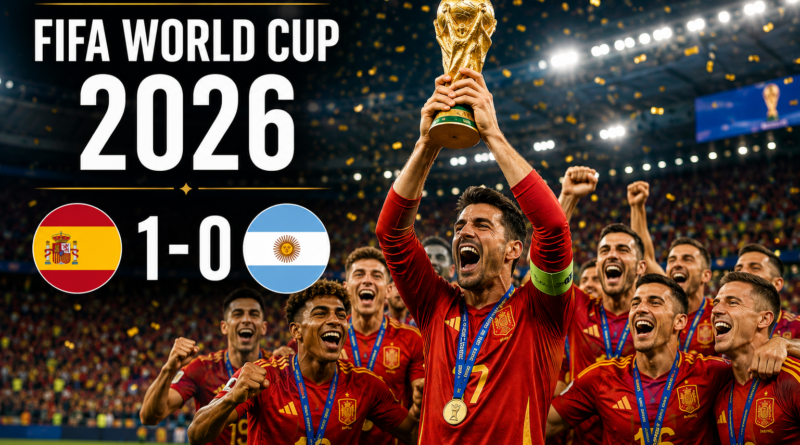
FIFA World Cup 2026 Final: Spain Beats Argentina to Become World Champions
FIFA World Cup 2026 final delivered an unforgettable night as Spain defeated Argentina to become world champions.
Football once again delivered one of its most unforgettable nights as Spain were crowned FIFA World Cup 2026 champions, defeating Argentina 1-0 after extra time in a tense and tactical final at MetLife Stadium in East Rutherford, New Jersey.
The match was expected to become an instant classic between two of the world’s strongest football nations. Argentina entered the final hoping to defend the title they won in Qatar in 2022, while Spain sought to lift football’s greatest trophy for the first time since their historic victory in South Africa in 2010.
For more than 100 minutes, neither side could find the decisive breakthrough. Spain controlled possession, patiently building attacks and forcing Argentina to defend for long periods, while the South Americans relied on counter-attacks and moments of individual brilliance.
The breakthrough finally arrived in the 106th minute of extra time when substitute Ferran Torres finished calmly from close range after an excellent attacking move. The goal proved enough to secure Spain’s second FIFA World Cup title and sparked celebrations among millions of Spanish supporters around the world.
Argentina pushed forward in the closing minutes in search of an equaliser but struggled to create clear opportunities. Their hopes became even more difficult after midfielder Enzo Fernández received a red card, leaving the defending champions to finish the match with ten players.
When the final whistle sounded, Spain’s players collapsed to the ground in celebration, while Argentina’s squad were left to reflect on a campaign that came agonisingly close to ending with back-to-back World Cup victories.
FIFA World Cup 2026 Final: Spain vs Argentina
Many fans expected a high-scoring encounter filled with attacking football. Instead, the final developed into a fascinating tactical battle.
Spain dominated possession throughout much of the game, demonstrating the passing style that has defined Spanish football for more than two decades. Their midfield consistently controlled the tempo, limiting Argentina’s opportunities to launch dangerous attacks.
Argentina defended with discipline for much of normal time, frustrating Spain and forcing the match into extra time. However, the physical demands of the tournament gradually became apparent, and Spain’s fresh substitutes eventually made the difference.
The winning goal highlighted Spain’s patience. Rather than forcing opportunities, they continued moving the ball confidently until the decisive opening appeared.
Football experts praised both teams for their defensive organisation, but Spain’s greater creativity ultimately proved decisive.
Spain’s Journey to the 2026 World Cup Title
Spain entered the tournament among the favourites, but few predicted how consistently they would perform throughout the competition.
The Spanish squad combined experienced international players with one of the most exciting new generations in world football.
Throughout the tournament Spain demonstrated:
- Excellent ball possession
- Strong defensive organisation
- Clinical finishing when chances appeared
- Tactical flexibility
- Outstanding squad depth
Unlike previous tournaments where Spain occasionally struggled to convert possession into goals, the 2026 side showed greater balance between attractive football and attacking efficiency.
Their unbeaten run to the title confirmed their status as one of international football’s dominant forces.
Argentina’s Brave Defence Ends in Heartbreak
Argentina arrived as defending champions and once again showed why they remain among football’s elite nations.
Throughout the tournament they displayed resilience, determination and tactical intelligence.
Although they were unable to retain the trophy, reaching another World Cup final underlined the remarkable consistency of Argentine football over recent decades.
Many analysts believe Argentina’s experience helped them survive Spain’s pressure for over 100 minutes before finally conceding.
Despite the disappointment, their campaign will still be remembered as one of the strongest performances in the tournament.
The History of FIFA
The Fédération Internationale de Football Association (FIFA) was founded on 21 May 1904 in Paris, France.
Its creation came as football rapidly expanded across Europe. National associations recognised the need for an international governing body that could establish common rules, organise competitions and oversee the development of the world’s most popular sport.
The seven founding members were:
- France
- Belgium
- Denmark
- Netherlands
- Spain
- Sweden
- Switzerland
Over the following century FIFA expanded dramatically.
Today the organisation includes 211 national football associations, making it one of the largest sporting organisations on Earth.
Its responsibilities include:
- Organising the FIFA World Cup
- Promoting football worldwide
- Developing youth football
- Supporting women’s football
- Establishing international regulations
- Funding football development programmes
FIFA headquarters are now located in Zurich, Switzerland.
The Birth of the FIFA World Cup
Although FIFA was established in 1904, the first FIFA World Cup was not held until 1930.
Uruguay hosted the inaugural tournament after winning two Olympic football championships.
Only thirteen nations participated, with Uruguay defeating Argentina 4-2 in the first-ever World Cup final.
What began as a relatively small competition has since become the biggest sporting event on the planet.
Today the World Cup attracts billions of television viewers, hundreds of millions of social media interactions and millions of travelling supporters.
Evolution of the Tournament
The FIFA World Cup has changed significantly throughout its history.
1930
13 participating nations.
1954
Introduction of group stages in a more recognisable format.
1982
Expansion to 24 teams.
1998
Expansion to 32 teams.
2026
Historic expansion to 48 teams, allowing more nations than ever before to compete on football’s biggest stage.
The larger format reflects football’s continued global growth, giving emerging nations greater opportunities to participate while increasing the tournament’s worldwide appeal.
Countries With the Most FIFA World Cup Titles
Only eight countries have ever lifted the FIFA World Cup trophy.
Brazil – Five Titles
Brazil remain the most successful nation in FIFA World Cup history.
Championships:
- 1958
- 1962
- 1970
- 1994
- 2002
Brazil have produced some of football’s greatest players, including Pelé, Ronaldo, Romário, Ronaldinho and Rivaldo.
Their famous yellow shirt has become one of the most recognisable symbols in world sport.
Germany – Four Titles
Germany have won the World Cup four times.
Victories:
- 1954
- 1974
- 1990
- 2014
Germany also hold one of the best overall World Cup records, regularly reaching the latter stages of the tournament through consistency and tactical discipline.
Italy – Four Titles
Italy captured the trophy in:
- 1934
- 1938
- 1982
- 2006
Italian football has long been associated with outstanding defending, tactical organisation and legendary goalkeepers.
Argentina – Three Titles
Argentina remain one of football’s traditional powerhouses.
Titles:
- 1978
- 1986
- 2022
Their football history includes iconic names such as Diego Maradona and Lionel Messi, two players widely regarded among the greatest in football history.
Spain – Two Titles
Spain’s victories came in:
- 2010
- 2026
The triumph in South Africa transformed Spanish football forever, while the 2026 success confirms that Spain has returned to the summit after rebuilding a new generation of talented players.
France – Two Titles
Championships:
- 1998
- 2018
France have consistently produced elite footballers and remain among the strongest international teams in the modern era.
Uruguay – Two Titles
Titles:
- 1930
- 1950
Although Uruguay has a relatively small population, it remains one of football’s greatest success stories.
England – One Title
England won their only World Cup in:
- 1966
Despite decades of strong domestic football, England continue searching for a second World Cup triumph.
Greatest Players in FIFA World Cup History
Every World Cup generation has produced unforgettable stars.
Among the most celebrated players are:
- Pelé
- Diego Maradona
- Franz Beckenbauer
- Ronaldo Nazário
- Zinedine Zidane
- Andrés Iniesta
- Lionel Messi
- Miroslav Klose
- Paolo Rossi
- Bobby Charlton
These footballers helped define entire eras through unforgettable performances on the world’s biggest sporting stage.
Remarkable FIFA World Cup Records
Some records have stood for decades.
Most World Cup titles
Brazil – 5
Most World Cup final appearances
Germany – 8
Most goals by one player
Miroslav Klose – 16
Youngest World Cup winner
Pelé – 17 years old
Largest tournament
2026 World Cup – 48 nations
Most watched sporting event
The FIFA World Cup remains the most watched sporting competition globally, attracting billions of viewers.
Why the FIFA World Cup Captivates the World
Few sporting events unite people quite like the FIFA World Cup.
Every four years supporters from every continent gather to celebrate football.
The tournament often transcends sport itself, becoming a showcase of national identity, culture and emotion.
Children dream of representing their countries, while veteran players often describe lifting the World Cup as the greatest achievement of their careers.
For many fans, the tournament creates memories that last a lifetime.
Spain’s Future Looks Bright
Spain’s victory could represent far more than a single successful tournament.
Their squad contains numerous young players capable of competing at the highest level for many years.
Combined with experienced leadership, a strong football development system and technical excellence, Spain appears well positioned to challenge for future European Championships and World Cups.
Many football analysts now believe the country could begin another golden era similar to the remarkable period between 2008 and 2012, when Spain won two UEFA European Championships and one FIFA World Cup.
Whether this generation ultimately reaches those historic heights remains uncertain, but the signs are certainly encouraging.
What This Means for World Football
The conclusion of the 2026 FIFA World Cup also signals a changing landscape in international football.
Traditional powers remain highly competitive, but the gap between nations continues to narrow.
The expansion to 48 teams introduced fresh stories, emerging football nations and unforgettable moments throughout the tournament.
For FIFA, the competition demonstrated football’s continuing global appeal and reinforced the World Cup’s status as the world’s premier sporting event.
For Spain, it represents a return to the pinnacle of international football.
For Argentina, it marks the end of an impressive title defence that once again showcased their quality.
And for football supporters everywhere, the 2026 FIFA World Cup will be remembered as another tournament that celebrated everything that makes the beautiful game unique.