
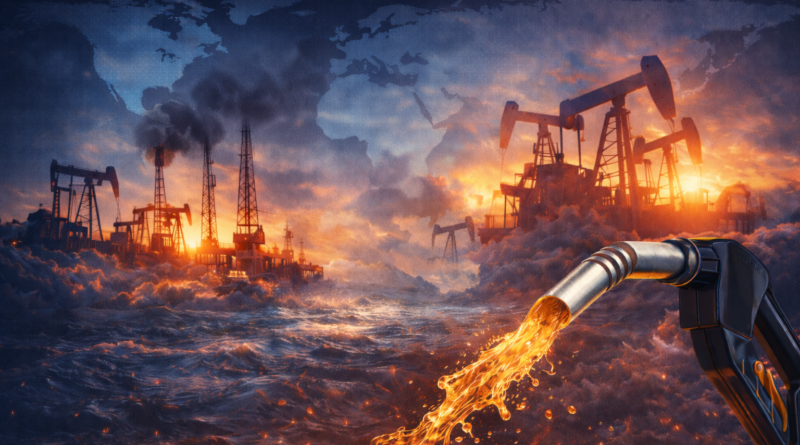
How International Conflicts Affect Fuel Prices and Daily Life
Fuel prices are influenced by many factors, but international conflicts play one of the biggest roles in causing sudden increases or long periods of high costs. When wars or military tensions affect major oil-producing or transit regions, global markets respond quickly. Conflicts involving Russia and Ukraine, instability in parts of the Middle East (including Israel, Gaza, Iran, Iraq, and Yemen), and unrest in oil-producing countries such as Libya and Nigeria have all contributed to supply risks in recent years.
Russia is one of the world’s largest energy exporters, producing around 10% of global oil supply, while the Middle East accounts for about 30% of worldwide oil production. When fighting, sanctions, or shipping disruptions affect these regions, even a loss or delay of 3–5% of global supply can cause prices to rise sharply. During major geopolitical crises, crude oil prices have increased by 20–40% within weeks.
These increases are then passed on to consumers. A 10% rise in crude oil prices typically leads to a 3–5% increase in fuel prices at petrol stations within several weeks. For households, this can mean spending £5–£20 more per month on fuel and transport. Higher fuel costs also affect food production and delivery, meaning supermarket prices can rise as transport and energy costs increase.
Understanding how global conflicts affect fuel prices helps explain why events in countries such as Ukraine, Israel, Iran, Iraq, Yemen, Libya, and Nigeria can directly influence the cost of driving, heating homes, and buying everyday goods. Because oil and gas are traded globally, political instability in one region can quickly translate into higher living costs elsewhere.
Key Countries and Their Role in Global Energy
| Country / Region | Role in Global Energy Market | Why Conflict Matters |
|---|---|---|
| Russia | ~10% of global oil production | Sanctions and war reduce exports and raise prices |
| Middle East (Iran, Iraq, Saudi Arabia region) | ~30% of global oil production | Conflicts risk supply cuts and shipping disruptions |
| Ukraine (transit routes) | Major gas transit corridor to Europe | Fighting affects gas flow and European prices |
| Libya | Major African oil exporter | Political instability reduces output |
| Nigeria | One of Africa’s largest oil producers | Unrest and pipeline attacks disrupt supply |
| Yemen (Red Sea route) | Controls access near key shipping lanes | Attacks on shipping increase transport and insurance costs |
The Global Nature of Oil and Gas
Oil and gas are traded on international markets. This means prices are determined by global supply and demand. Conditions in a single country do not set prices. Approximately 100 million barrels of oil are consumed worldwide daily. Even small changes in supply can have a large effect on prices. Because energy markets are highly interconnected, events in one region can quickly influence costs everywhere.
Major oil-producing regions include the Middle East (about 30% of global production), Russia (around 10%), the United States (roughly 20%), and parts of Africa, particularly Nigeria, Libya, and Angola. When conflict occurs in or near these areas, traders and governments become concerned about potential disruptions to production or transport. Even the risk of disruption can push prices higher, as buyers seek to secure supplies in advance and investors price in uncertainty.
When a large exporter reduces output due to war, sanctions, or political instability, global supply tightens. Struggles to ship fuel can also cause these issues. A reduction of just 1–2 million barrels per day (about 1–2% of global supply) can lead to price increases of 5–15% in a short period. When supply falls but demand remains stable, prices rise. This is especially true in transport, industry, and heating. Buyers compete for fewer available barrels, causing the increase.
This sensitivity explains why conflicts affecting key producers or transport routes often lead to rapid changes in fuel prices. This happens even when physical shortages have not yet occurred. Markets react not only to actual losses but also to expectations of future disruption. As a result, energy prices are highly responsive to geopolitical events.
| Region / Country Group | Share of Global Oil Production | Why It Matters for Prices |
|---|---|---|
| Middle East | ~30% | Conflicts here can affect a large part of world supply |
| United States | ~20% | Major producer that can influence global balance |
| Russia | ~10% | Sanctions or war reduce exports to world markets |
| Africa (Nigeria, Libya, Angola) | ~8–9% | Political instability can disrupt output |
| Rest of world | ~30% | Smaller producers with limited ability to offset shocks |
Figures are approximate and based on recent international energy estimates. Actual production and prices vary over time.
Transport Routes and Shipping Risks
International conflicts can also affect fuel prices by threatening key transport routes used to move oil and gas around the world. Energy is transported mainly by oil tankers and pipelines, and many of these routes pass through narrow sea lanes or politically sensitive regions. Around 60% of the world’s oil supply is transported by sea, making maritime routes especially critical to global energy markets.
Several key chokepoints play an outsized role in global fuel prices. These include the Strait of Hormuz, which handles about 20% of global oil shipments, the Bab el-Mandeb Strait near the Red Sea, the Suez Canal, and the Bosporus Strait. When conflict or military activity threatens these areas, ships may be delayed, rerouted, or temporarily prevented from passing through.
If tankers are forced to avoid dangerous waters, they often have to take much longer routes. For example, avoiding the Red Sea or Suez Canal can add 7 to 15 days to a journey between Asia and Europe. Longer journeys mean higher fuel consumption, increased crew costs, and reduced availability of ships, all of which push transport prices higher.
Insurance costs also rise sharply when waters are considered high-risk. During periods of conflict, war-risk insurance for tankers can increase by several hundred percent, adding thousands or even millions of dollars to the cost of a single voyage. These added costs are built into the final price of oil and gas and are eventually passed on to fuel suppliers and consumers.
Delays at ports and terminals can further tighten supply. When ships queue for unloading or face restrictions on where they can dock, deliveries become slower and less predictable. Even without a full blockade, uncertainty about shipping schedules can reduce the amount of fuel reaching markets on time, which increases price pressure.
In this way, international conflicts do not need to directly damage oil fields to affect fuel prices. Simply raising the risk and cost of transporting energy can reduce supply efficiency and increase costs across the entire system. Because modern fuel markets rely on fast and reliable shipping, any disruption to key routes can quickly translate into higher prices for petrol, diesel, and heating fuel.
Key Oil Shipping Routes and Their Importance
| Route / Chokepoint | Share of Global Oil Flow | Why Conflict Matters |
|---|---|---|
| Strait of Hormuz (Middle East) | ~20% | Blockages or attacks can disrupt a large part of world supply |
| Suez Canal / Red Sea | ~10–12% | Closures force ships to take longer routes around Africa |
| Bab el-Mandeb Strait | ~9% | Conflict increases risk and insurance costs |
| Bosporus Strait (Turkey) | ~3% | Restrictions affect exports from the Black Sea region |
| Panama Canal | Smaller share | Delays increase delivery time and transport costs |
Figures are approximate and based on international energy and shipping estimates. Actual flows vary over time.
Sanctions and Trade Restrictions
Governments often respond to international conflicts by placing sanctions on certain countries. These measures can limit a nation’s ability to export oil and gas. They can restrict access to international banking systems. Additionally, they can block the use of shipping and insurance services needed for trade. When sanctions target major energy producers, the effects are felt across global markets.
For example, countries such as Russia and Iran account for a significant share of global oil and gas exports. When sanctions reduce their ability to sell energy freely, global supply can tighten. A reduction of just 1–3 million barrels per day from sanctioned exporters can raise international oil prices by 5–15%, depending on demand conditions and available spare capacity from other producers.
Other oil-producing countries may try to increase output to compensate, but this often takes time. New production requires drilling, investment, and technical adjustments, meaning supply cannot always rise quickly enough to offset losses. As a result, markets experience periods where demand remains stable but available supply is lower, pushing prices upward.
Sanctions also make energy trade more complex and expensive. Buyers must search for alternative suppliers, sometimes paying higher prices or accepting longer delivery times. Sellers may need to reroute shipments through third countries or use less efficient transport routes, increasing fuel and shipping costs. Financial restrictions can slow transactions and raise borrowing costs for energy companies, further increasing expenses.
These added costs and uncertainties are reflected in fuel prices. When traders expect long-term restrictions to remain in place, prices can stay elevated for months or even years. In this way, sanctions do not only affect the targeted country; they reshape global energy flows and contribute to higher petrol, diesel, and heating costs for consumers worldwide.
Market Psychology, Daily Impact, and Long-Term
Fuel prices are shaped not only by physical supply and demand but also by expectations about future events. When international conflicts begin or intensify, traders often fear shortages even if oil and gas production has not yet changed. This fear can push prices higher because markets react not only to confirmed disruption but also to perceived risk.
For example, conflicts involving Russia and Ukraine, tensions in the Middle East (Israel, Gaza, Iran, Iraq, and Yemen), and instability in Libya and Nigeria have all raised concerns about supply and transport safety. According to the U.S. Energy Information Administration (EIA), global crude oil consumption was about 101 million barrels per day (b/d) in 2023, and disruptions affecting even a few million barrels per day can significantly tighten available supply. During major geopolitical crises in the past decade, crude oil prices have jumped by 20–40% over a few weeks as markets priced in increased risk.
Investors often respond by buying oil futures contracts as a hedge against uncertainty. When demand for futures rises, this pushes benchmark prices such as Brent crude or West Texas Intermediate (WTI) higher. As of early 2024, Brent crude has regularly traded above $80–90 per barrel, compared with long-term averages near $60–70 in more stable periods. This behaviour means fuel prices can rise before any real supply loss occurs, demonstrating that energy markets respond not only to events themselves but also to how risky those events appear.
When fuel prices increase, the effects are felt across the global economy. Transport becomes more expensive for individuals and businesses. Shipping companies, public transport operators, and airlines across major economies such as the United States, Germany, Japan, and the United Kingdom face higher operating costs. For example, fuel can account for 20% or more of total operating costs in some airlines, and a sustained rise in jet fuel prices often leads to higher airfares. Similarly, freight and logistics firms may raise delivery charges to cover higher diesel expenses.
Food prices are also affected because modern agriculture and global supply chains rely heavily on petroleum-based products. The Food and Agriculture Organization (FAO) estimates that fuel and fertiliser costs together can make up 30–40% of total agricultural costs in many countries. When fuel prices rise, farmers face higher expenses for tractors, irrigation, fertilisers, and transport, which in turn contribute to increased food prices at supermarkets and markets worldwide.
Households may also experience higher heating and electricity bills as energy providers adjust tariffs in response to international energy market shifts. In 2023, households in many European countries saw annual energy bill increases of 15–25% due in part to elevated fossil fuel costs, according to regional energy regulators.
Governments sometimes intervene to reduce the impact of rising fuel prices. Measures can include temporary fuel tax reductions, subsidies for energy providers, or direct financial support for vulnerable households. For instance, some EU countries introduced reduced VAT rates on petrol and diesel in 2022–2023, while the United States released more than 180 million barrels from the Strategic Petroleum Reserve to help moderate price spikes. While these actions can provide short-term relief, they do not always resolve longer-term supply problems caused by extended conflicts or trade restrictions.
Repeated global disruptions have encouraged many countries to rethink their energy strategies. Heavy dependence on a small number of suppliers increases vulnerability during crises. As a result, there is growing investment in renewable energy, domestic production, and long-term supply agreements with more stable partners. In 2023, global renewable energy capacity grew by more than 10%, reaching record installations in wind, solar, and hydropower. Countries such as Germany and Japan have significantly expanded renewable projects, while the United States has increased domestic oil and gas output to reduce reliance on volatile imports. These efforts aim to reduce exposure to conflict-driven price shocks in the future.
However, this transition takes time. Global fuel markets remain highly sensitive to political developments because modern economies depend on reliable and predictable energy supplies. Any event that threatens stability in major producing or transport regions continues to introduce risk, and risk increases costs. This is why conflicts in countries such as Ukraine, Israel, Iran, Libya, and Nigeria can still have a direct impact on fuel prices, heating costs, and everyday living expenses in countries thousands of kilometres away.
Global Energy and Price Impact
| Indicator | Global Figure | Why It Matters |
|---|---|---|
| Global oil consumption | ~101 million barrels per day | Even small supply losses can move prices sharply |
| Middle East share of oil production | ~30% | Conflicts here affect a large part of world supply |
| Russia’s share of oil production | ~10% | Sanctions and war reduce exports |
| Oil shipped by sea | ~60% of global supply | Shipping risks raise transport and insurance costs |
| Price rise during major crises | +20–40% in weeks | Markets react quickly to geopolitical risk |
| Strategic reserves released (US, 2022–23) | ~180 million barrels | Used to stabilise prices temporarily |
Figures are approximate and based on international energy agency and market data. Actual production and prices vary over time.
Average Petrol Prices by Country (Approximate)
| Country | Average Price (USD per litre) | Main Reason for Level |
|---|---|---|
| United Kingdom | 1.90 | High fuel taxes and import dependence |
| Germany | 2.05 | High taxes and environmental levies |
| France | 1.95 | Taxes and transport costs |
| Italy | 2.00 | High taxation and import reliance |
| Spain | 1.75 | Lower taxes than northern Europe |
| United States | 1.15 | Large domestic production, lower taxes |
| Japan | 1.40 | Import dependence and shipping costs |
| Turkey | 1.70 | Currency weakness and import costs |
| India | 1.30 | Taxes and controlled pricing system |
| Saudi Arabia | 0.60 | Major producer with subsidised fuel |
Prices are approximate averages and vary by region and over time. Figures are for comparison purposes only.