
Winter Olympics Day Nine: Team GB Shine as Curling Takes Centre Stage After Historic Gold Medal Haul
Team GB returned to the ice on day nine of the Winter Olympics with confidence surging after a landmark day that saw British athletes deliver an unprecedented medal return, including two golds within hours and a third earlier in the Games. As curling action unfolded against Switzerland, Britain’s remarkable progress across multiple disciplines underscored what is rapidly becoming the nation’s most successful Winter Olympics campaign on record.
With competition spread across curling, skeleton, snowboard cross, ski jumping, freestyle skiing, figure skating and ice hockey, day nine offered a compelling snapshot of a Games gathering momentum — and of a British team pushing new boundaries in winter sport.
A Day That Redefined Team GB’s Winter Olympic Legacy
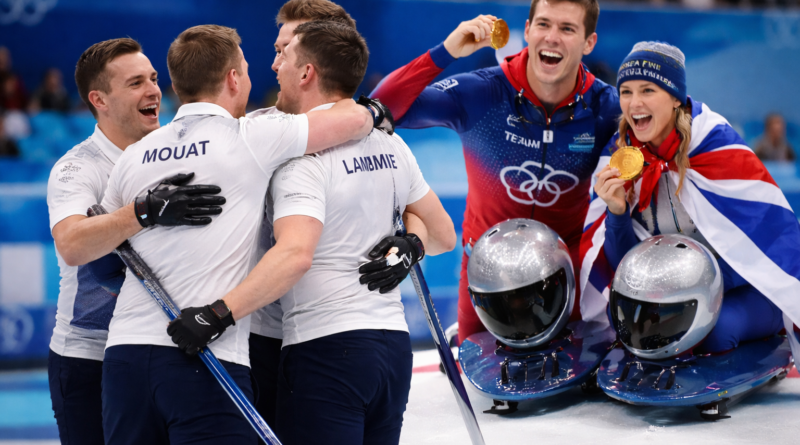
The headlines were already written before the curling stones slid onto the ice. Earlier in the day, Tabby Stoecker and Matt Weston claimed gold in the mixed team skeleton, delivering Team GB’s second gold medal of the day and continuing a dominant showing in a sport where Britain has long punched above its weight.
That triumph followed the historic gold secured by Charlotte Bankes and Huw Nightingale in the snowboard cross mixed team, a moment that marked Britain’s first-ever Olympic gold medal on snow. Combined with earlier success at these Games, Team GB now boasts three gold medals, eclipsing the nation’s previous Winter Olympic best of one.
For a team often defined by near-misses and isolated podium moments, the scale of achievement represents a turning point , one that athletes, coaches and officials believe could transform British winter sport for years to come.
Curling: GB Men Locked in Tactical Battle with Switzerland
As celebrations from earlier victories settled, attention turned to curling, where Britain’s men faced a demanding test against Switzerland. After beating Germany earlier in the day, the British quartet entered the match knowing that consistency and precision would be essential against one of the tournament’s strongest sides.
At the break, the match stood finely poised at 3–2 in Britain’s favour, reflecting a contest defined by tactical nuance rather than explosive scoring. A hog-line violation by Switzerland in the sixth end — an unambiguous error confirmed by the red light — briefly handed Team GB an opening, though the Swiss responded with resilience.
British skip Bruce Mouat produced one of the shots of the match with an audacious penultimate throw that sent stones skidding across the ice. Switzerland, however, matched the quality, limiting Britain’s advantage and ensuring the contest remained delicately balanced.
Observers described the match as “high-grade curling”, with both sides executing under pressure and margins measured in millimetres rather than metres.
The Human Side of High Performance
Away from the cameras, small details offered insight into the demands of elite competition. British sweepers Hammy McMillan, Bobby Lammie and Grant Hardie were seen refuelling with cereal bars between ends — part of a carefully planned nutrition strategy honed over years of international competition.
Hardie revealed the team had recently swapped dried mango for quicker carbohydrate options after a toothache scare during a North American event. Mouat, whose role as skip requires intense concentration rather than continuous physical exertion, opted for a lighter boost, a tangerine, underscoring the different physical demands within the team.
These moments, though minor, highlight the meticulous preparation underpinning Britain’s curling success.
Skeleton: Pride Despite Narrow Miss for Tarbit and Wyatt
Not every British athlete left day nine with hardware, but performances in skeleton continued to reflect the depth of the programme. Freya Tarbit and Marcus Wyatt finished fourth in the mixed team event, missing out on a medal by just 0.01 seconds, one of the narrowest margins of the Games so far.
Despite the disappointment, both athletes spoke with pride about their achievements. Tarbit, competing in her first Olympics, said she could “hold her head high” after delivering under pressure and enjoying the experience rather than being overwhelmed by it.
Wyatt, reflecting on previous Olympic disappointment in Beijing, described the performance as proof that earlier struggles were an anomaly rather than a trend. He also pointed to the long-term impact of Britain’s skeleton success, predicting that the latest golds would raise expectations and standards for the next generation.
Ski Jumping: Historic Gold in Women’s Large Hill
Elsewhere, history was made in women’s ski jumping, with the Olympic debut of the large hill individual event. Norway’s Anna Odine Strøm claimed gold after producing the best jump of the final, finishing ahead of compatriot Eirin Maria Kvandal.
Strøm’s combined score of 284.8 proved decisive, rewarding a performance that balanced distance, technique and control under immense pressure. The event itself marked a milestone for women’s ski jumping, reflecting the sport’s growing prominence and long-awaited Olympic recognition at the highest level.
Freestyle Skiing: Qualification Drama in Men’s Big Air
In Livigno, the men’s big air qualification unfolded with trademark flair. France’s Matias Roche topped the leaderboard after the first run with a score of 95.25, narrowly ahead of American duo Mac Forehand and Timothe Podmilsak.
The format — three jumps with the best two counting, one from each direction, left room for dramatic shifts in standings. Britain’s Chris McCormick, however, struggled in the opening run, placing well outside contention and facing an uphill battle to reach the final.
Judges assessed each jump on difficulty, execution, amplitude and landing control, with even minor errors carrying significant penalties.
Figure Skating: A Remarkable Olympic Debut at 42
One of the most compelling stories of the Games emerged not from medal contention but from perseverance. Canada’s Deanna Stellato-Dudek prepared to make her Olympic debut at the age of 42, following a 15-year hiatus from competitive skating.
After returning to the sport, Stellato-Dudek captured a world title in 2024 alongside Maxime Deschamps, defying expectations and rewriting assumptions about longevity in elite sport. Fitness concerns had briefly cast doubt over her Olympic participation, but medical clearance paved the way for a moment many thought would never come.
Her story resonated across the ice rink, offering a powerful counterpoint to the Games’ focus on youth and early peak performance.
Britain’s Pair Skaters Eye Qualification
For Team GB, attention turned to the pairs short program, where Anastasia Vaipan-Law and Luke Digby aimed to secure a place in the free skate. With previous finishes of fifth at the European Championships and 12th at the World Championships, expectations were realistic rather than inflated.
Both skaters stressed that progression, not podium positions, remained the priority. Qualification for the free skate, requiring a top-16 finish, represented a tangible and achievable goal, particularly in a discipline known for unpredictability.
Ice Hockey: Canada Dominate Group A
In men’s ice hockey, Canada delivered a statement performance, dismantling France 10–2 in their final Group A match. Ten different players found the net, including captain Sidney Crosby, as Canada scored at least three goals in every period.
The result secured top spot in the group with a perfect record. Elsewhere, Switzerland edged the Czech Republic 4–3 in overtime, while Denmark led Latvia midway through their Group C clash. The USA and Germany were set to meet later in the evening, a fixture expected to carry significant implications for knockout qualification.
Britain’s Best Winter Games?
With three gold medals already secured, two on day nine alone, Team GB is enjoying its most successful Winter Olympics by a considerable margin. Historically, Britain has struggled to convert competitive performances into podium finishes on snow and ice, making the current medal haul all the more remarkable.
Officials and athletes alike caution against complacency, but optimism is unmistakable. From skeleton dominance to curling consistency and breakthrough success in snowboard cross, Britain’s investment in winter sport appears to be paying dividends.
As Milan-Cortina continues to unfold, day nine may come to be remembered not just for medals won, but for the sense that British winter sport has entered a new era, one defined by confidence, depth and genuine contention across multiple disciplines.