
AI Assistants AreReplacing Entry-Level Jobs
What It Means for Workers in 2026
The rise of artificial intelligence is not a distant future scenario; it is a present-day reality reshaping the global workforce. As 2026 unfolds, the most significant impact is being felt not at the top of the corporate ladder, but at its very first rung. Entry-level positions, long the gateway to a professional career for millions, are disappearing at an accelerated rate, automated by increasingly sophisticated AI assistants. This transformation carries profound implications for young workers, corporate structures, and the very fabric of our economies, forcing a global conversation about the future of work itself.
From customer service chatbots handling complex queries to AI tools that can write code and analyze data, the capabilities of automated systems have grown exponentially. For businesses, the allure is undeniable: the promise of increased efficiency, reduced costs, and 24/7 productivity. However, this rapid adoption is creating a bottleneck at the entry point to the job market, leaving a generation of new talent struggling to find a foothold and raising urgent questions about long-term career progression and societal equity.
The Shrinking Entry Point
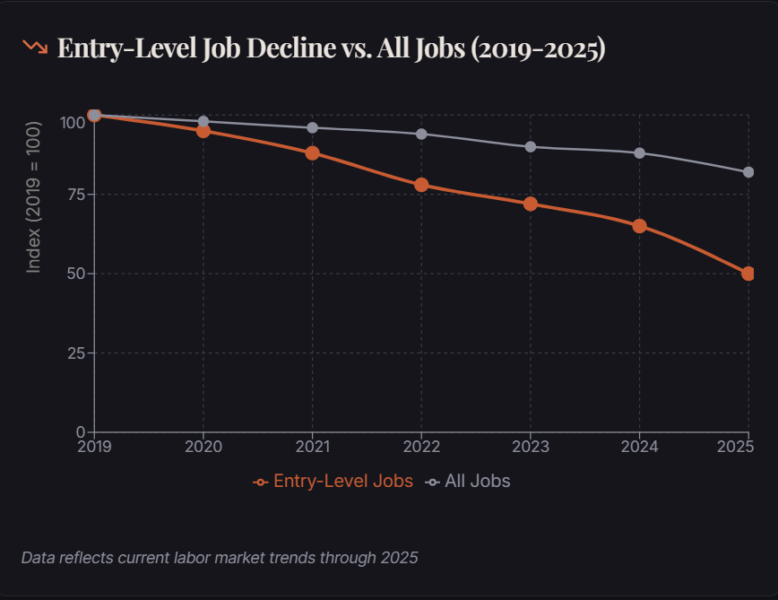
The data paints a stark picture of a contracting landscape for junior roles. Since January 2023, job postings for entry-level positions in the United States have plummeted by approximately 35%, according to labor market analysis. This trend is not an isolated anomaly. Data from professional networks shows that entry-level hiring rates have fallen 23% compared to pre-pandemic levels, a significantly steeper drop than the 18% decline observed across all other job tiers.
Entry-Level Job Market Trends (2019-2025)
| Period | Entry-Level Jobs Index | All Jobs Index | Differential Decline |
|---|---|---|---|
| 2019 | 100 | 100 | — |
| 2020 | 95 | 98 | -3% |
| 2021 | 88 | 96 | -8% |
| 2022 | 78 | 94 | -16% |
| 2023 | 72 | 90 | -18% |
| 2024 | 65 | 88 | -23% |
| 2025 | 50 | 82 | -32% |
Source: Labour market trend analysis
The divergence between entry-level and overall job market performance has accelerated significantly since 2023, indicating that AI adoption is disproportionately affecting junior positions relative to the broader employment landscape.
The technology sector, a harbinger of broader economic shifts, offers an even more dramatic view. Analysis of hiring at major tech companies and mature startups reveals a staggering 50% decline in the number of new roles filled by graduates with less than a year of experience since 2019. This contraction is consistent across all business functions, from engineering and marketing to finance and human resources.
Corporate decision-making reflects this new reality. Recent surveys reveal that two-thirds of enterprises are actively reducing their entry-level hiring specifically because of AI integration, with an overwhelming 91% reporting that automation has already changed or entirely eliminated certain jobs within their organizations. This sentiment is echoed globally, with employers across continents anticipating workforce reductions in areas where tasks can be automated. The cumulative effect is the erosion of the traditional career launchpad, leaving a void where the first professional experiences were once forged.
“The ladder isn’t broken—it’s just being replaced with something that looks a lot flatter.”— Industry analyst
Corporate Adoption: A Tale of Ambition and Ambivalence
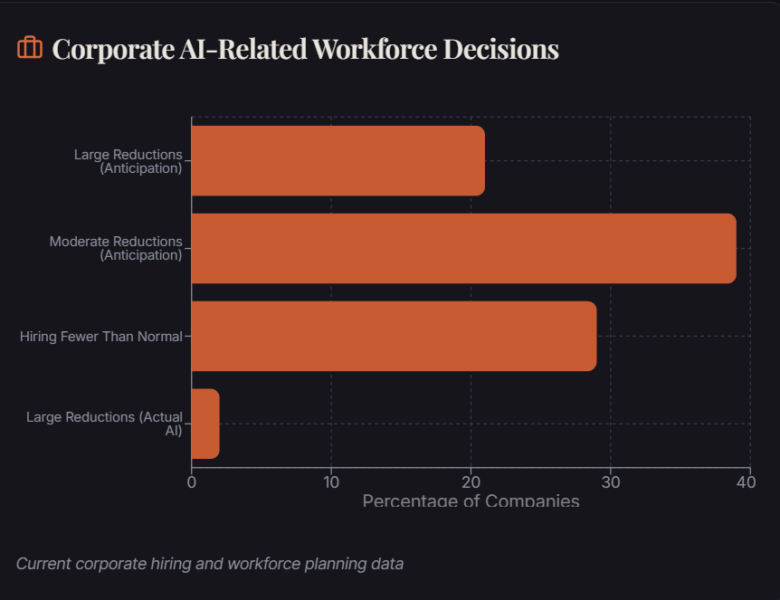
For corporations, the move to integrate AI is driven by a compelling logic of efficiency and competitive advantage. Yet the transition is proving to be more complex than a simple switch. Many companies are making significant workforce decisions based on the anticipated potential of AI, rather than its proven, current performance. A revealing trend highlights this dynamic: while only 2% of organizations have made large headcount reductions directly attributable to the results of AI implementation, a combined 60% have already cut jobs or slowed hiring in anticipation of future AI capabilities.
Tasks Increasingly Automated by AI vs. Skills Requiring Human Expertise
| Highly Automatable Tasks | Estimated Automation Rate | Human-Led Skills in Demand |
|---|---|---|
| Data entry and processing | High | Strategic data analysis |
| Customer service inquiries | High | Complex problem-solving |
| Basic coding tasks | Moderate-High | System architecture design |
| Report writing (routine) | Moderate-High | Creative and strategic writing |
| Email and scheduling | Moderate | Stakeholder management |
| Financial analysis (standard) | Moderate | Risk assessment and judgment |
| Content moderation | Moderate | Ethical decision-making |
Source: Workplace automation trend analysis
While AI excels at routine, repetitive, and well-defined tasks, positions requiring judgment, creativity, complex problem-solving, and interpersonal skills remain predominantly human-led, though AI increasingly serves as a supporting tool.
This pre-emptive rightsizing suggests that for some leaders, AI has become a convenient justification for broader cost-cutting measures. Such approaches can foster a climate of cynicism and fear among the remaining workforce, potentially hindering the very innovation the technology is meant to inspire.
Case studies from the front lines of adoption reveal a mixed and often cautionary tale. The Swedish fintech company Klarna reduced its human workforce by 40% between late 2022 and 2024 through a combination of a hiring freeze and natural attrition as it invested heavily in AI-driven customer service. However, the company later conceded that the aggressive cost-cutting had led to a decline in service quality, necessitating the rehiring of human agents to handle complex cases the AI could not manage. In contrast, technology giant IBM is actively bucking the trend, announcing it would triple its entry-level hires for 2026. The company’s leadership stated that while AI can handle most entry-level tasks, the work still requires a distinctly human touch.

A New Imperative: Reskilling and Policy Responses
As the ground shifts beneath the labor market, a consensus is emerging that a massive, coordinated effort in reskilling and upskilling is essential. The challenge is not merely to train workers for new jobs, but to foster a culture of lifelong learning and adaptability. However, investment in this critical area lags significantly behind spending on the technology itself. Current analysis shows that while companies spend an average of $9,100 per employee on software annually, they invest only $1,200 in training and development.
Country Readiness for AI Workforce Transition
| Country/Region | Tertiary Education Investment | Lifelong Learning Access | Policy Response Status |
|---|---|---|---|
| Finland | High | Comprehensive | Advanced |
| Ireland | High | Comprehensive | Advanced |
| Denmark | High | Comprehensive | Advanced |
| Canada | Moderate-High | Developing | Active |
| United States | Moderate-High | Developing | Active |
| United Kingdom | Moderate | Moderate | Emerging |
| Germany | Moderate-High | Moderate | Active |
| Australia | Moderate | Moderate | Emerging |
Source: Education and labour policy assessment
Nations with robust tertiary education systems and accessible lifelong learning infrastructure are better positioned to manage workforce transitions, while countries with developing training ecosystems face greater challenges in reskilling displaced workers.
Governments and institutions are beginning to respond. International organizations have called for a comprehensive redesign of education systems to focus on cognitive, creative, and technical skills that complement AI rather than compete with it. Several countries are leading the way. Finland, Ireland, and Denmark have been identified as the best-positioned nations due to their robust investments in tertiary education and accessible lifelong learning programs. In North America, both the US and Canadian governments have announced initiatives aimed at funding rapid retraining for workers displaced by AI and supporting programs that teach skills for emerging AI-related jobs.
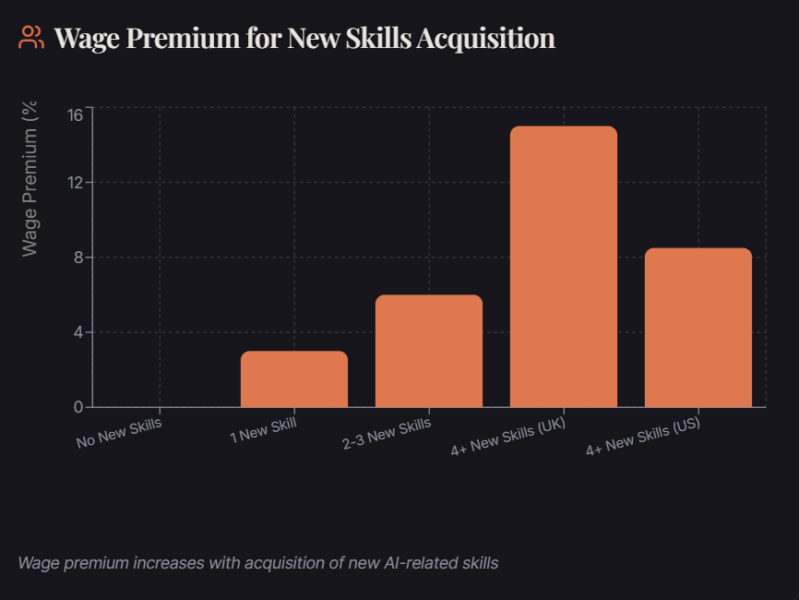
Corporations are also experimenting with new training models. The most effective approaches treat reskilling not as a standalone program, but as a continuous on-the-job journey. This involves creating initiatives where building employee capabilities precedes the wide-scale deployment of new AI tools. At the same time, universities are forging partnerships with leading AI firms to transform their campuses into what are effectively AI training grounds, aiming to equip the next generation with the fluency needed to thrive in an automated world.
The Future for Workers and Employers
The road ahead in 2026 and beyond is one of profound adjustment for both employees and employers. For workers, particularly those at the start of their careers, the message is clear: continuous learning is no longer optional. The ability to work alongside AI, to leverage it as a tool for productivity, and to specialize in tasks that require uniquely human skills, such as critical thinking, emotional intelligence, and complex strategic planning, will be paramount for career survival and success.
For employers, the focus must shift from a short-sighted strategy of cost-cutting through automation to a more sustainable vision of value creation. This involves a dual investment: in the right technologies and, just as critically, in the human talent needed to operate them effectively. Companies that succeed will be those that redesign workflows, upskill their workforce, and cultivate an environment where human and artificial intelligence collaborate to achieve more than either could alone. The risk of failing to do so is not just a loss of productivity, but the creation of a hollowed-out corporate structure, devoid of the institutional knowledge and experienced leadership that is cultivated from the ground up.
The disappearance of entry-level jobs is not merely a labor market statistic; it is a societal challenge that strikes at the heart of economic opportunity and social mobility. Navigating this transition successfully will require a concerted effort from policymakers, educators, and business leaders to build a future where technology serves to augment human potential, not simply replace it. The choices made today will determine whether the AI revolution leads to broadly shared prosperity or a future of deepening inequality.