Russia and Ukraine Hit Essential Energy Targets Despite Truce Talks
Drones were still falling on Kyiv. Missiles were still striking Russian refineries on Tuesday, September 15. Meanwhile, diplomats in Washington, Moscow and Kyiv talked about switching off the energy war, as Russia Ukraine energy strikes continued. Leaders’ public statements and their militaries’ overnight actions have diverged. That divergence is now a defining pattern of this phase. This week followed the same trend.
Another Night of Strikes
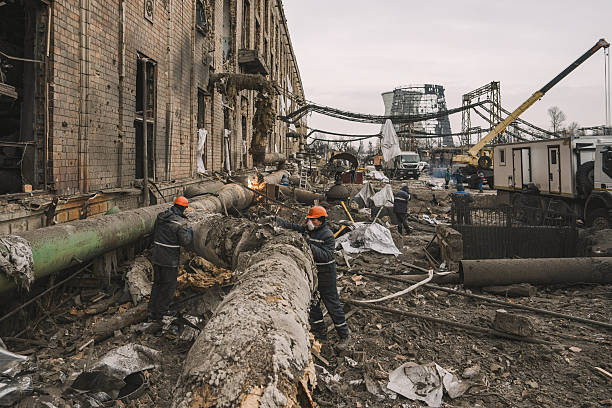
Ukrainian officials said Russia launched roughly 200 drones at targets across the country overnight into Tuesday. Kyiv was hit hard, with petrol stations damaged in the capital alongside energy and port facilities elsewhere in Ukraine. Two people were reported killed.
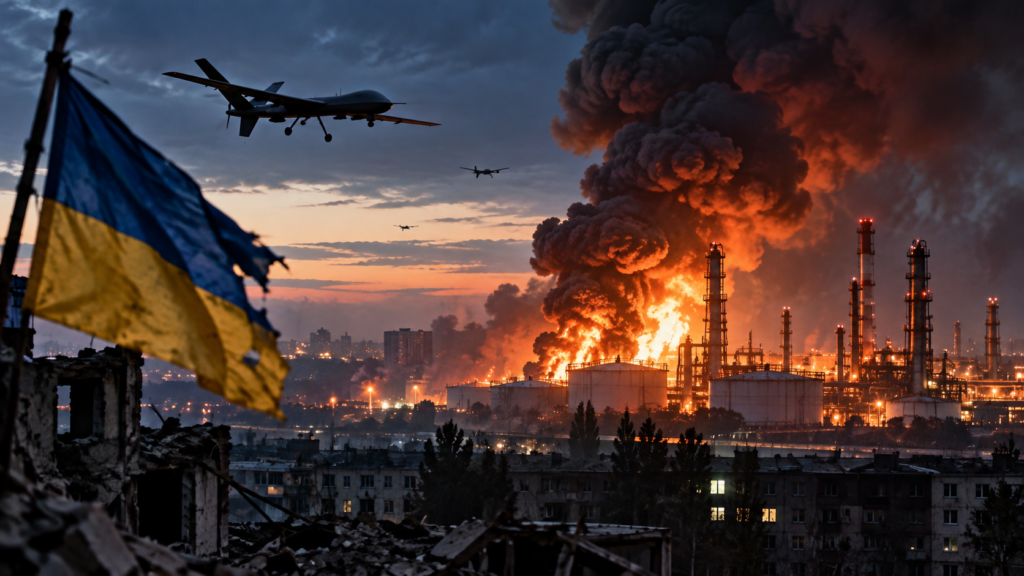
Ukraine did not sit still either. President Volodymyr Zelenskiy said his forces struck an oil refinery in Syzran, deep inside Russia’s Samara region, along with sites tied to drone manufacturing in Taganrog and the Oryol region. It was the latest entry in a long-running exchange: Russia grinding at Ukraine’s power grid, Ukraine grinding at Russia’s refineries, both sides betting that breaking the other’s energy system will eventually break its will to keep fighting.
That this happened on the same day diplomats were discussing a possible pause on exactly this kind of strike says a lot about how fragile any arrangement is likely to be.
Trump’s Push — and a Familiar Pattern of Confusion
U.S. President Donald Trump has spent recent days pressing both sides to stop hitting each other’s energy infrastructure, and he said publicly that Moscow and Kyiv had already agreed to do so. Ukrainian officials pushed back almost immediately, saying no such deal had actually been finalized. According to reporting from the Kyiv Independent, a senior Ukrainian energy official said they were not even aware such a ceasefire existed when Trump made the announcement.
Zelenskiy’s own position, laid out on social media and echoed by his officials, is that Kyiv would suspend its strikes only if it gets real assurance that Russia will genuinely stop targeting Ukraine’s electricity grid, other energy sites, wider infrastructure and food-supply routes — not just a verbal promise. Ukraine’s Foreign Minister Andrii Sybiha reinforced that position on Tuesday, saying Kyiv backs the broader U.S. effort to build an agreement covering energy infrastructure and noting that international partners have floated additional ideas for how such a deal might actually be enforced.
Trump, for his part, has also linked the push for a truce to the price of diesel, telling reporters days earlier that Ukraine needed to stop hitting Russian fuel facilities because it was contributing to a diesel shortage — a claim covered in detail by the Jefferson City News-Tribune and by Bloomberg’s wire coverage.
Moscow’s Conditions
The Kremlin has also said, in principle, that it likes the idea of an energy truce. Spokesperson Dmitry Peskov described Moscow’s reaction as positive. Russia Ukraine energy strikes have shaped the debate on broader terms. He tied broader terms to separate issues, chiefly the safety of Russian shipping. The sanctions have been squeezing Russian energy exports.
That linkage is important, because it turns what sounds like a narrow, achievable step — “stop hitting power plants and refineries” — into something entangled with the much harder questions of sanctions relief and maritime security in the Black Sea. Russia has used this kind of linkage before. This is not the first time Washington has floated an energy-specific ceasefire between the two countries; a similar arrangement was announced after a Trump-Putin call back in March 2025, brokered on very similar terms, only for both sides to accuse each other of violating it almost immediately, according to a BOE Report analysis. That earlier truce never really took hold, and the current round of diplomacy is unfolding under the shadow of that failure.
Why Russia’s Refineries Are Under So Much Pressure
Ukraine’s long-range drone campaign against Russian refining capacity has been unusually effective this year. Reuters reported that six of Russia’s largest diesel-producing refineries have either cut output sharply or stopped operating altogether after repeated drone strikes — plants that together account for roughly half of the diesel capacity among Russia’s leading refineries.
The scale of the campaign is striking. According to the International Energy Agency, cited in the BOE Report piece linked above, a Russian refinery was successfully hit on average every three days during the first eight months of 2026. That is a sustained, high-tempo campaign, not a handful of isolated strikes, and it has visibly dented Russia’s ability to process its own crude oil into usable fuel.
Faced with domestic shortages, Russia has restricted exports of petrol, diesel and jet fuel to protect supplies at home. Before those restrictions, Russian diesel and gasoil exports were running at roughly 3.3 to 3.4 million tonnes a month, with Turkey and Brazil among the largest buyers. Cutting that flow doesn’t just affect Russia — it removes barrels from a global diesel market that was already tight.
A Global Diesel Squeeze
The knock-on effects are showing up well beyond the front lines. Diesel prices in the United States reportedly hit a record $6.23 per gallon (about $1.65 per liter) over the weekend, a spike that Trump has pinned largely on Ukrainian strikes against Russian fuel facilities rather than on other pressures in global energy markets, such as the ongoing disruption tied to the conflict in Iran.
Brent crude, meanwhile, pushed above $108 a barrel on Tuesday, with markets reacting to disruptions hitting Saudi Arabian exports as well as continuing instability across the Middle East. The Russia-Ukraine energy fight is layering additional uncertainty on top of an oil market that already has plenty to worry about.
Diesel matters more than most refined products because so much of the physical economy runs on it: trucking, farming, shipping, construction and heavy industry all depend on a steady diesel supply. When refinery output drops — whether because of drone strikes in Russia or restricted exports in response to them — the cost of moving goods and running machinery rises well outside the countries actually at war.
Even a genuine, lasting energy truce wouldn’t fully solve that problem on its own. Analysts quoted in the BOE Report piece note that the broader refining crunch, especially around diesel, is shaped by more than just this one conflict, and that fixing the immediate threat from strikes doesn’t repair capacity that has already been knocked offline or reroute supply chains that have already adjusted.
Déjà Vu: This Isn’t the First “Energy Ceasefire”
However, it’s worth stepping back to note how familiar this moment feels. In March 2025, Trump and Putin held a lengthy call. They announced what the White House called an ‘energy and infrastructure ceasefire’. Russia agreed, according to the Kremlin, to pause strikes on Ukrainian energy infrastructure. Ukraine would reciprocate. This context relates to Russia Ukraine energy strikes.
That arrangement also fell apart quickly. Zelenskiy said at the time that Russia wasn’t genuinely ready to end the war, and within hours of the announcement, air-raid sirens were sounding in Kyiv again. A year and a half later, the two sides are essentially back at the same negotiating table, discussing a very similar concept, with the same core disagreement at its heart: neither side trusts the other to actually stop, and neither wants to be the one that stands down first without a guarantee.
Ukraine has, at various points, tried to break that stalemate by proposing narrower deals — for instance, a Ukrainian offer last month to halt strikes on ships carrying agricultural cargo through the Black Sea. Russia rejected that proposal because it wanted its own guarantees on energy infrastructure attached to the deal, illustrating just how tangled these individual “limited” ceasefire ideas tend to become in practice.
What a Real Energy Truce Would Actually Require
On paper, an energy-only ceasefire is one of the more modest forms of de-escalation available to Moscow and Kyiv. Unlike a full ceasefire, it wouldn’t require either side to stop fighting on the front lines — it would simply take power plants, refineries, fuel depots and similar facilities off the target list while the broader war continues elsewhere.
In practice, making that work is much harder than it sounds. Both governments would need to agree on a precise, mutually accepted list of which facilities count as protected. They would need some mechanism for verifying whether an attack occurred and whether it violated the agreement — something that is inherently difficult in an active war zone with limited independent access. And they would need a plan for what happens the moment one side accuses the other of cheating, which, given the history here, seems less like an edge case and more like an inevitability.
Underlying all of that is a basic trust problem that more than four years of full-scale war have only deepened. Ukraine has made clear it isn’t willing to unilaterally stop hitting Russian energy targets without solid guarantees that Russia will do the same — it doesn’t want a situation where its own facilities keep getting hit while its own strikes stay paused. Russia, for its part, keeps trying to fold the energy question into a bigger negotiation involving sanctions relief and protections for its commercial shipping, which gives Moscow leverage but also makes a narrow, quickly implementable deal much harder to reach.
A Weapon Both Sides Have Used for Years
None of this is new, even if the intensity keeps rising. Russia has been targeting Ukraine’s electricity and energy systems since the earliest stages of its full-scale invasion in February 2022, and the tactic has become a near-annual feature of the war: as temperatures drop each autumn, Russian strikes on the grid tend to pick up, aimed at making winters as difficult as possible for Ukrainian civilians and, by extension, wearing down public support for continuing the fight.
Ukraine’s answer has evolved over time too. Rather than trying to match Russia’s missile arsenal, Kyiv has built out a long-range drone program specifically to reach deep into Russian territory and hit the refineries, storage depots and processing plants that keep Russia’s war economy funded. Ukrainian officials have been explicit about the logic: oil and gas exports are one of the Kremlin’s largest sources of revenue, and every barrel of diesel that can’t be refined or shipped is, in their framing, a barrel that can’t help pay for the war.
That strategy has clearly had an effect — the scale of refinery damage documented this year, with roughly half of Russia’s leading diesel capacity offline or reduced, is hard evidence of that. But it has also created the exact dynamic now complicating truce talks: Ukraine’s strikes have become one of its most effective levers against Russia, which makes Kyiv reluctant to give them up cheaply, even as the resulting fuel shortages ripple out into global markets and become a political liability for Western leaders trying to manage energy prices at home.
What to Watch Next
For now, words and drone footage are telling two different stories. Officials on both sides continue to say they support the idea of an energy truce, or at least a version of one, while both militaries have kept striking energy-related targets through this same stretch of days. Whether the current diplomatic push — driven partly by U.S. concern over diesel prices as much as by humanitarian considerations — produces anything more durable than the failed March 2025 arrangement is still an open question.
The clearest signal to watch for isn’t another statement from Washington, Moscow or Kyiv. It’s whether the pace of strikes on refineries, power stations and fuel depots on both sides actually starts to fall in the coming days. Until that happens, an “energy ceasefire” remains, as it has been for much of this war, more of a talking point in diplomatic calls than a fact on the ground.